
DigitalOcean’s Bet on Simplicity and AI: Can a Focused Cloud Platform Outmaneuver Hyperscale Rivals?
DigitalOcean is targeting the explosive growth in AI-native and digital-native businesses with a streamlined, agentic cloud platform and predictable pricing. As it expands its infrastructure, product portfolio, and developer ecosystem, the company faces a profitability squeeze and intensifying competition from hyperscale cloud providers. The next phase will test whether its simplicity-first approach and customer focus can drive durable growth—or whether scale and capital intensity will hamper its ambitions.
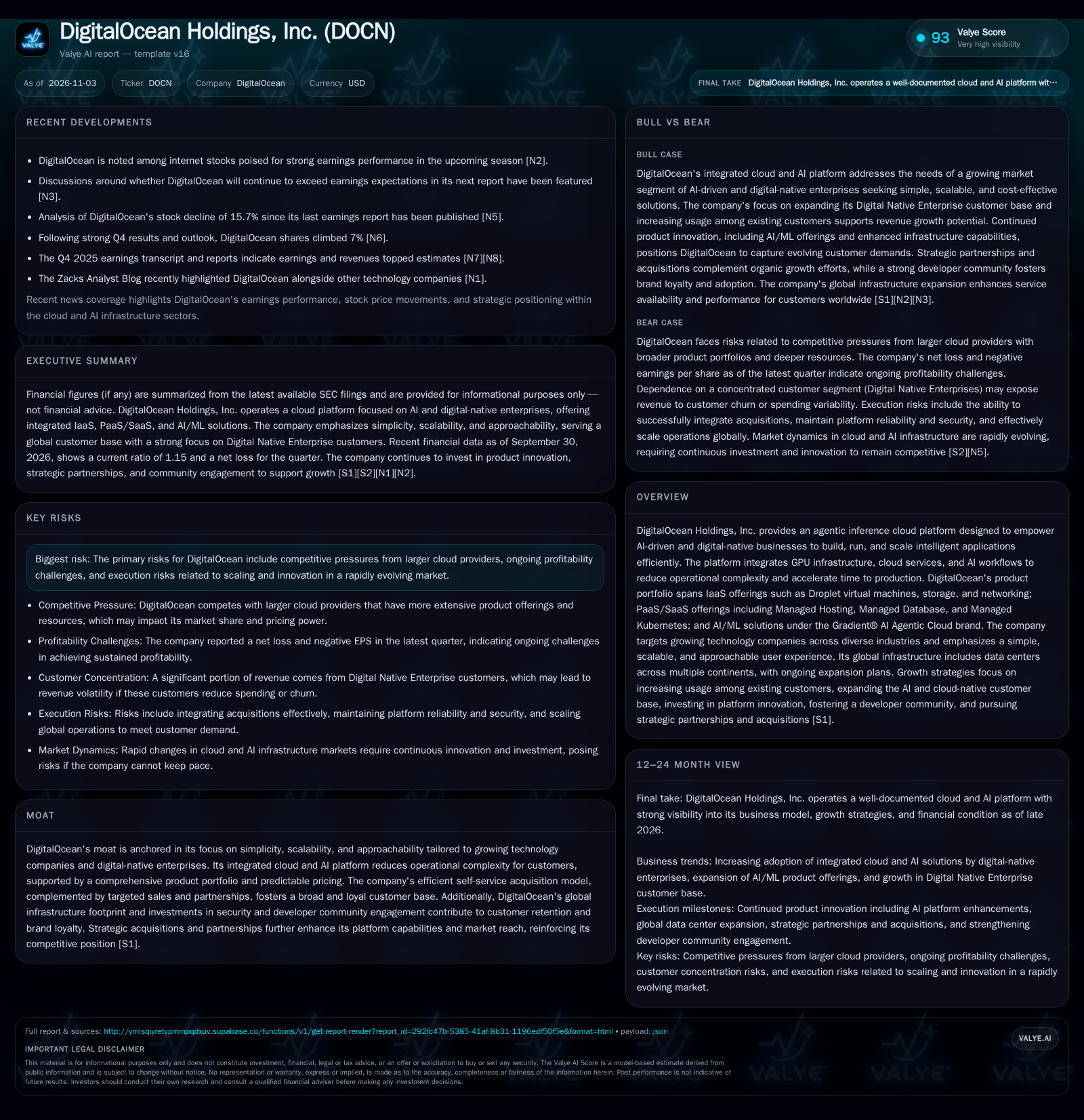
DigitalOcean is doubling down on AI and digital-native enterprise customers with an integrated cloud platform, new GPU-powered offerings, and global data center expansion. While the company’s self-service model and developer focus provide differentiation, continued net losses and fierce competition from larger cloud vendors present real challenges. The sustainability of its growth will depend on its ability to deepen customer spend, evolve its product suite, and manage capital deployment, all while fending off hyperscale rivals and maintaining operational discipline. [S1] [S2]
DigitalOcean Holdings, Inc. is positioning itself as the agentic inference platform of choice for AI-native and digital-native businesses—a cohort that increasingly values speed, simplicity, and transparent pricing over the sprawling complexity of hyperscale clouds. By integrating production-grade GPU infrastructure, robust cloud services, and model-first AI workflows, DigitalOcean is racing to capture developers and enterprises building the next generation of intelligent applications. However, as the company scales its platform, expands global infrastructure, and invests in AI-centric product innovation, it must overcome persistent profitability challenges and the gravitational pull of industry giants. The question is whether DigitalOcean’s focused strategy and community-driven growth can carve out a defensible niche, or if it will be outpaced by the scale economics and product breadth of hyperscalers.
AI Product Expansion and Financial Strain Define DigitalOcean’s Current Position
As of September 30, 2026, DigitalOcean reported cash and equivalents of $666.1 million, current assets of $1.07 billion, and current liabilities of $927.2 million, yielding a current ratio of 1.15 and a cash ratio of 0.72. The company posted a net loss of $42.6 million for the quarter, with negative basic and diluted EPS of -$0.37. [S2]
Product-wise, DigitalOcean has accelerated its AI/ML footprint with the Gradient® AI Agentic Cloud, featuring GPU Droplets, Bare Metal GPUs, and prebuilt LLM and agentic workflows. Recent launches include AI GPU infrastructure (AMD, NVIDIA), enhanced backup and storage solutions, and new network file storage capabilities. [S1]
The customer base is increasingly weighted toward Digital Native Enterprise (DNE) customers—those spending over $500 per month. As of year-end 2025, roughly 21,000 DNEs represented 60% of total revenue, underscoring both growth momentum and potential concentration risk. [S1]
While the company is investing in new data centers (Memphis, Richmond, Kansas City) for 2026, recent news highlights have focused on earnings volatility, with a 15.7% stock decline following a prior report and a bounce after strong Q4 results. [N5] [N6]
How DigitalOcean’s Platform Tries to Monetize Simplicity and Predictable Cloud Spend
DigitalOcean’s core business model relies on monetizing cloud infrastructure and platform services—Droplets (VMs), storage, managed databases, Kubernetes, and now AI/ML products—primarily through usage-based and subscription pricing. The company’s self-service onboarding and transparent, predictable pricing are designed to attract developers and small to midsize tech companies frustrated by the opaque, complex fee structures of hyperscalers.
The economics of this approach depend on high customer retention, steady expansion of wallet share (especially from DNEs), and operational leverage as fixed infrastructure costs are spread across a growing base. However, the capital intensity of running global data centers and deploying leading-edge GPUs for inference workloads means variable costs can rise sharply if utilization or pricing lags.
AI/ML and agentic workflows could be higher-margin if DigitalOcean can drive scale, avoid race-to-the-bottom pricing, and upsell value-added services (e.g., managed inference, orchestration, storage, enhanced security). But persistent net losses suggest that either pricing power is limited, customer acquisition costs are elevated, or fixed costs are not yet sufficiently leveraged. The challenge is to compress the gap between gross margin and profitability as the platform scales.
Competing for Developers: DigitalOcean’s Differentiators Versus Hyperscale Clouds
DigitalOcean’s value proposition is built around simplicity, developer-centric design, and predictable pricing—attributes that appeal to startups, SMBs, and independent developers who may be underserved by hyperscalers’ enterprise-focused sales models and complex product catalogs.
However, the competitive environment is fierce. The company faces direct competition from hyperscale providers (AWS, Azure, Google Cloud), specialized AI clouds, and regional/niche players. Hyperscalers have deeper pockets, broader product portfolios, and entrenched enterprise relationships, allowing for bundling and aggressive pricing. Specialized AI clouds may be able to move faster or offer unique capabilities in inference, orchestration, or vertical-specific solutions.
DigitalOcean’s moat depends on its self-service onboarding, community engagement, and ease of adoption for new projects. Still, as AI workloads become more demanding and customers scale, there is a risk that price-sensitive or performance-hungry customers may migrate to providers with greater scale, richer AI toolsets, or more aggressive incentives.
If DigitalOcean Converts Simplicity into Stickiness—The Path to Profitable Niche Leadership
In a favorable scenario, DigitalOcean’s emphasis on simplicity, transparent pricing, and developer experience continues to resonate with the growing ranks of AI-native and digital-native businesses. As these customers scale, they increasingly adopt higher-value services—managed databases, AI inference, orchestration, and integrated security—driving up ARPU and improving gross margins.
The agentic AI platform, with easy model deployment and workflow automation, could become a preferred choice for small and midsize firms seeking to operationalize AI without the overhead of hyperscale environments. Platform enhancements, such as autoscaling GPUs and quick-start LLM agents, further reduce friction and deepen customer lock-in.
Confirmation would come from sustained growth in DNE customer count and ARPU, narrowing net losses or a pivot to profitability, and continued product adoption without significant price erosion. Strategic partnerships and developer ecosystem expansion would reinforce network effects and accelerate organic growth.
Most Likely: Solid Growth, but Margin Pressure and Customer Churn Remain
The most plausible path forward sees DigitalOcean maintaining healthy revenue growth by expanding its DNE base and deepening adoption of new AI/ML and storage products. However, margin expansion is muted by ongoing capital investments, rising infrastructure costs, and the need to price competitively in a market crowded with hyperscalers and emerging AI specialists.
Customer acquisition and retention remain challenging as larger customers periodically reassess platform fit, and price-sensitive segments may churn or negotiate discounts. The net loss narrows gradually, but profitability remains elusive until either scale effects kick in or the product mix shifts more decisively toward higher-margin services.
Evidence supporting this scenario would be continued growth in DNE revenue contribution, stable or gently improving gross margins, and incremental improvement in net losses. Signs of persistent customer churn or pricing pressure would suggest the company is struggling to differentiate sufficiently.
When Scale Isn’t Enough—Risks of Margin Compression and AI Arms Race
The adverse scenario is one where DigitalOcean is squeezed by the capital intensity and pace of innovation in AI cloud infrastructure. Larger rivals outspend the company on GPU procurement, data center expansion, and ecosystem development, driving up customer expectations for performance, integration, and global reach.
If DigitalOcean cannot maintain pricing discipline, or if utilization rates and customer expansion fall short, fixed infrastructure costs erode margins and net losses widen. Churn among DNE customers or failure to win new AI-native clients may expose the company’s revenue concentration and limit upside from new product launches.
Confirmation would come from persistently widening net losses, stagnant or declining DNE revenue contribution, and news of key customers migrating to larger clouds or AI-specialist competitors. Delayed product rollouts or underutilized data centers would further signal that scale and capital requirements are outstripping DigitalOcean’s resources.
What Will Prove Out DigitalOcean’s AI-Native Cloud Thesis?
Sustained growth in Digital Native Enterprise (DNE) customer count and their share of total revenue would help validate the platform’s market fit for higher-spend customers. [S1]
Trends in ARPU (average revenue per user), especially among DNEs, if disclosed, would be critical for gauging success in expanding wallet share.
Gross margin progression, especially as GPU and AI/ML services scale, would signal whether product mix and infrastructure investments are generating leverage.
Net loss trajectory—whether losses narrow with scale or persist/widen—will be a clear indicator of unit economics and operational discipline. [S2]
Customer churn rates and retention among higher-spend segments, if disclosed, would help test the stickiness of the platform and risk of revenue concentration.
Utilization rates of new GPU and AI infrastructure, if disclosed, would provide insight into the return on capital invested in new data centers and hardware.
Updates on competitive win rates and migration patterns (e.g., customers moving to or from hyperscalers) would clarify the company’s relative positioning.
Evidence of continued developer ecosystem engagement—such as active Marketplace growth, open source contributions, or community events—would reinforce the network effect thesis.
Disclaimer: This is research-only, informational analysis and not investment advice. It may include AI-generated interpretation and general industry context. Always verify important details using primary sources.

Comments