
Madrigal Pharmaceuticals: Advancing Rezdiffra and Expanding Opportunities in the MASH Market
Madrigal Pharmaceuticals is now generating substantial revenue from its MASH therapy Rezdiffra, following U.S.
Madrigal Pharmaceuticals is now generating substantial revenue from its MASH therapy Rezdiffra, following U.S. and European launches. Execution, regulatory outcomes, and market adoption will determine whether Madrigal can translate its early success into durable value creation. [S2]
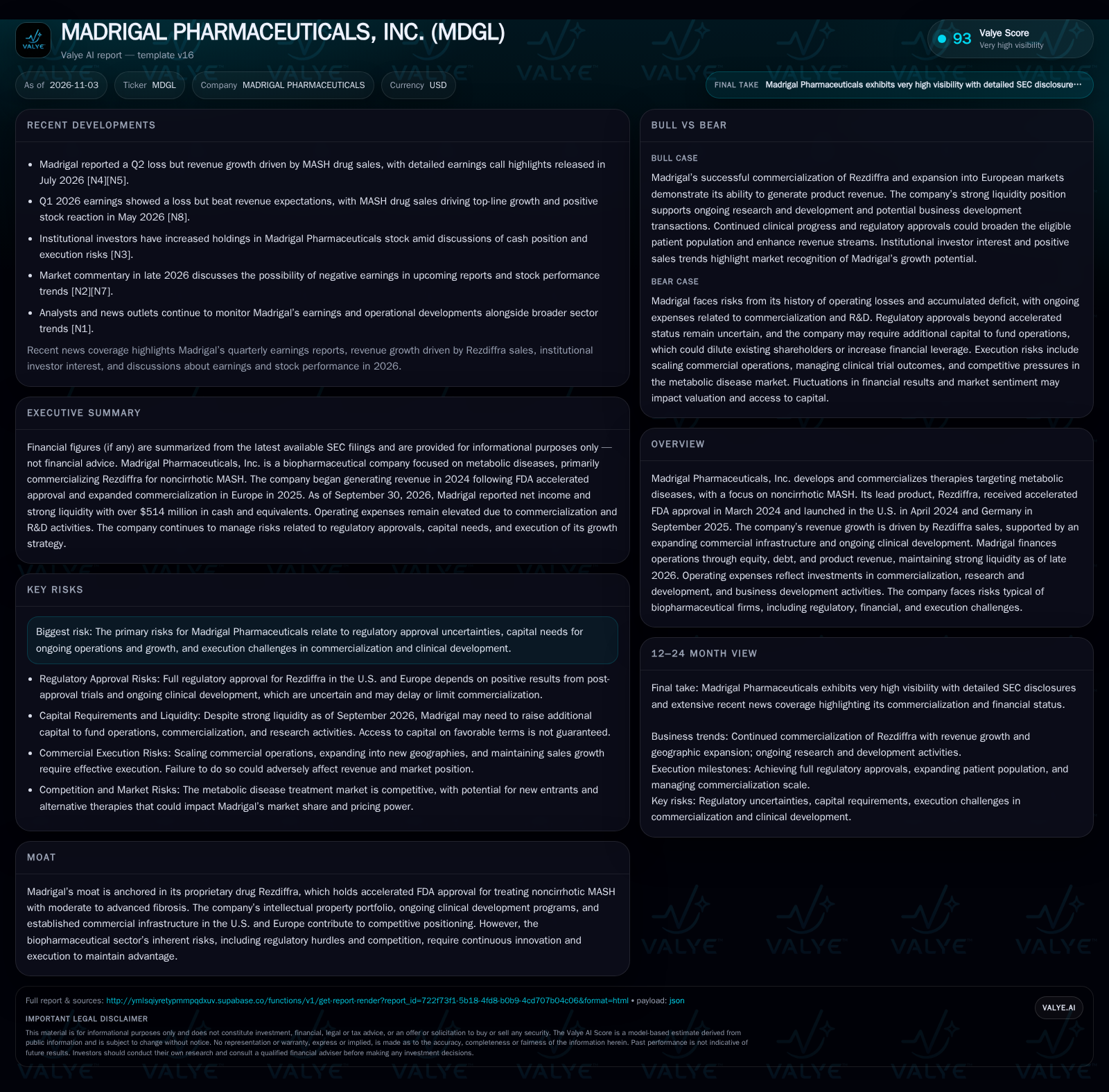
Madrigal Pharmaceuticals stands at a defining juncture after successfully commercializing Rezdiffra for noncirrhotic MASH, a major unmet need in metabolic liver disease. The company’s leap in revenue and recent net profitability mark a rare transition for biopharma—moving from R&D-driven losses to commercial-stage execution. Yet, the durability of this shift hinges on regulatory milestones, commercial scale-up, and the evolving competitive landscape. While liquidity and initial sales momentum are strong, the next phase will test whether Madrigal can secure sustainable leadership as rivals intensify and regulatory scrutiny persists.
Rezdiffra Launch Sparks a New Revenue Phase for Madrigal
Madrigal’s operational profile transformed in 2024–2025 with the FDA’s accelerated approval of Rezdiffra for noncirrhotic MASH and subsequent U.S. and German launches. Net product revenue surged from $180.1 million in 2024 to $958.4 million in 2025—a more than fivefold increase—driven by commercial uptake and expanded market access. The September 2026 balance sheet shows approximately $514.6 million in cash and a current ratio above 3, while Q3 2026 net income reached $55.4 million, translating to positive EPS for the quarter. These shifts reposition Madrigal from a development-stage company with persistent losses to a commercial-stage player with real cash flow and operational flexibility. However, expenses have also climbed as commercialization and development efforts scale, and the company continues to acknowledge the likelihood of future operating losses as it invests in growth. [S2]
Potential Changes in Madrigal’s Revenue Streams and Cost Dynamics
Madrigal’s business model now centers on sales of Rezdiffra, with revenue recognized net of rebates, discounts, and assistance programs. Pricing power in the U.S. and Europe is influenced by reimbursement dynamics, the size of the eligible MASH population, and competitive pressure. As a specialty therapy for a chronic, progressive disease, Rezdiffra could support premium pricing, but payers may push back as more options enter the market. The cost of sales includes not only manufacturing and distribution but also royalties to Roche, creating a variable margin structure that scales with sales volume. Operating leverage will depend on the pace at which SG&A and R&D expenses moderate relative to revenue growth: in 2025, both categories rose sharply due to launch costs and pipeline investments. Should revenue growth slow or price pressure intensify, fixed costs from expanded infrastructure could weigh on margins. Capital needs are partially mitigated by cash reserves and a $500 million credit facility, but sustained R&D and global commercialization may eventually require further funding, especially if regulatory timelines slip or commercial uptake underperforms.
The interplay between pricing strategies and payer dynamics will be critical in shaping Madrigal’s long-term revenue trajectory. Given the chronic nature of MASH and its associated comorbidities, payers are likely to scrutinize cost-effectiveness rigorously, potentially demanding real-world evidence that demonstrates tangible health economic benefits such as reduced hospitalizations or delayed disease progression. If Madrigal can successfully generate and present such data, it may justify premium pricing and favorable formulary positioning. Conversely, failure to meet these expectations could prompt payers to impose utilization management tools, such as prior authorizations or step therapy, which would constrain patient access and dampen sales growth.
Moreover, the cost structure’s sensitivity to sales volume underscores the importance of operational scalability. While fixed costs related to commercialization infrastructure may initially pressure margins, economies of scale could emerge if revenue growth sustains. However, this assumes that incremental sales do not require proportionally higher marketing or clinical support expenses, which could occur if competitive intensity forces more aggressive promotional efforts or patient support programs. Thus, careful management of SG&A spending relative to revenue gains will be essential to unlocking operating leverage and improving profitability over time.
Maintaining Position Amidst Intense Competition in Metabolic Disease
Madrigal’s current competitive advantage is rooted in being first to market with an FDA-accelerated approval for noncirrhotic MASH with moderate to advanced fibrosis. This confers a head start in prescriber adoption, payer contracting, and real-world data generation. Proprietary rights to Rezdiffra and ongoing clinical programs build a short-term moat, but the metabolic disease space is attracting large pharma and biotech rivals—many with deep pipelines targeting NASH/MASH, fibrosis, and related metabolic disorders. As rivals approach late-stage data or regulatory submissions, differentiation will depend on long-term efficacy, safety, label breadth, and real-world outcomes. Substitutes, including lifestyle interventions and emerging therapeutics with alternative mechanisms, could erode pricing power if they achieve similar or superior outcomes. Channel access, formulary placement, and physician education will be decisive in defending share, especially as payers scrutinize cost-effectiveness in a population with high comorbidities and healthcare utilization.
Factors That Could Sustain Madrigal’s Growth Over Time
A favorable scenario for Madrigal would see full regulatory approval for Rezdiffra in both the U.S. and Europe, with label expansion to broader patient populations (e.g., earlier-stage fibrosis or cirrhosis). If clinical data continue to support meaningful improvements in liver outcomes and safety, physician adoption could accelerate, especially as real-world evidence accumulates. Commercial execution—through payer wins, expanded salesforce reach, and effective patient identification—could drive penetration beyond initial expectations. Evidence supporting this scenario would include: consistently beating revenue expectations, positive real-world outcomes data, successful regulatory milestones, and improved margin trends despite rising volumes.
Ongoing Commercialization Tempered by Emerging Market Challenges
The most plausible trajectory is continued revenue growth from Rezdiffra, but at a moderating pace as initial pent-up demand is met and payer scrutiny intensifies. Full regulatory approval may be delayed or come with label restrictions, limiting the eligible population and slowing uptake. Competitive entrants could begin to fragment the market, pressuring both price and volume growth. Confirmation of this scenario would include: steady but slowing revenue growth, periodic operating losses, incremental regulatory wins (rather than transformative), and ongoing commentary about execution risks in earnings and filings.
Risks from Regulatory Hurdles and Competitive Pressures That May Stall Progress
The adverse scenario would be triggered by failure to secure full regulatory approval, negative post-marketing data, or safety signals that limit Rezdiffra’s use or result in label restrictions. Aggressive competition could lead to rapid price erosion or loss of formulary status, particularly if a rival demonstrates superior efficacy, convenience, or safety. If payers restrict access or require step-through therapy, new patient starts could stall, undermining revenue and cash flow. Fixed costs from scaled-up infrastructure would exacerbate losses, potentially forcing cost cuts or dilutive capital raises. Evidence of this scenario would include: regulatory setbacks, declining quarterly sales, negative real-world safety data, major payer exclusions, or sudden increases in operating losses and cash burn.
Events That Could Confirm the Strength of Madrigal’s Market Traction
Quarterly Rezdiffra sales growth and geographic patient penetration, especially new patient starts and refill rates in both the U.S. and Europe.
Regulatory progress toward full approval in the U.S. and Europe, including outcomes from required post-marketing studies and label expansion efforts.
Disclosure of real-world safety and efficacy data for Rezdiffra, as this will influence prescriber confidence, payer coverage, and competitive positioning.
SG&A and R&D expense growth relative to revenue, a key indicator of whether operating leverage is emerging or costs are outpacing top-line gains.
Any announcement of new competitive entrants, clinical trial readouts from rivals, or shifts in payer coverage policies that could alter the market landscape.
Updates on the company’s cash runway and any capital-raising activity, which would signal management’s view of funding needs and risk tolerance.
Pipeline milestones, including advancement or setbacks in next-generation candidates or new indications for Rezdiffra, which could diversify or concentrate risk.
Disclaimer: This is research-only, informational analysis and not investment advice. It may include AI-generated interpretation and general industry context. Always verify important details using primary sources.

Comments