
Alkermes After Avadel: Portfolio Expansion, Pipeline Optionality, and the Economics of Neuroscience Therapeutics
Alkermes’ acquisition of Avadel and the addition of LUMRYZ mark a pivotal expansion into narcolepsy, complementing its established schizophrenia, bipolar, and addiction franchises. As the company posts positive net income and pipeline progress, the balance between portfolio breadth, dependence on key assets, and external licensing economics will shape its next phase.
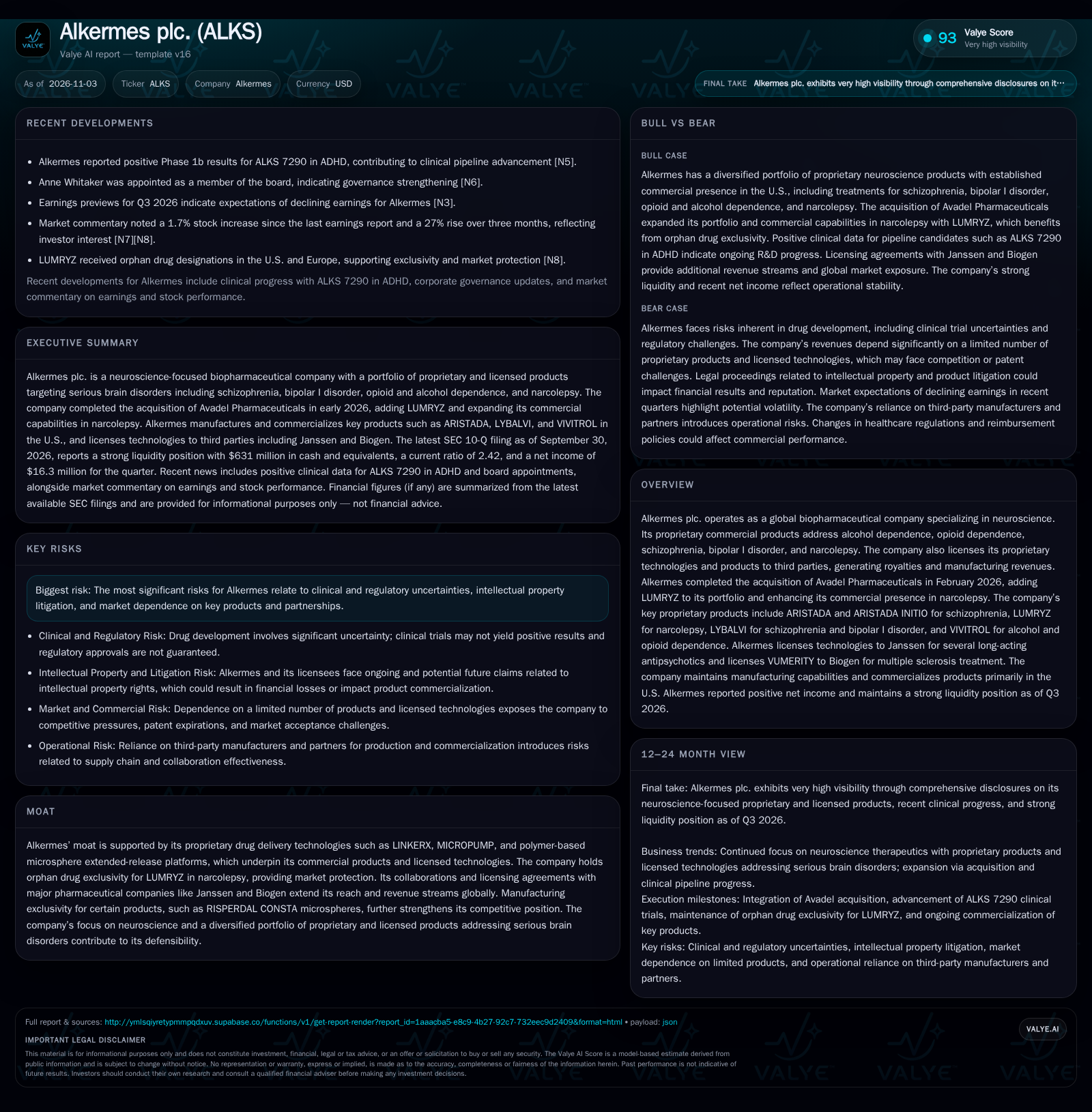
Alkermes, a neuroscience-focused biopharma, recently acquired Avadel—bringing LUMRYZ and narcolepsy expertise into its portfolio. The company reported positive Q3 2026 net income and maintains over $631 million in cash, but faces expectations of declining earnings. Its mix of proprietary drugs and licensing deals (notably with Janssen and Biogen) provides revenue diversification, yet dependence on flagship assets and ongoing clinical, regulatory, and IP risks remain material considerations. Pipeline progress, especially in ADHD, and successful integration of Avadel will be critical to sustaining future growth and mitigating volatility. [S1] [S2] [N3] [N5]
Alkermes’ strategic evolution accelerated in early 2026 with the acquisition of Avadel Pharmaceuticals, bringing LUMRYZ—an extended-release narcolepsy therapy with orphan drug exclusivity—into its fold. This move expands Alkermes’ neuroscience portfolio beyond its established schizophrenia, bipolar I disorder, and addiction therapies, and leverages a U.S.-centric commercial model complemented by global licensing. As the company posts positive net income and pipeline progress, the next chapter hinges on integrating Avadel, advancing novel candidates like ALKS 7290, and navigating the enduring risks of clinical development, patent defense, and commercial concentration.
Recent Moves Reshape Alkermes’ Commercial and R&D Landscape
Alkermes completed the acquisition of Avadel Pharmaceuticals in February 2026, adding LUMRYZ—a once-nightly, extended-release oral suspension for narcolepsy with U.S. orphan drug exclusivity through 2030/2031—to its commercial portfolio. This expands Alkermes’ reach in sleep disorders and brings a dedicated narcolepsy sales organization in-house [S1].
The latest SEC filing shows Alkermes generated $16.3 million in net income for Q3 2026, with a cash and equivalents position of $631.3 million and a current ratio of 2.42 as of September 30, 2026 [S2]. However, earnings previews indicate expectations of near-term earnings declines [N3].
Pipeline momentum was demonstrated with positive Phase 1b results for ALKS 7290 in ADHD, signaling continued investment in new neuroscience indications [N5].
How Alkermes Makes Money: Proprietary Products, Royalties, and the Cost of Innovation
Alkermes’ economics reflect a hybrid model: direct U.S. commercialization of proprietary drugs (ARISTADA, LYBALVI, VIVITROL, LUMRYZ), complemented by royalties and manufacturing revenues from licensing its delivery technologies to global pharma partners (notably Janssen and Biogen) [S1]. This mix diversifies revenue sources, but the bulk of commercial risk and upside is concentrated in a handful of branded assets.
Pricing power for proprietary drugs in neuropsychiatry and rare diseases is typically supported by clinical differentiation, delivery technology, and—where available—regulatory exclusivity. LUMRYZ’s orphan exclusivity, for example, could shield U.S. pricing and volume for several years, though payer management and the emergence of generic or new branded competitors post-exclusivity remain threats.
Operating leverage in this model is driven by scale in the commercial infrastructure and manufacturing footprint. The addition of Avadel’s commercial team could yield cost synergies, but also raises integration and fixed-cost absorption challenges. R&D spend is a structural necessity given the clinical pipeline and ongoing lifecycle management requirements.
Royalties from licensing deals (e.g., RISPERDAL CONSTA, INVEGA SUSTENNA/XEPLION, VUMERITY) provide global exposure and high-margin income, but these streams are subject to partner performance, patent duration, and ongoing IP defense costs.
Defensibility Hinges on Drug Delivery Technology, Exclusivity, and Partner Reach
Alkermes’ competitive position is underpinned by proprietary drug delivery platforms (LINKERX, MICROPUMP, polymer-based microspheres), which enable differentiated dosing, adherence, and safety profiles—key in chronic neuropsychiatric indications. Orphan drug exclusivity for LUMRYZ and manufacturing exclusivity for certain products (e.g., RISPERDAL CONSTA microspheres) add temporary barriers to entry [S1].
However, the company operates in highly competitive markets: schizophrenia and bipolar treatments compete with generic and branded atypical antipsychotics, while VIVITROL faces non-injectable alternatives and increasing generic risk as patent protection ages. In narcolepsy, LUMRYZ’s extended-release profile may offer a convenience edge, but competition from other orexin agonists and wake-promoting agents is intensifying.
Licensing partnerships with large pharma (Janssen, Biogen) expand Alkermes’ geographic reach and revenue base, but also create dependency on external commercialization and development decisions. The durability of these relationships—and associated IP—will be tested as competitive pipelines advance and patent cliffs approach.
Integration Success and Pipeline Progress Catalyze Sustained Growth
The most favorable scenario for Alkermes sees seamless integration of Avadel, with LUMRYZ achieving strong adoption in narcolepsy and the combined commercial organization capturing operational synergies. Preservation of orphan drug exclusivity through 2030/2031 would enable premium pricing and predictable market share, while cross-selling to sleep specialists and psychiatrists could expand the addressable market.
Pipeline advancement—particularly successful late-stage trials for ALKS 7290 (ADHD) or other orexin agonists—could add new revenue streams and reinforce Alkermes’ reputation in neuroscience innovation. Expansion of licensing deals or new technology out-licensing could further diversify high-margin royalty income.
Evidence confirming this scenario would include: accelerating LUMRYZ sales, additional positive late-stage clinical data, new licensing agreements, and margin expansion from cost synergies post-acquisition.
Portfolio Breadth Offsets Asset Concentration, but Volatility Persists
The most plausible outcome is that Alkermes’ expanded portfolio provides some insulation against single-asset risk, but volatility remains due to concentration in a few key drugs and the unpredictable nature of clinical and regulatory events. LUMRYZ contributes meaningful, but not breakout, growth, while ARISTADA, LYBALVI, and VIVITROL continue to anchor the U.S. business amid competitive and payer pressures.
Licensing royalties remain stable but face gradual erosion as patent terms expire and competing products emerge. The clinical pipeline yields incremental advances, with ALKS 7290 and other candidates progressing but not transforming the growth profile in the near term.
Confirmation would come from steady, but not accelerating, top-line and net income trends, stable or slowly declining royalty streams, and a pipeline that advances but does not deliver major new launches within the next 12-24 months.
Product Concentration, Patent Erosion, and Pipeline Setbacks Expose Fragility
In the adverse scenario, Alkermes’ dependence on a handful of proprietary and licensed products becomes a liability as generic competition accelerates, payer pressure intensifies, or unexpected safety or regulatory setbacks occur. LUMRYZ adoption may disappoint if competing narcolepsy therapies or new orexin agonists gain favor, or if REMS requirements limit prescriber uptake.
Pipeline setbacks—such as failed or delayed trials for ALKS 7290 or other candidates—would sap future growth options and pressure R&D return on investment. If key licensing partners deprioritize Alkermes-derived products, royalty streams could erode faster than anticipated.
Downside evidence would include: declining sales or share in core products, negative late-stage trial results, loss of exclusivity without adequate replacement, or adverse IP litigation outcomes.
Testing Alkermes’ Thesis: Commercial Execution, Pipeline Progress, and External Dependencies
LUMRYZ U.S. sales trajectory: Watch for quarterly adoption rates, formulary wins, and prescriber penetration to gauge integration and commercial execution (if disclosed).
Progress of ALKS 7290 and orexin agonist pipeline: Key milestones include advancement to Phase 2/3 trials, regulatory feedback, and early efficacy/safety signals.
Royalty and manufacturing revenue from Janssen and Biogen: Monitoring changes in reported royalty income would reveal partner commitment and the impact of patent cliffs (if disclosed).
Gross margin trends: Cost synergy realization and product mix post-Avadel will be reflected in reported margins (if disclosed).
R&D expense as a share of revenue: Sustained or rising R&D intensity may indicate pipeline prioritization or late-stage trial investments.
Patent litigation and exclusivity developments: Any adverse legal outcomes or loss of exclusivity for flagship products would be a critical negative signal.
Board and management updates: Additional governance changes or executive turnover could signal shifts in strategy or integration challenges.
Earnings guidance and revisions: Changes in management’s financial outlook would help test the impact of integration, pipeline progress, and market dynamics.
Disclaimer: This is research-only, informational analysis and not investment advice. It may include AI-generated interpretation and general industry context. Always verify important details using primary sources.

Comments