
Liberty Global After VodafoneZiggo: Integration, Scale, and the Evolving Economics of European Connectivity
Liberty Global's recent acquisition of VodafoneZiggo and plans to divest tower assets mark a pivotal phase for the company, sharpening its focus on operational scale, integration, and capital recycling in a volatile European telecom landscape. With nearly 30 million homes passed and over 48 million mobile subscribers, Liberty Global’s challenge is to translate its vast footprint and portfolio moves into sustainable margin expansion amid competitive, regulatory, and macroeconomic headwinds.
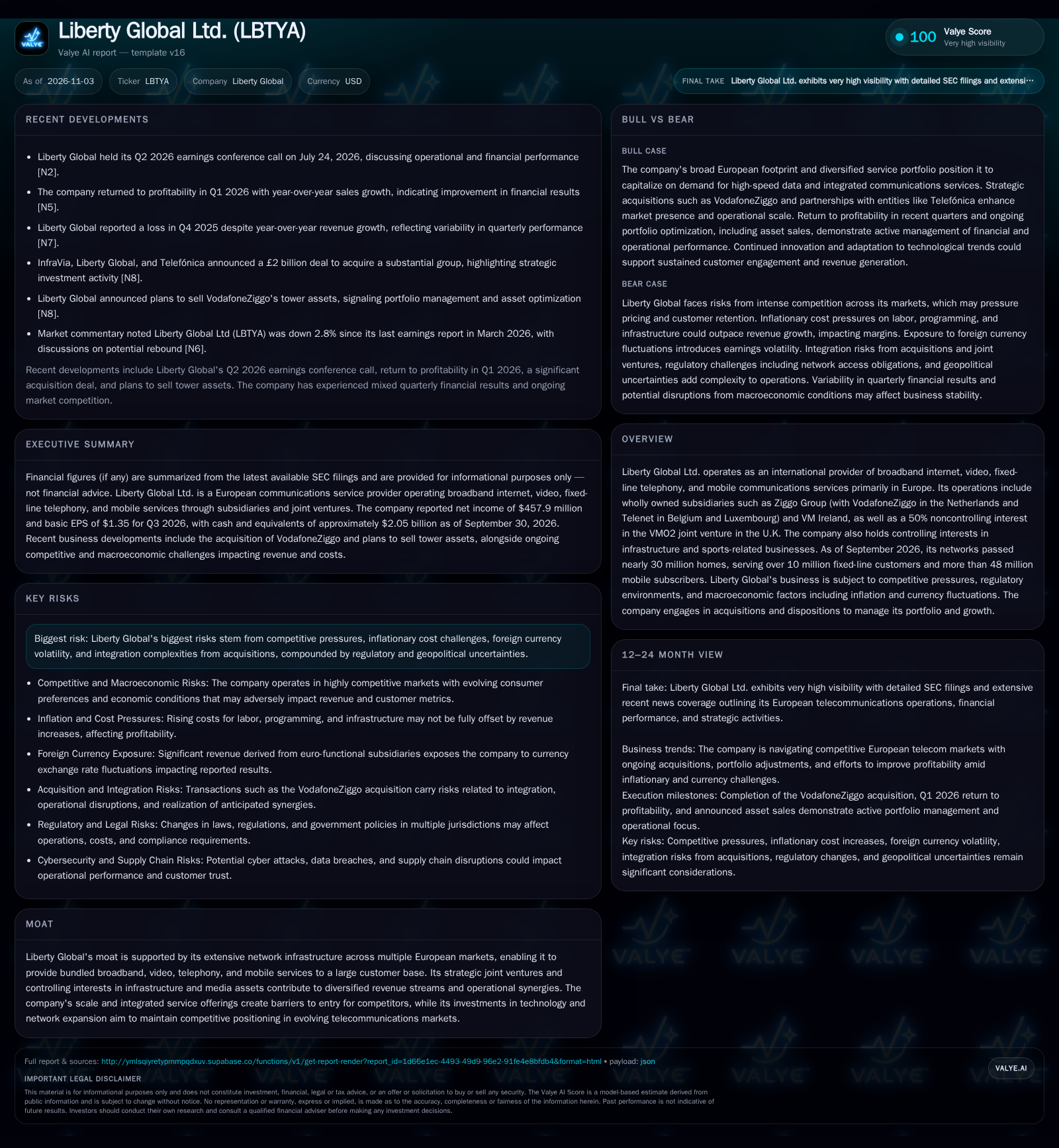
Liberty Global’s Q3 2026 net income rebound and VodafoneZiggo acquisition highlight its push for scale and operational leverage. The company’s asset sales and portfolio adjustments aim to optimize capital deployment. However, persistent competition, inflation, FX volatility, and integration risks complicate the path to consistent margin and cash flow improvement. Key metrics to watch include integration progress, ARPU trends, cost management, and the realization of synergies from recent deals. [S2] [N5] [N8]
Liberty Global Ltd. stands at a strategic crossroads after completing the VodafoneZiggo acquisition and returning to profitability in 2026. With a pan-European communications footprint, the company now serves tens of millions of customers across broadband, video, fixed-line, and mobile segments. However, the operational challenge is acute: integrating new assets, extracting cost and revenue synergies, and defending margins against inflation, fierce competition, and regulatory change. Liberty Global’s evolving strategy—balancing scale with active portfolio management—will be tested by the realities of European telecom economics over the next 12–24 months. [S2] [N5] [N8]
VodafoneZiggo Acquisition and Profitability Shift Define the New Baseline
Liberty Global’s operational context has shifted significantly with two recent developments: the July 2026 completion of the VodafoneZiggo acquisition, and a return to profitability in Q1 and Q3 2026. The VodafoneZiggo deal materially increases Liberty Global’s scale in the Netherlands, adding both fixed-line and mobile subscribers and deepening its presence in a key European market. For the quarter ended September 30, 2026, Liberty Global reported net income of $457.9 million USD, with basic EPS of $1.35, following a first quarter that also saw the company return to the black after prior losses. Networks now pass approximately 29.9 million homes, serving 10.8 million fixed-line customers and 48.1 million mobile subscribers, underscoring the company’s vast infrastructural reach. The company’s announced plans to sell VodafoneZiggo’s tower assets point to ongoing asset optimization and capital recycling.[S2] [N5] [N8]
How Scale and Integration Could Drive Margin Expansion—If Costs Stay Contained
Liberty Global’s core economics hinge on the ability to monetize a large network footprint through broadband, video, fixed-line, and mobile services, primarily in highly developed European markets. Revenue is generated via a mix of monthly subscriptions (broadband, pay TV, mobile), value-added services (such as premium content or higher-speed tiers), and—in some markets—wholesale or infrastructure leasing. The addition of VodafoneZiggo should, in theory, bolster operating leverage by spreading fixed network and IT costs over a larger customer base. However, the durability of this leverage is tested by inflationary labor, programming, and infrastructure costs, which may not be fully offset by ARPU growth or incremental scale. If Liberty Global can successfully integrate VodafoneZiggo, harmonize back-office and network operations, and cross-sell bundled services, there is potential for both revenue and cost synergies. The company reported cash and liquidity metrics for the period; these figures do not by themselves establish operating runway, investment capacity, financial flexibility, or financing capacity. [S2]
Defending Share in Fragmented and Regulated European Markets
Liberty Global competes with incumbent national telecom operators, regional challengers, and—on mobile—pan-European players and MVNOs. Its competitive advantages include a broad, modernized network infrastructure, the ability to offer quad-play bundles (broadband, video, fixed, mobile), and operational experience in managing multi-country portfolios. However, European telecom markets are characterized by strict regulation (including open-access and pricing rules), high customer churn, and price-sensitive consumers. The need to invest in ongoing network upgrades (fiber, 5G) is persistent, while OTT services and new digital entrants threaten legacy video and fixed-line revenues. The VodafoneZiggo integration could strengthen Liberty Global’s scale-based advantages in the Netherlands, but realization of synergies is far from automatic—especially as local rivals are likely to respond with aggressive promotions or investment. The planned sale of tower assets reflects a broader trend of asset-light strategies, but also removes a source of potential infrastructure economics if not offset by improved returns elsewhere. [S2] [N4] [N8]
If Integration Delivers: Synergies, ARPU Growth, and Capital Recycling Fuel Outperformance
The bull case for Liberty Global centers on the successful integration of VodafoneZiggo and ongoing portfolio optimization. If the company can quickly align operations, unlock procurement and network synergies, and cross-sell bundled services, it could drive higher average revenue per user (ARPU) and reduce per-subscriber costs. Asset sales—such as the planned divestiture of tower infrastructure—could free up capital for debt reduction, share buybacks, or targeted network investment. A stabilizing macro environment, combined with effective cost containment and modest ARPU expansion, would support both margin growth and free cash flow improvement. Confirmation of this scenario would come from sustained increases in operating margins, visible ARPU and subscriber growth in key markets, and evidence of successful capital deployment from asset sales (e.g., deleveraging or accretive reinvestment). [S2] [N8]
Incremental Progress Amid Ongoing Cost and Competitive Pressures
The most plausible outcome is a mixed environment: Liberty Global gradually realizes some integration benefits from VodafoneZiggo, but faces offsetting pressures from inflation, regulatory constraints, and aggressive competition. ARPU may grow modestly in selected segments, but price competition and churn remain elevated. Cost inflation—especially in labor and programming—continues to pressure margins, making operational discipline and automation essential. The company’s portfolio moves (including asset sales) help shore up the balance sheet, but do not fundamentally change the profitability profile unless reinvestment is both disciplined and accretive. This scenario would be confirmed by stable to slightly improving margins, steady (but not rapid) subscriber trends, and evidence that cost increases are being at least partially offset by integration savings or pricing. Falsification would come from margin erosion, sustained negative subscriber growth, or failure to close announced asset sales. [S2] [N5] [N8]
Integration Stumbles, Inflation Bites, and Revenue Pressure Squeezes Margins
The bear case emerges if integration of VodafoneZiggo proves more difficult or costly than expected, with operational disruptions, higher-than-anticipated capex, or failure to realize planned synergies. Simultaneously, if inflation in labor and content costs outpaces ARPU or subscriber growth, margins could compress sharply. Heightened competition—especially in the Netherlands and Belgium—could drive increased churn and promotional intensity, further pressuring revenue and profitability. Regulatory or legal changes (such as mandated wholesale access or stricter pricing controls) would exacerbate these headwinds. Downside confirmation would come from declining margins, negative free cash flow, missed synergy targets, persistent subscriber losses, or delays in completing announced asset sales—potentially raising questions about the sustainability of the current financial structure. [S2] [N5] [N8]
What Will Clarify Whether Liberty Global’s Scale and Integration Strategy Is Delivering?
Progress on VodafoneZiggo integration milestones, including back-office consolidation, network harmonization, and synergy realization—if disclosed.
ARPU trends and subscriber churn rates by segment and geography, especially in the Netherlands and Belgium.
Operating margin and free cash flow progression, with a focus on whether cost increases are being offset by synergies or pricing.
Timing and proceeds from the announced VodafoneZiggo tower asset sale, and how capital is redeployed (debt reduction, buybacks, or investment).
Net capital expenditures and the pace of network upgrades (fiber, 5G), particularly in competitive markets.
FX impacts on reported results and any hedging or mitigation strategies disclosed.
Evidence of regulatory or policy changes affecting pricing, access, or investment requirements in core markets.
Any guidance or disclosure on customer mix shifts (residential vs. B2B) and implications for revenue stability.
Disclaimer: This is research-only, informational analysis and not investment advice. It may include AI-generated interpretation and general industry context. Always verify important details using primary sources.

Comments