
Beam Therapeutics: Can Base Editing and Deep Liquidity Power a Transition from Science to Market?
Beam Therapeutics sits at a critical inflection point: armed with over $1 billion in liquidity, a portfolio of issued patents, and early clinical progress—yet still pre-commercial and facing serious IP and clinical hurdles. The company's future hinges on the interplay between its proprietary gene editing technologies, the outcome of ongoing patent disputes, and the pace of clinical and regulatory milestones.
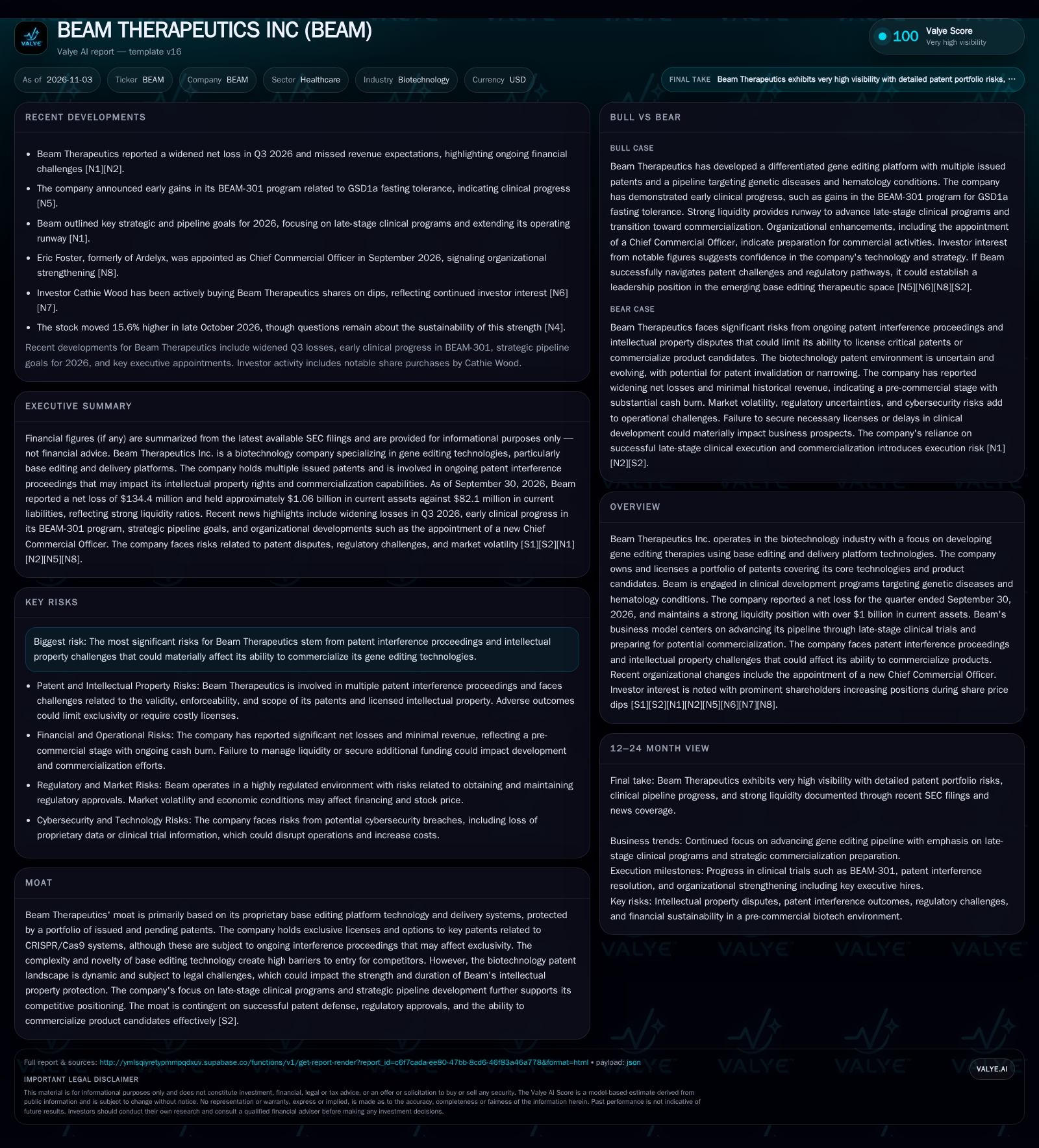
Beam Therapeutics remains pre-commercial but has made early clinical gains with BEAM-301 and holds over $1 billion in current assets. The company's patent portfolio is both a moat and a vulnerability, as ongoing interference proceedings could materially impact commercialization. With deep liquidity and prominent investor interest, Beam's ability to convert scientific progress into marketable therapies will define its next chapter. [S2] [N1] [N2] [N5] [N6]
Beam Therapeutics stands out as a high-profile gene editing company at the crossroads of scientific promise and commercial uncertainty. With more than $1 billion in current assets and a robust base editing patent portfolio, Beam is advancing late-stage clinical programs, notably BEAM-301 for glycogen storage disease. Yet, the company remains pre-commercial, burning significant cash and navigating a highly contentious patent environment that threatens its ability to bring therapies to market. The next 12-24 months will test whether Beam’s technological and financial assets can translate into enduring competitive advantage—or whether IP and execution risks will overwhelm early gains.
Beam’s Financial Cushion, Clinical Milestones, and IP Uncertainties Define Its Current State
Beam Therapeutics reported a net loss of $134.4 million for Q3 2026, with basic and diluted EPS of -$1.28, continuing its pattern of substantial cash burn as a pre-commercial biotech [S2]. Yet, the company’s liquidity remains formidable, holding $213.3 million in cash and equivalents and $830.6 million in short-term investments, totaling roughly $1.06 billion in current assets against $82.1 million in current liabilities—a current ratio of 13 [S2].
Clinically, Beam has announced early gains in its BEAM-301 program for GSD1a, demonstrating initial proof-of-concept in fasting tolerance and supporting the pipeline's momentum [N5]. However, the company is deeply entangled in ongoing patent interference proceedings related to CRISPR/Cas9 systems, which could materially affect its ability to commercialize any approved products [S2].
Investor sentiment, as signaled by prominent shareholders increasing positions during price dips, adds a layer of market confidence, but the fundamental value will ultimately depend on how Beam navigates IP and clinical execution risks [N6].
How Beam’s Business Model Could Scale—If Clinical and IP Hurdles Are Overcome
Beam’s fundamental business model is to develop, patent, and ultimately commercialize gene editing therapies, with a focus on proprietary base editing technologies. The economics of this model are binary: high up-front R&D and regulatory costs, followed by the potential for high-margin, high-revenue product sales or licensing streams if therapies reach market approval.
Pricing power in the gene editing field could be substantial, especially for first-in-class or best-in-class therapies addressing rare or previously untreatable genetic diseases. However, volume will initially be limited to rare disease populations, and revenue mix may depend on whether Beam out-licenses its platform or commercializes products directly. If Beam’s platform is validated clinically and IP is defended, it could command premium pricing and attract partnerships with larger pharma players, creating additional milestone and royalty revenues.
Operating leverage is significant in this model: fixed costs are high (R&D, regulatory, manufacturing ramp), but successful product launches or licensing deals could rapidly expand margins as revenue scales without a proportional increase in expenses. Conversely, the capital intensity and long timelines of drug development mean Beam must continually invest in pipeline progression and regulatory milestones before any commercial returns materialize.
The company reported cash and liquidity metrics for the period; these figures do not by themselves establish operating runway, investment capacity, financial flexibility, or financing capacity. [S2]
Proprietary Base Editing: Moat, Litigation Magnet, and the Battle for Platform Leadership
Beam’s competitive positioning is rooted in its portfolio of issued patents covering base editing and delivery platform technologies—twelve issued U.S. patents for base editing and six for delivery systems [S2]. This intellectual property portfolio creates a substantial barrier to entry for direct competitors, as base editing is a technically and legally complex field.
However, the same IP that underpins Beam’s moat also exposes it to significant risk. Ongoing patent interference proceedings—especially those involving foundational CRISPR/Cas9 systems—could erode or even eliminate Beam’s freedom to operate if rulings go against the company [S2]. In the broader competitive landscape, Beam faces both legacy gene therapy firms and newer gene editing entrants, including those pursuing alternative editing modalities, as well as large pharmaceutical companies with deeper commercialization and legal resources.
Switching costs for customers (clinicians, patients, or partners) are likely to be high if Beam’s therapies prove to be more effective or safer than existing options, particularly for rare diseases with few alternatives. However, if IP outcomes narrow Beam’s claims or force expensive cross-licensing, the economic moat could shrink rapidly.
Thus, Beam’s long-term defensibility hinges on prevailing in patent disputes and demonstrating clinical differentiation—otherwise, its technology could become commoditized or even blocked from market entry.
What a Breakthrough Looks Like: Patent Wins and Successful BEAM-301 Data Drive Commercial Inflection
The most favorable outcome for Beam would involve positive resolution of ongoing patent interference proceedings, securing broad and enforceable claims over its base editing and delivery technologies. This would allow Beam to commercialize therapies unimpeded or to license its platform to other biotech/pharma players on favorable terms.
Concurrently, successful late-stage clinical data—especially from the BEAM-301 program in GSD1a—would validate the platform’s safety and efficacy, positioning Beam for regulatory approval and rapid adoption in targeted disease populations [N5]. Early clinical gains have already been announced, but pivotal data and regulatory milestones would provide the necessary catalysts for revenue inflection.
Investor confidence could be reinforced by partnership announcements, licensing deals, or early product launches, enabling Beam to leverage its liquidity into a self-sustaining business model. Confirmation of this scenario would include: positive patent litigation outcomes, successful pivotal trial readouts, clear regulatory guidance, and the announcement of commercial agreements or first product sales.
Falsification would occur if patent losses restrict Beam’s ability to operate, or if late-stage clinical data fail to demonstrate meaningful benefit or safety.
Incremental Progress: Pipeline Advances Tempered by Prolonged IP and Regulatory Timelines
The most likely path for Beam over the next 12-24 months is a mixed outcome: continued advancement of late-stage clinical programs, with BEAM-301 and other pipeline candidates moving toward pivotal data, but with patent proceedings dragging on and delaying full commercial clarity.
In this scenario, Beam leverages its existing liquidity to fund ongoing trials and operational build-out, potentially announcing additional early-stage clinical progress or new partnerships. However, revenue remains minimal or non-existent as the company remains pre-commercial, and uncertainty around IP persists, limiting the willingness of partners or payers to make large upfront commitments.
The company’s valuation and investor sentiment may fluctuate with each clinical and legal milestone, but no decisive breakthrough occurs. Confirmation would include incremental clinical updates, ongoing litigation disclosures, and continued cash burn with periodic equity raises or partnership funding.
Falsification of this scenario would occur if Beam either achieves a rapid, clean IP victory and pivotal clinical data (upside), or if it suffers a major clinical or legal setback that dramatically curtails its commercial prospects (downside).
When Science Isn’t Enough: IP Defeats or Clinical Failures Undercut Beam’s Path to Market
The primary risk for Beam is an adverse outcome in patent interference proceedings—such as loss of key CRISPR/Cas9 claims or inability to secure necessary licenses—which could block or severely restrict commercialization, regardless of clinical progress [S2]. In this scenario, Beam’s proprietary edge evaporates, and it may be forced into expensive cross-licensing agreements or abandon certain pipeline assets.
A secondary risk is clinical: if late-stage studies for BEAM-301 or other candidates reveal safety issues or insufficient efficacy, Beam could face trial halts, regulatory setbacks, and diminished interest from partners or investors. Given the high fixed costs and pre-commercial cash burn, such setbacks would rapidly erode Beam’s liquidity and increase the risk of dilutive financing or downsizing.
Confirmation of the downside would include negative patent rulings, clinical trial discontinuations, or explicit guidance that key programs will be delayed or abandoned. Falsification would require evidence of legal victories, successful clinical milestones, or new funding/partnerships that extend the company’s runway and optionality.
Milestones That Will Clarify Beam’s True Competitive Position in Gene Editing
Resolution or material updates in ongoing patent interference proceedings, especially regarding CRISPR/Cas9 foundational claims.
Pivotal clinical trial data for BEAM-301 and other late-stage pipeline programs—efficacy, safety, and regulatory feedback would be decisive.
Any announced partnerships, licensing deals, or collaborations with large pharmaceutical companies, which would validate the platform’s commercial potential.
Changes in cash burn rate, runway guidance, or additional financing events (equity raises, debt, or partnership funding), if disclosed.
FDA or global regulatory agency feedback, fast-track or breakthrough therapy designations, and timelines for potential approvals.
Clarity on organizational build-out, such as commercial infrastructure investments or new executive hires related to market launch.
Shifts in investor sentiment or major institutional position changes, which could reflect market confidence or concern.
Disclaimer: This is research-only, informational analysis and not investment advice. It may include AI-generated interpretation and general industry context. Always verify important details using primary sources.

Comments