
Dynatrace’s AI-Driven Platform: Navigating Growth Pressures and Competitive Shifts in Observability
Dynatrace’s unified observability platform, powered by agentic AI and a scalable data lakehouse, continues to attract global enterprise customers—even as trimmed guidance and stock volatility underscore intensifying competition and execution risk. The company’s flexible SaaS model and deep partner ecosystem offer growth levers, but sustaining momentum will require ongoing innovation and demonstrated customer expansion.
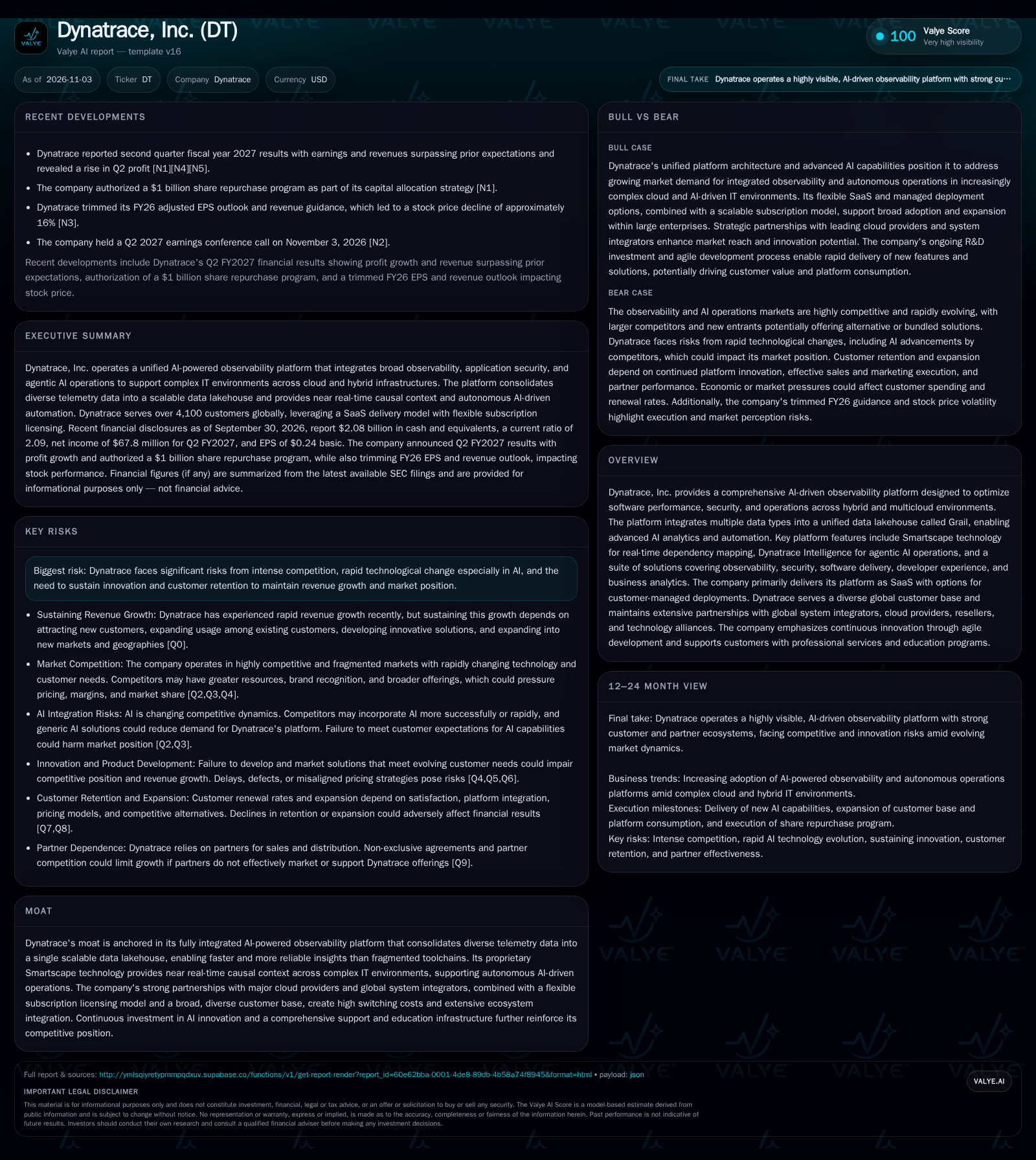
Dynatrace reported higher Q2 FY2027 profits and a $1 billion buyback authorization, but trimmed its FY26 guidance, triggering a sharp stock decline. Its AI-powered observability platform serves 4,100+ customers via a SaaS-first model, integrating diverse telemetry for automation and analytics. While its technology and partnerships support strong positioning, execution, innovation, and customer expansion remain critical as competition intensifies and market expectations rise. [S1] [S2] [N1] [N3]
Dynatrace stands at a crossroads: its AI-powered observability platform continues to deliver profit growth and attract global enterprise customers, yet the company’s decision to trim its FY26 outlook sent a clear signal about rising execution and competitive pressures. With a $1 billion buyback authorization and a robust balance sheet, Dynatrace has resources to invest in innovation and customer acquisition. However, as the observability and AIOps market evolves rapidly—driven by cloud complexity, automation, and a wave of AI-driven offerings—the company’s ability to maintain differentiation, expand its customer base, and defend its pricing model will be tested. The next phase hinges on translating technical leadership into durable growth and customer loyalty.
Recent Guidance Cut and Share Buyback Shape Investor Focus
Dynatrace reported Q2 FY2027 net income of $67.8 million and cash and equivalents of $2.08 billion, with a current ratio of 2.09 and a cash ratio of 1.61 as of September 30, 2026. The company also authorized a $1 billion share repurchase program, suggesting capacity for shareholder returns and capital management flexibility. However, Dynatrace trimmed its FY26 adjusted EPS and revenue guidance, prompting a 16% stock price decline and highlighting investor sensitivity to growth expectations and forward visibility. These developments bring execution risk and market confidence to the forefront, underscoring the importance of delivering on innovation, customer expansion, and retention in the coming quarters. [S2] [N1] [N3]
How Dynatrace’s Unified Platform Drives Revenue and Margin Dynamics
Dynatrace’s business model centers on SaaS subscriptions for its unified observability platform, with additional options for customer-managed deployments. Revenue is primarily driven by annual subscription commitments under the Dynatrace Platform Subscription (DPS) model, which offers scalability and transparency—customers pay a minimum annual spend based on anticipated usage, with no penalty overages. This model supports predictable recurring revenue and can incentivize expansion as customers increase platform consumption. The platform’s modular architecture (covering observability, security, analytics, and automation) enables cross-sell and upsell opportunities, potentially driving higher average contract values over time.
Gross margins in SaaS models like Dynatrace’s tend to be high due to software scalability, but the company’s significant R&D investment and global go-to-market costs create a balance between operating leverage and continued spend. Agentic AI, automation, and the Grail data lakehouse may further reduce incremental service costs and enable Dynatrace to serve complex, large-scale enterprise environments efficiently. However, pricing pressure remains an ongoing risk, especially as competitors bundle observability with broader cloud or DevOps offerings.
Competitive Dynamics: Defending Differentiation in a Crowded Observability Landscape
Dynatrace operates in a fiercely competitive environment populated by both legacy IT monitoring vendors and cloud-native entrants. Its major rivals include large cloud service providers offering integrated observability and AIOps tools, dedicated observability platforms, and infrastructure management companies pivoting toward AI-driven automation. Dynatrace’s moat stems from its unified data lakehouse (Grail), agentic AI operations, and Smartscape’s real-time causal mapping, which together promise faster, more actionable insights than fragmented toolchains.
However, several counterforces threaten this advantage: hyperscalers may bundle observability features at low or no incremental cost, eroding pricing power and customer loyalty; emerging open-source and modular solutions could lower switching barriers; and rapid AI advances may reduce perceived differentiation if competitors close the gap in autonomous operations. The company’s broad partner ecosystem—including global SIs, resellers, and technology alliances—expands reach and integration opportunities, but also creates exposure to partner execution and channel conflict. Ultimately, Dynatrace’s ability to defend its position will hinge on continuous innovation, demonstrable customer outcomes, and the transition from point solution to indispensable platform.
Platform Expansion and AI Innovation Unlock Accelerated Adoption
A favorable trajectory for Dynatrace could emerge if the company leverages its AI and automation capabilities to deliver clear, quantifiable business value for large enterprise customers—reducing incident response times, minimizing outages, and enabling more autonomous IT operations. If the flexible DPS subscription model and deep integrations with cloud, DevOps, and security ecosystems drive broader platform adoption, Dynatrace could see higher net dollar retention rates and expanded contract values among its 4,100+ customers. Successful execution of the $1 billion share buyback could also signal management confidence and attract long-term investors.
Evidence supporting this scenario would include: sustained double-digit growth in annual recurring revenue, rising net dollar retention, increased customer adoption of multiple modules (e.g., security, analytics, automation), and visible expansion in Fortune 1000 or global enterprise segments. Announcements of new, high-profile customer wins, partner-led deals, or cross-industry deployments would further strengthen the case. Confirmation would also come from consistent margin expansion alongside continued R&D velocity and product innovation—particularly in agentic AI and automation.
Maintaining Share in a Maturing, Competitive Observability Market
In the most plausible near-term scenario, Dynatrace maintains its current customer base and gradually expands platform adoption within existing accounts, offsetting some pricing and competitive pressures. Growth moderates as the market for AI-driven observability matures and hyperscale providers intensify competition, but Dynatrace’s differentiated platform and established enterprise relationships provide a buffer against rapid share loss. The company continues to invest in R&D, sustaining innovation in automation and AI, while relying on its partner ecosystem to drive incremental wins.
This scenario would be confirmed by steady (but not accelerating) subscription revenue growth, stable net dollar retention, and moderate margin improvements. Customer expansion metrics may show incremental module adoption and upsell activity, but not the breakout acceleration seen in earlier growth phases. While the $1 billion buyback supports the share price, investor focus remains on the company’s ability to translate technical strengths into consistent financial performance and customer expansion.
Market Saturation and Competitive Bundling Erode Growth and Margins
Adverse outcomes could materialize if cloud providers and large-scale competitors aggressively bundle observability and AIOps into broader offerings, compressing Dynatrace’s pricing and making platform switching more attractive. If innovation fails to keep pace with customer expectations—particularly around AI-driven automation and security—Dynatrace could face lower renewal rates, reduced upsell opportunities, and increased customer churn. Partner-driven sales may stall if alliances prioritize competing solutions or if channel conflict intensifies.
Signs of this scenario would include: decelerating annual recurring revenue growth, declining net dollar retention, evidence of customer contraction or competitive displacements, and margin pressure despite ongoing R&D spend. Further guidance cuts or missed execution milestones could reinforce investor skepticism, while increased reliance on buybacks signals limited organic growth opportunities. Negative sentiment may be amplified by macroeconomic headwinds or IT budget constraints, compounding competitive pressures.
Testing the Dynatrace Thesis: Concrete Markers for Platform Momentum and Competitive Resilience
Annual recurring revenue growth rate, especially in enterprise and global accounts, as a direct measure of platform expansion and customer adoption.
Net dollar retention and churn rates, if disclosed, to gauge the company’s ability to expand within existing customers and defend its footprint against competitors.
Adoption rates for newer platform modules such as security, automation, and analytics, which would indicate cross-sell success and deepening customer engagement.
Frequency and scale of high-profile customer wins or competitive displacements, particularly in sectors where cloud providers or large incumbents are strong.
Evidence of incremental margin expansion, both gross and operating, as a signal of SaaS leverage and efficiency gains from AI-driven automation.
Pace of product innovation, measured by new feature releases, enhancements in agentic AI, and integration with emerging cloud and DevOps ecosystems.
Partner-driven deal volume and the effectiveness of the global SI and technology alliance network in driving new customer acquisition or platform expansion.
Trends in deferred revenue and remaining performance obligations (if disclosed), to provide additional visibility into future revenue streams.
Disclaimer: This is research-only, informational analysis and not investment advice. It may include AI-generated interpretation and general industry context. Always verify important details using primary sources.

Comments