
Vital Farms at a Crossroads: Supply Chain Investment, Margin Pressures, and the Future of Ethical Eggs
Despite robust multi-year revenue growth and a powerful brand in ethical food, Vital Farms faces a period of margin compression, operational losses, and increased competition. The company’s next phase hinges on delivering processing scale, product innovation, and profitability in a market shaped by commodity oversupply and shifting consumer preferences.
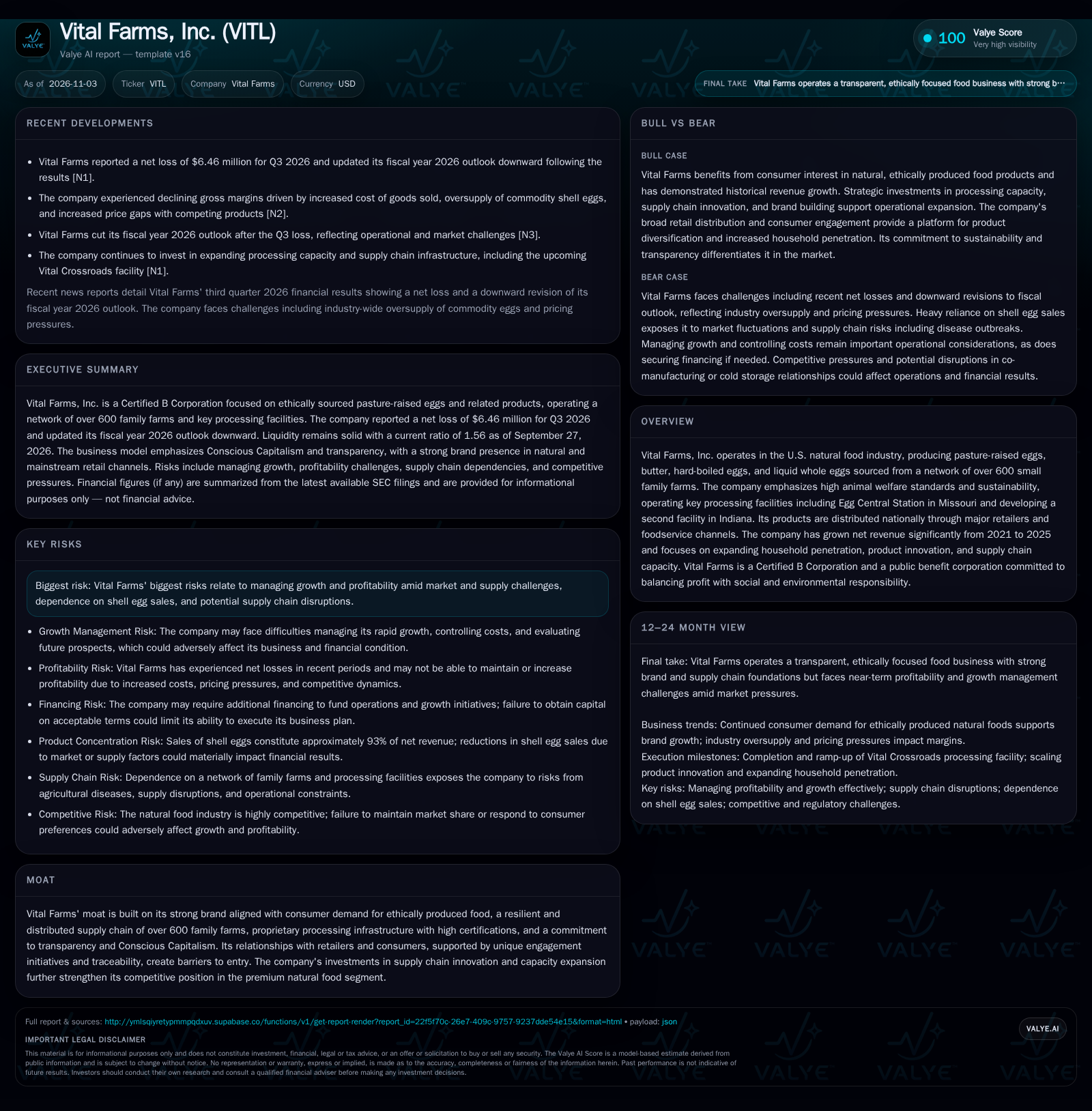
Vital Farms’ rapid revenue expansion and national retail footprint underscore its brand strength in pasture-raised eggs and related products. However, declining gross margins, a Q3 loss, and a cut fiscal year outlook reveal the strain of commodity oversupply and operational scaling. The company’s ongoing investments in processing capacity and supply chain technology are critical to reaching sustainable margins and reducing risk from its heavy reliance on shell eggs.
Vital Farms, Inc. has built a nationally recognized brand around ethical, pasture-raised eggs and related products, leveraging a distributed network of more than 600 family farms and a philosophy of Conscious Capitalism. However, after years of strong revenue growth, the company now confronts margin compression, operational losses, and the challenges of scaling its infrastructure amid a commodity egg glut and heightened competition. The next chapter for Vital Farms will be defined by its ability to translate supply chain investments into cost discipline, product innovation, and a more resilient profit model.
Margin Compression and Operational Losses Define the Near-Term Landscape
Vital Farms’ recent financial results highlight a turning point: for Q3 2026, the company posted a net loss of $6.46 million and negative EPS, driven by rising cost of goods sold and an oversupply in the commodity egg market [S2] [N2]. These pressures forced management to revise its fiscal year 2026 outlook downward [N3]. Concurrently, the company is investing heavily in processing capacity, with the Egg Central Station packing over 7.5 million eggs per day and the new Vital Crossroads facility in Indiana expected online in 2027 [S1] [N1]. Liquidity remains measurable, with $83.95 million in cash and a current ratio of 1.56 as of late September 2026 [S2], but the focus is squarely on restoring profitability and ensuring that supply chain expansion translates into margin recovery.
The Economics of Pasture-Raised Eggs: Pricing Power vs. Volume and Cost Dynamics
Vital Farms’ business is built around premium pricing for pasture-raised eggs and differentiated dairy products. However, nearly 93% of revenue still comes from shell eggs, tying economics closely to both commodity markets and consumer willingness to pay a premium for animal welfare and transparency [S2]. The company’s fixed-cost base is rising with new processing infrastructure and technology investments, while variable costs—feed, labor, logistics—are subject to agricultural volatility and inflation.
Operating leverage should, in theory, improve as new facilities scale, but only if revenue growth and pricing power keep pace with cost increases. In periods of commodity oversupply, Vital Farms faces pressure to narrow its price gap with conventional eggs to maintain volume, potentially sacrificing margins. Product innovation and mix shift (e.g., value-added eggs, butter, hard-boiled, liquid eggs) could help diversify revenue and margin structure, but the pace and profitability of this transition remain uncertain.
Capital needs are also rising, not only for physical expansion but for working capital to support a larger supply chain. The risk is that persistent losses and thin margins could eventually force the company to seek external financing, especially if margin recovery is slow.
Brand Strength Meets Intensifying Competition and Substitution Risks
Vital Farms holds a strong position in the premium egg segment, with national distribution through over 24,000 stores and a brand associated with high animal welfare and transparency [S1]. Its moat rests on consumer trust, differentiated sourcing, and proprietary processing infrastructure with industry-leading certifications. However, the broader egg and dairy market is highly competitive, with both traditional commodity producers and private-label natural brands seeking share.
Substitution risk is significant: in price-sensitive environments, consumers may trade down to cheaper eggs, particularly when the price gap widens due to commodity oversupply. Larger food conglomerates and emerging regional natural brands may also replicate animal welfare claims or undercut pricing, eroding differentiation. While Vital Farms’ traceability and consumer engagement initiatives could increase switching friction, these advantages are not insurmountable if competitors close the perception gap or if economic pressures shift consumer priorities.
The company’s network of over 600 family farms provides supply chain resilience but also introduces complexity and potential vulnerability to disease outbreaks or disruptions—a risk heightened by the concentrated reliance on shell eggs.
If Scale and Innovation Drive Margin Recovery and Broader Category Growth
A favorable scenario unfolds if Vital Farms successfully brings the new Indiana facility online as planned and leverages its expanded processing capacity to lower unit costs and improve supply chain efficiency.
Simultaneously, if product innovation (e.g., value-added egg formats, dairy extensions) accelerates and gains traction in both natural and mainstream retail, the company could reduce its dependence on commodity egg pricing and build a more resilient, higher-margin portfolio. Increased household penetration and successful brand storytelling may allow the company to maintain premium pricing even in a competitive environment.
Evidence that would confirm this scenario includes a rebound in gross margin, sustained positive operating cash flow, successful ramp of the Indiana facility, and a growing share of revenue from non-shell-egg products. Retailer expansion and increased velocities in mainstream channels would further validate the upside case.
Balancing Growth Ambitions with Margin Discipline in a Crowded Market
The most plausible path is one of continued revenue scaling, but with ongoing volatility in margins and periodic operational losses. Vital Farms is likely to maintain its leadership in the premium ethical egg segment, but commodity oversupply and aggressive competition will constrain pricing power and force periodic promotional activity.
Shell eggs will remain the dominant revenue driver for the next several years, keeping the company exposed to agricultural shocks and price cycles. Incremental product innovation and gradual mix shift will help, but are unlikely to dramatically alter the margin profile in the near term. The company’s investments in processing and technology will support long-term scalability, but fixed-cost absorption will lag if volume growth slows or supply chain disruptions occur.
Key confirming evidence would be stable or slightly improving gross margins, successful commissioning of the new facility without major cost overruns, and steady growth in non-shell-egg categories. Falsification would come from persistent negative operating margins, loss of major retail placements, or supply chain issues that impact egg availability or quality.
Oversupply, Cost Pressures, and Heavy Concentration Trigger a Profitability Squeeze
In a negative scenario, commodity egg oversupply persists, forcing Vital Farms to further lower prices or increase promotional spending to maintain shelf space and volume. If input costs (feed, labor, logistics) rise or disease outbreaks affect the farm network, gross margins could contract further.
If the new Indiana facility faces delays, cost overruns, or underutilization, the company may struggle to absorb higher fixed costs, compounding losses. Heavy reliance on shell eggs (93% of revenue) leaves the business vulnerable to even modest declines in category demand or supply chain disruptions.
Should operating losses persist, cash reserves could dwindle, increasing the need for external financing at potentially unfavorable terms. Erosion of brand premium or retailer shelf space to lower-priced or private-label competitors would further threaten the business model. Confirmation of this scenario would include continued net losses, declining cash reserves, margin erosion, and evidence of lost distribution or farm supply disruptions.
What Will Determine the Next Chapter for Vital Farms’ Value Proposition?
Gross margin trends quarter-over-quarter, especially as new processing capacity ramps and as commodity egg price volatility continues.
The pace and cost of bringing the Seymour, Indiana (Vital Crossroads) facility online, and whether it achieves targeted scale and efficiency.
Growth in revenue contribution from non-shell-egg products (e.g., butter, hard-boiled, liquid eggs), if disclosed, to test the company’s ability to diversify its mix.
Retail velocity and shelf presence in mainstream grocery chains, including any evidence of shelf space gains or losses.
Cash burn and operating cash flow metrics, particularly in light of continued infrastructure investment and potential operating losses.
Any material supply chain disruptions, such as disease outbreaks among hens or interruptions in farm network operations.
The impact of pricing and promotional activity on both volume and margin—whether the company can maintain a price premium without sacrificing share.
Management commentary or disclosures around the need for external financing, especially if margin recovery is slower than anticipated.
Disclaimer: This is research-only, informational analysis and not investment advice. It may include AI-generated interpretation and general industry context. Always verify important details using primary sources.

Comments