
Upstart’s AI Lending Model: Automation, Capital Diversity, and the Realities of Platform-Driven Credit Expansion
Upstart’s Q3 2026 results highlight the company’s distinctive AI-driven approach to consumer lending, underpinned by high automation and a diversified funding base. The challenge: translating algorithmic and operational advantages into durable growth while navigating macro, funding, and model risk.
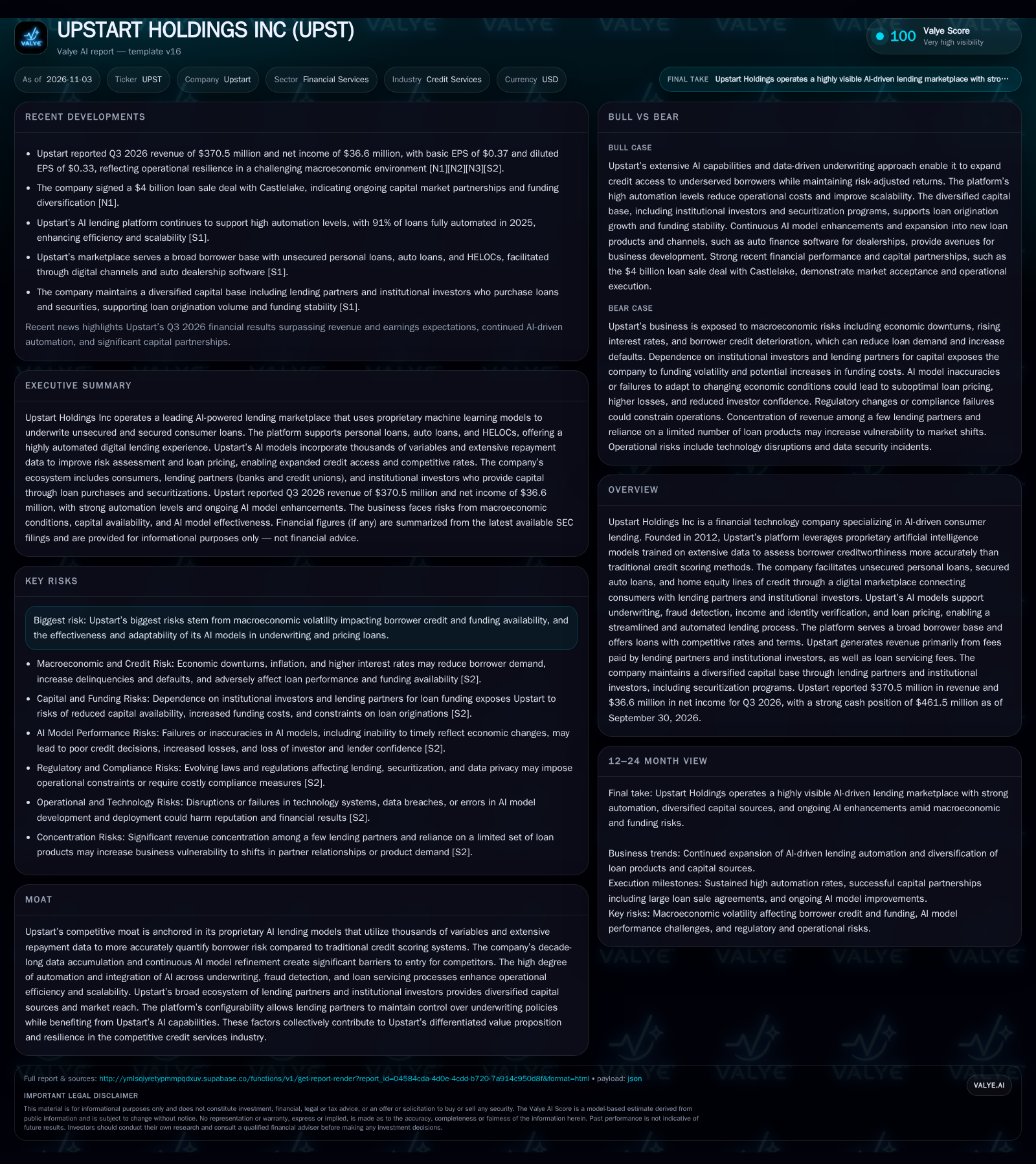
Upstart Holdings reported $370.5 million in Q3 2026 revenue and $36.6 million in net income, reflecting operational resilience amid a complex macro backdrop. The company’s AI-driven lending platform boasts 91% loan automation and a capital model reliant on both institutional investors and lending partners. While automation and model depth create efficiency and potential credit-access advantages, Upstart’s fortunes remain tightly linked to economic cycles, funding appetites, and the ongoing accuracy of its risk models. The next phase depends on sustaining model performance, expanding product breadth, and managing funding volatility. [S1] [S2]
Upstart Holdings’ Q3 2026 results frame a business at the intersection of algorithmic underwriting and marketplace lending. With $370.5 million in revenue and $36.6 million in net income, the company’s AI-first approach is delivering operational scale—91% of loans are fully automated—while its capital model relies on a blend of lending partners and institutional investors. The core question is whether Upstart’s data and automation edge can consistently deliver superior credit outcomes and platform economics as macro, funding, and regulatory headwinds evolve.
Recent Performance and Model Execution in Q3 2026
Upstart reported Q3 2026 revenue of $370.5 million and net income of $36.6 million, with basic EPS of $0.37 and diluted EPS of $0.33 [S2]. These results reflect operational resilience, especially given ongoing macroeconomic uncertainty and capital market volatility [N1] [N2] [N3]. The company’s platform remains highly automated, with 91% of loans processed end-to-end without human intervention in 2025 [S1]. This level of automation signals both a cost structure advantage and the maturity of its AI-driven underwriting engine. Upstart’s funding model is noteworthy: in 2025, institutional investors purchased 64% of loan originations, lending partners 26%, and 10% were held on balance sheet [S1]. This broad capital base supports origination volumes but also exposes the platform to shifts in institutional risk appetite. The company reported cash and liquidity metrics for the period; these figures do not by themselves establish operating runway, investment capacity, financial flexibility, or financing capacity. [S2]
How Upstart’s Platform Turns Automation and Data Into Revenue Streams
Upstart’s business model is fundamentally fee-driven: the company earns platform and referral fees from lending partners and institutional investors, as well as loan servicing fees [S1]. This structure separates Upstart from traditional balance-sheet lenders and aligns its economics with transaction volume and partner/investor activity. The core engine is the company’s proprietary AI, which uses more than 2,500 variables and nearly 104 million repayment events to optimize borrower risk assessment [S1]. This data-driven approach supports both higher conversion and the potential to serve segments underserved by legacy credit models.
Automation is critical to Upstart’s unit economics. With 91% of loans processed automatically in 2025 [S1], the company can scale origination without linear growth in headcount or operational cost, suggesting strong operating leverage if volume grows. However, the business is capital-light only to the extent that funding partners remain active; Upstart does not generally retain credit risk but does hold some loans on its own balance sheet (10% of originations in 2025), exposing it to some asset risk [S1].
Revenue mix may shift with changes in capital provider composition and product mix. The company’s fee take is influenced by the balance between marketplace (partner/investor-funded) and on-balance-sheet loans, as well as by the types of products originated (e.g., personal loans, auto, HELOCs)—each with distinct risk, duration, and fee profiles. Upstart’s ability to maintain or expand fee rates will depend on the perceived value-add of its AI underwriting versus competing platforms and traditional lenders.
Barriers, Substitutes, and the Reality of AI-Driven Lending Competition
Upstart’s moat is anchored in its proprietary AI models, which leverage a decade’s worth of repayment data and thousands of underwriting variables [S1]. This accumulated data and model refinement create barriers for new entrants, as effective credit risk modeling requires both scale and longitudinal data. High automation rates further amplify cost advantages versus legacy lenders and less mature fintechs.
However, Upstart operates in a competitive field that includes traditional banks (with legacy customer bases and funding advantages), other fintech lenders (some with significant venture backing or public capital), and emerging AI-powered platforms. Credit scoring giants and large consumer banks have the resources to develop or license advanced models, potentially eroding Upstart’s differentiation over time. Moreover, as AI tools become commoditized, the incremental value of algorithmic underwriting may diminish unless Upstart continues to innovate and expand its data edge.
Switching costs for lending partners and institutional investors may be moderate: while partners benefit from Upstart’s AI, they retain control over underwriting parameters and can theoretically migrate to alternative platforms. For borrowers, the consumer experience is largely price- and convenience-driven, with limited brand loyalty. The key strategic question is whether Upstart can maintain a sustainable data and automation edge as competitors close the technology gap.
What Would It Take for Upstart to Achieve Breakout Scale and Margin Expansion?
The favorable scenario for Upstart centers on the continued outperformance of its AI models, leading to lower default rates, improved borrower targeting, and better risk-adjusted returns for funding partners. If Upstart’s models consistently price risk more accurately than traditional or competing models, the platform could attract more lending partners and institutional capital, supporting higher origination volumes and fee revenue.
Expansion into new product verticals (such as HELOCs and auto) and deeper penetration into existing channels (notably auto dealership software) could unlock incremental growth. Sustained high automation rates would compound operating leverage, potentially driving margin expansion as revenue scales faster than costs.
Evidence that would confirm this scenario includes: (a) continued or accelerating origination growth across multiple loan categories, (b) stable or improving loss rates versus industry benchmarks, (c) rising partner/investor adoption, (d) expansion of fee margins, and (e) new product launches or channel partnerships that result in measurable volume gains.
Structural Growth, but Cyclical Exposure and Model Risk Define the Next Phase
The most plausible trajectory is that Upstart continues to grow, but at a pace shaped by macroeconomic cycles and the evolving risk appetite of institutional investors. Loan origination volumes may rise as credit demand recovers, but periodic setbacks are likely if economic conditions deteriorate or capital markets tighten. The company’s automation and AI models will likely remain a relative advantage, but competitors will also improve their digital and data capabilities.
Fee revenue should track origination volume with some sensitivity to product mix and funding source. Margins may be pressured in periods when Upstart must hold more loans on balance sheet (due to weaker investor demand), increasing capital needs and risk exposure. The company will need to continuously invest in AI/ML improvements to maintain its edge and mitigate model drift.
This scenario would be confirmed by steady (but not breakout) origination and revenue growth, relatively stable automation rates, and modest improvement in partner/investor diversification. Evidence against this case would include sharp declines in originations, significant model performance issues, or loss of key funding partners.
How Funding Shocks or Model Failures Could Disrupt the Platform
The primary risk chain for Upstart involves a sudden tightening of funding from institutional investors or lending partners, leading to a sharp drop in origination volumes. Because 64% of 2025 originations were purchased by institutional investors, any pullback could force Upstart to either slow loan growth or retain more loans on its own balance sheet—potentially increasing risk and capital usage [S1].
A second risk is model failure: if Upstart’s AI models fail to predict default risk accurately—especially during periods of economic stress—losses could rise, reducing investor confidence and partner willingness to use the platform. This would not only dampen fee revenue but could also trigger regulatory scrutiny or reputational damage.
This scenario would be confirmed by: (a) a sudden decline in loan originations, (b) an increase in loans held on balance sheet, (c) a spike in realized loan losses, or (d) publicized partner/investor defections. Evidence against this scenario would include stable funding flows and robust model performance even during macro volatility.
Milestones That Will Test Whether Upstart’s AI Edge Is Durable
Originations volume by product category and funding channel—trends in personal, auto, and HELOC loans, as well as the share funded by institutional investors versus lending partners, will illuminate demand and capital depth.
Default and loss rates on loans originated through Upstart’s platform—especially compared to industry benchmarks—would help evaluate the real-world effectiveness of the company’s AI models.
Automation rate (% of loans fully automated)—sustaining or improving on the 91% level would signal continued operational efficiency and model maturity.
Fee margin per loan or per dollar originated—a useful metric would be the trend in average platform and referral fee rates, which would reflect pricing power and platform value-add.
Partner and investor concentration—changes in the number and diversity of funding partners and institutional investors would signal platform resilience (or vulnerability) to shifts in capital supply.
Loans held on Upstart’s balance sheet as a proportion of originations—an increase could indicate funding stress or changing capital strategy.
Evidence of regulatory or compliance challenges, such as new investigations, settlements, or restrictions, would help test exposure to non-market risks.
Pace and impact of new AI model deployments—disclosed evidence of meaningful model upgrades, and their effect on risk, approval rates, and partner adoption, would support the thesis of sustained innovation.
Disclaimer: This is research-only, informational analysis and not investment advice. It may include AI-generated interpretation and general industry context. Always verify important details using primary sources.

Comments