
Shopify’s Subscription Engine: Profit Momentum and the Next Phase of Platform Economics
Shopify’s Q3 2026 results highlight surging profitability and reported liquidity position, but the next leg of value creation likely depends on deepening merchant integration, expanding higher-value solutions, and maintaining a defensible platform advantage as e-commerce competition intensifies.
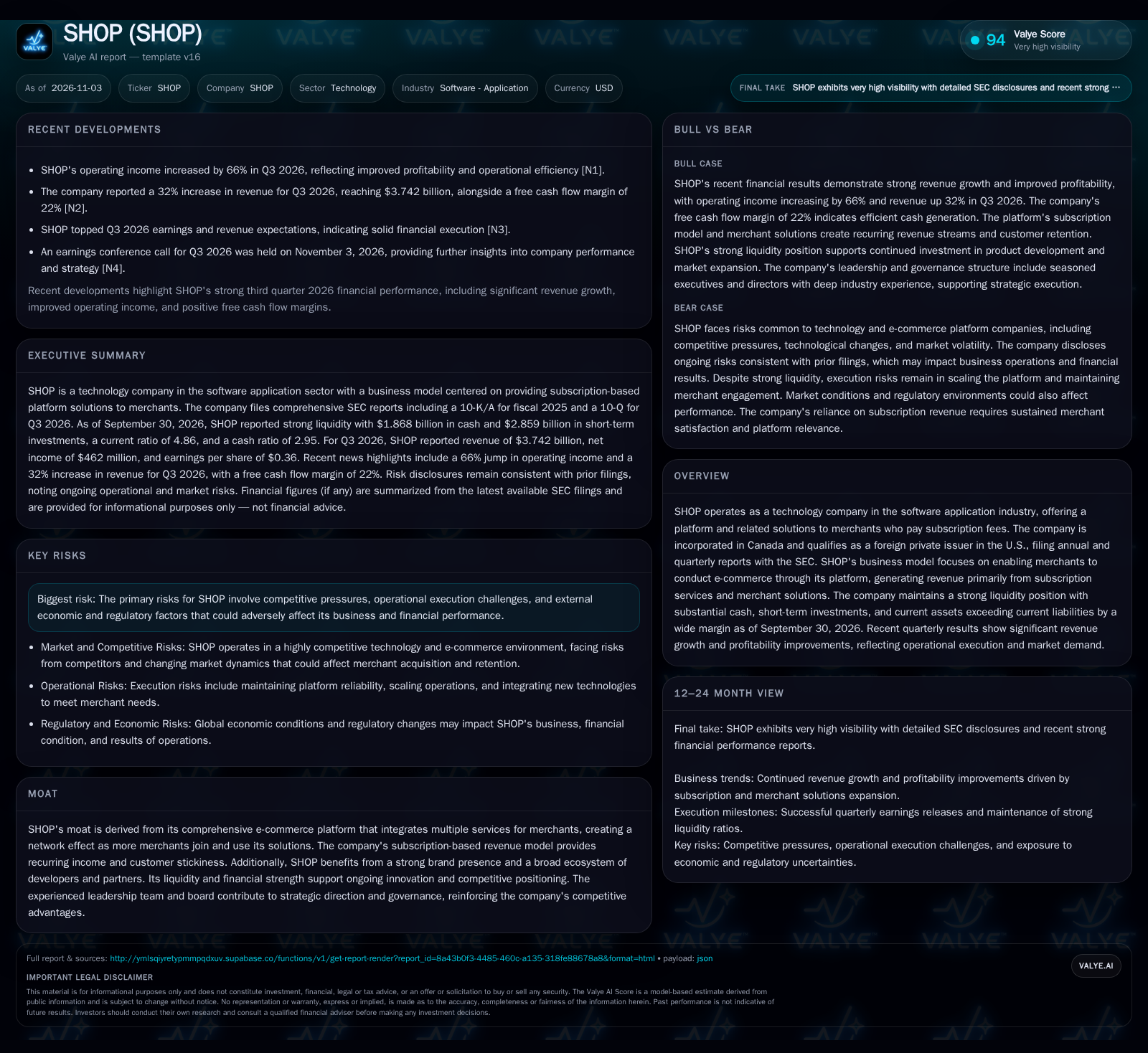
Shopify reported a 32% year-over-year revenue increase and a 66% jump in operating income for Q3 2026, with a free cash flow margin of 22% and $4.7 billion in liquid assets. These results underscore the strength of its subscription-driven platform model. The business now faces the challenge of sustaining growth and margin expansion amid evolving competitive, technological, and regulatory pressures.
Shopify’s latest quarterly results mark a critical inflection for the platform—demonstrating not only strong top-line growth but also a significant surge in operating profitability and cash generation. With $3.742 billion in Q3 revenue, a 32% year-over-year increase, and operating income up 66%, Shopify’s core subscription-plus-merchant-solutions model is firing on all cylinders. The company’s future will likely be shaped by its ability to expand its value proposition for merchants, defend its ecosystem, and navigate an increasingly crowded and innovative e-commerce landscape.
Recent Results Signal a Step-Change in Profitability and potential Financial Flexibility
Shopify reported Q3 2026 revenue of $3.742 billion, representing a 32% jump year-over-year, and net income of $462 million, with earnings per share of $0.36 [S2] [N3]. Operating income grew by 66% in the quarter, and the company delivered a free cash flow margin of 22% [N3]. Shopify’s liquidity was reported at $1.868 billion in cash and $2.859 billion in short-term investments as of September 30, 2026, resulting in a current ratio of 4.86 and a cash ratio of 2.95 [S2]. The company reported cash and liquidity metrics for the period; these figures do not by themselves establish operating runway, investment capacity, financial flexibility, or financing capacity.
How Shopify Converts Merchant Adoption into Profitable Growth
Shopify’s core economics are driven by a dual-revenue engine: recurring subscription fees from merchants using its e-commerce platform and transaction-based merchant solutions layered on top. Subscription revenue tends to be highly predictable, given the monthly or annual contract structure, while merchant solutions (such as payment processing, shipping, and capital advances) scale with the gross merchandise volume (GMV) flowing through the platform. The Q3 surge in operating income and free cash flow margin suggests that fixed platform costs are being leveraged over a growing merchant base and rising transaction volumes, driving operating leverage.
Sustained margin improvement likely depends on a favorable mix shift—either through higher-value merchant solutions with superior unit economics or by upselling larger merchants to premium subscription tiers. While Shopify’s capital needs for the core business are modest compared to hardware-centric or inventory-heavy models, ongoing investment is necessary for R&D, ecosystem support, and international expansion.
A critical driver behind Shopify’s profitable growth is the scalability of its technology infrastructure, which allows incremental merchant additions and transaction volumes to expand revenue without a proportionate increase in fixed costs. This dynamic creates operating leverage that can accelerate margin expansion as the platform grows. However, sustaining this leverage depends on maintaining high system uptime, security, and performance standards, especially as transaction complexity and merchant requirements evolve. Investments in cloud infrastructure, data analytics, and AI-driven personalization tools can further enhance merchant experience and operational efficiency, but these require careful capital allocation to balance near-term profitability with long-term platform resilience.
Defending the Ecosystem: Platform Advantage and Competitive Pressures
Shopify’s value proposition rests on an integrated, extensible platform that lowers barriers for merchants to launch, scale, and operate online businesses. This ecosystem includes not only the core platform but also a broad array of third-party apps, developer tools, and merchant services. The resulting network effects make it incrementally harder for merchants to switch once embedded, and a large installed base attracts more partners and integrations.
However, competitive threats are real and evolving. Large enterprise software vendors, payment processors, and niche vertical SaaS providers are each targeting overlapping segments of the commerce stack. Technology substitution—such as direct-to-consumer platforms, headless commerce, or embedded commerce solutions—could erode Shopify’s stickiness if merchants perceive greater value or flexibility elsewhere. The challenge is to continually enhance platform depth, merchant ROI, and ecosystem defensibility to avoid commoditization and margin pressure.
The platform’s defensibility also hinges on the breadth and depth of its ecosystem partnerships, which can create multi-layered switching costs for merchants. A diverse and vibrant third-party developer community not only enriches the platform’s functionality but also fosters innovation that Shopify alone might not rapidly develop. However, this ecosystem must be managed to avoid fragmentation or quality dilution that could undermine merchant confidence. Strategic curation of partners, transparent developer policies, and support for seamless integration are essential to maintaining a cohesive user experience. Additionally, Shopify must anticipate and adapt to shifts in merchant preferences, such as increasing demand for headless commerce architectures or embedded AI capabilities, to stay ahead of technology substitution risks.
Platform Expansion and Merchant Value-Add Unlock the Next Growth S-Curve
The bull case for Shopify is that its recent profitability surge is just the beginning of a new multi-year expansion phase. If the company can successfully deepen its integration of merchant solutions—such as embedded financial services, omnichannel retail capabilities, and advanced analytics—average revenue per merchant could rise substantially. Expanding into new international markets and upmarket with larger enterprise merchants would further increase addressable volume and stickiness.
Confirmation of this scenario would include continued acceleration in subscription and merchant solutions revenue, rising ARPU, and sustained or expanding free cash flow margins. Additional evidence would be the launch and visible adoption of new high-value services, deeper partner ecosystem engagement, and a growing share of larger, more complex merchants on the platform. Falsification would occur if revenue growth decelerates materially, merchant churn rises, or new solutions fail to gain traction.
Expanding merchant value-add solutions can create a virtuous cycle where enhanced platform capabilities attract higher-value merchants, who in turn generate more data and transaction volume to refine offerings further. For instance, embedding financial services like lending or insurance tailored to merchant cash flows could unlock new revenue streams with attractive unit economics. Similarly, advanced analytics and AI-powered insights could help merchants optimize inventory, pricing, and marketing spend, increasing their lifetime value on the platform. However, realizing this potential requires overcoming integration complexities, regulatory compliance challenges, and ensuring that new services deliver clear and measurable ROI to merchants to justify additional spend within their budgets.
Sustained Growth with Moderating Margins as Competitive Dynamics Intensify
The most plausible near-term outcome for Shopify is continued double-digit revenue growth, but with operating margins stabilizing as the company faces more intense competition and incremental investments in product and merchant support. The core subscription business remains a reliable anchor, but merchant solutions revenue may become more sensitive to shifts in e-commerce volumes, pricing pressure, or regulatory changes affecting payments and logistics.
Supporting evidence would include steady merchant count growth, resilient subscription renewal rates (if disclosed), and continued reported liquidity position. However, margin expansion could be limited by rising customer acquisition costs, the need to subsidize new capabilities, or competitive discounts. A plateau or decline in operating leverage, or a shift in mix toward lower-margin solutions, would signal this scenario is playing out.
As competitive dynamics intensify, Shopify may need to balance margin preservation with strategic investments in customer acquisition and retention. This could manifest as increased marketing spend, promotional pricing, or enhanced customer support services to maintain merchant loyalty. While such initiatives may compress margins temporarily, they could be necessary to defend market share against emerging entrants or incumbents expanding their commerce offerings. Moreover, regulatory developments affecting payments, data privacy, or cross-border commerce could introduce compliance costs or operational constraints, influencing the pace and cost structure of growth. Monitoring these factors will be critical to assessing whether operating margins stabilize or erode over time.
Competitive Disruption and Platform Fatigue Erode Growth and Profitability
A credible downside scenario is that Shopify’s merchant base becomes more transient or price-sensitive, with switching costs eroding as alternative commerce platforms or embedded solutions mature. If competitors innovate faster—offering better integration, lower total cost of ownership, or more tailored vertical solutions—Shopify could see merchant churn rise, ARPU stagnate, and margins compress.
This scenario would be confirmed by a slowdown or reversal in merchant count, flat or declining revenue per merchant, and compression of free cash flow margins. Early warning signs include increased promotional activity, negative merchant sentiment, or announcements of major customer defections. If the platform’s ecosystem becomes less differentiated, the risk of commoditization and profit squeeze rises.
What Will Determine Shopify’s Next Chapter in Platform Economics?
Merchant count growth and retention rates—if disclosed—would clarify whether platform adoption remains robust or is hitting saturation.
Average revenue per merchant (ARPU) trends would reveal the success of upselling higher-value solutions and extracting incremental value from the installed base.
Gross merchandise volume (GMV) growth and the share of GMV processed through Shopify Payments would indicate the health of transaction-driven merchant solutions.
The mix and adoption rate of new merchant solutions (e.g., financial services, logistics, analytics) would help test the durability of margin expansion.
Customer acquisition cost (CAC) and payback period—if disclosed—would offer insight into the efficiency and scalability of Shopify’s go-to-market strategy.
International revenue growth versus domestic would reveal progress in geographic expansion and risk diversification.
Ecosystem engagement metrics, such as third-party developer activity or app downloads, would signal platform vibrancy and network effect strength.
Announcements or evidence of significant competitive wins or losses, particularly with large or high-profile merchants, would frame the evolving competitive landscape.
Disclaimer: This is research-only, informational analysis and not investment advice. It may include AI-generated interpretation and general industry context. Always verify important details using primary sources.

Comments