
Peoples Bancorp of North Carolina: Loan Growth, Margin Dynamics, and the Realities of Community Banking Scale
Peoples Bancorp leverages steady local loan growth and disciplined cost management to expand net interest margins, but its performance remains highly sensitive to regional economic cycles and evolving competition from larger financial institutions.
Peoples Bancorp of North Carolina has delivered rising net interest income and loan balances through Q3 2026, supported by lower funding costs and a disciplined community-banking focus. While recent results showcase margin expansion and capital return, the company’s outlook is closely tied to interest rate cycles, local economic resilience, and its ability to maintain asset quality amid increasing competition.
Peoples Bancorp of North Carolina continues to demonstrate the operating leverage possible in a well-run community bank model. Through Q3 2026, the company has capitalized on regional loan demand, disciplined deposit cost management, and a focused local-market approach to deliver steady net income growth and expanding margins. However, its fortunes remain closely linked to local economic cycles and the shifting competitive landscape, raising questions about the durability of its current momentum as macro and regulatory conditions evolve.
Recent Performance Anchored by Loan Expansion and Margin Improvement
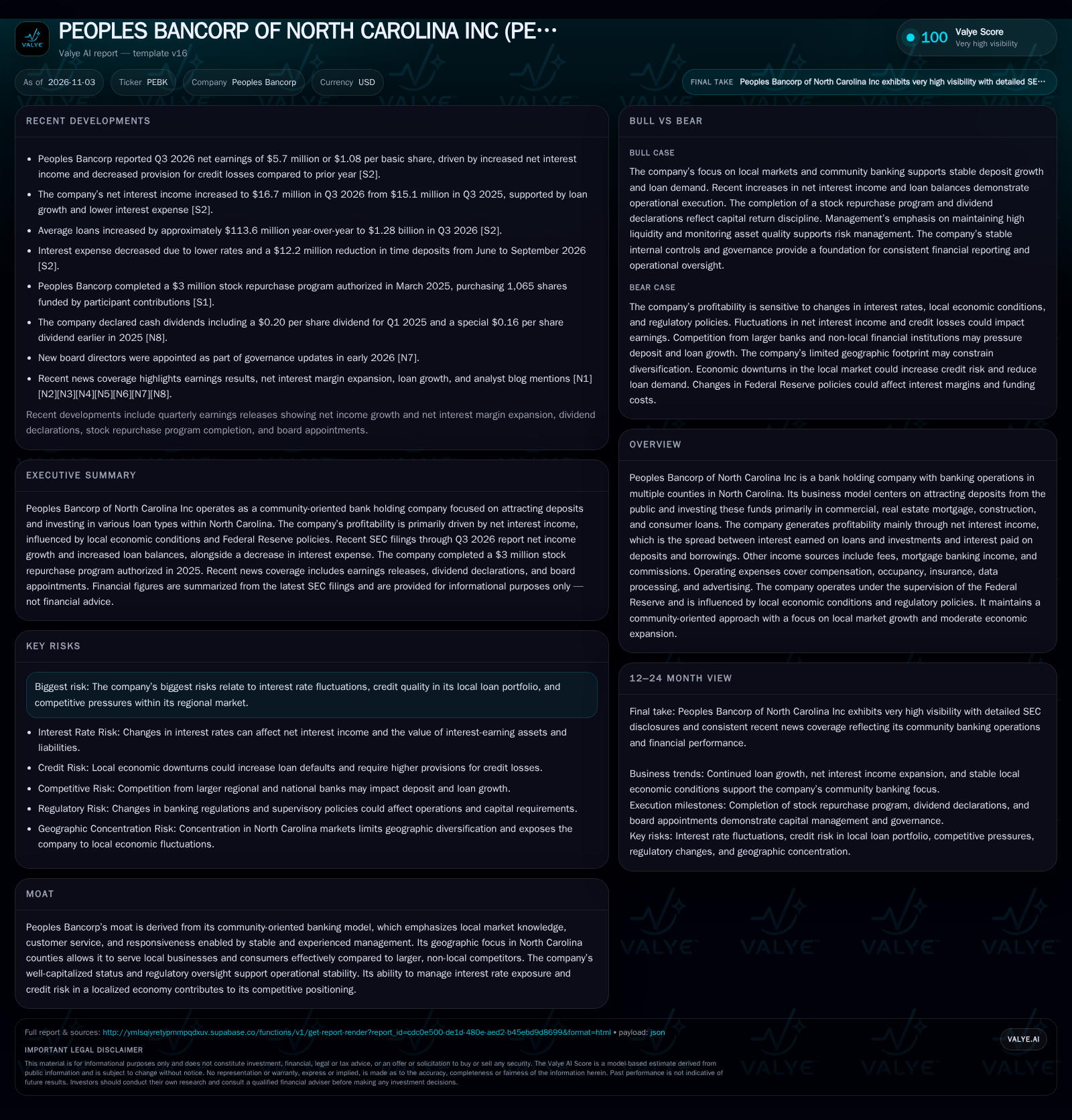
For the quarter ended September 30, 2026, Peoples Bancorp reported net income of $5.7 million, translating to $1.08 per basic share and $1.05 diluted. This marks an improvement over prior-year results, underpinned by a rise in net interest income to $16.7 million from $15.1 million a year earlier. The primary driver was an increase in average loans to $1.28 billion, up roughly $113.6 million year-over-year, while average investment securities declined slightly [S2].
Notably, interest expense decreased as time deposits fell by $12.2 million between June and September 2026, reflecting both lower rates and a shift in funding mix. The company also completed a $3 million stock repurchase program and reported $57.15 million in cash and equivalents as of quarter-end [S1] [S2]. These developments highlight a period of strong core banking performance, capital discipline, and liquidity management, but also reinforce the company’s exposure to local loan demand and funding cost dynamics.
How the Community Bank Model Drives Profitability—and Its Limits
Peoples Bancorp’s business model centers on attracting retail and commercial deposits, then recycling those funds into loans—primarily commercial, real estate, construction, and consumer credits. Net interest income, the spread between interest earned on these loans and investments versus interest paid on deposits and borrowings, is the core profit engine. Fee income from mortgage banking, deposit services, and investment product commissions provides some diversification, but remains a minority of revenue [S2].
The fixed cost base—comprising compensation, occupancy, data processing, and insurance—means operating leverage is achieved if loan volumes and spreads rise faster than expenses. The company’s recent net interest income expansion suggests it has benefited from both loan growth and reduced funding costs, likely due to disciplined deposit pricing and a favorable local rate environment. However, this model is inherently exposed to rate cycles: rising deposit costs or flat/inverted yield curves can quickly compress margins. Capital needs are moderate compared to larger banks, but asset growth or regulatory changes could require further capital raises or reinvestment. Asset quality and provisioning also play a critical role in net returns, especially in a concentrated regional portfolio.
Local Market Focus: Relationship Edge or Scale Disadvantage?
Peoples Bancorp’s competitive strength lies in its community-oriented approach—local knowledge, tailored service, and established relationships in North Carolina counties such as Catawba, Lincoln, and Mecklenburg. This can translate into stickier deposits, better credit underwriting, and responsiveness compared to larger, non-local competitors [S2].
However, this geographic concentration is a double-edged sword. The company faces competition from large regional and national banks that can offer broader product sets, digital convenience, and more aggressive pricing. Non-bank lenders and fintech platforms also represent a growing source of competition, particularly in consumer and small business lending. Peoples Bancorp’s moat is thus best characterized as localized and relationship-driven, but vulnerable to share loss if customer preferences shift or if larger players intensify their focus on these markets. The lack of diversification also heightens exposure to regional economic shocks.
What Sustained Loan Growth and Stable Funding Could Unlock
If local economic conditions remain healthy and Peoples Bancorp continues to grow its loan book at recent rates, while maintaining or further lowering funding costs, net interest income could expand further. This would drive higher returns on equity and assets, reinforcing capital strength and potentially enabling additional capital returns (dividends or buybacks) [S2].
Confirmation of this scenario would come from continued year-over-year loan growth, stable or improving net interest margin, low credit losses, and steady deposit inflows—especially if accompanied by further reductions in time deposits or a successful shift toward lower-cost transaction accounts. Additional evidence would include a stable efficiency ratio and minimal increases in nonperforming assets or charge-offs. Conversely, a slowdown in loan origination, a spike in deposit costs, or rising credit losses would challenge this thesis.
Likely Trajectory: Incremental Gains Amid Structural Constraints
The most plausible outlook is for incremental growth in loans and net interest income, but at a slower pace than recent quarters as the local economy normalizes and competition for both loans and deposits intensifies. Net interest margin could remain stable or compress modestly if funding costs begin to rise or if loan yields face pressure from competitors.
Earnings are likely to track moderate asset growth and disciplined expense control, but further upside may be capped without geographic or product diversification. Asset quality is likely to remain solid barring a local downturn, but any uptick in nonperforming loans would require higher provisions, impacting margins. Confirmation would be steady quarterly earnings, stable or slightly rising efficiency ratios, and no dramatic moves in asset quality metrics. Signs to the contrary would include a reversal in loan growth, margin compression, or material increases in credit costs.
How Local Shocks or Rate Volatility Could Erode Profitability
A significant local economic downturn—such as a recession in North Carolina’s key counties—could lead to higher delinquencies, rising charge-offs, and weaker loan demand. Simultaneously, if interest rates were to rise sharply, deposit costs could outpace loan repricing, compressing net interest margins. In this scenario, Peoples Bancorp’s concentrated loan book and deposit base would amplify earnings volatility.
Early warning signs would include a spike in nonperforming assets, an increase in provision for credit losses, a sudden rise in deposit betas (cost sensitivity to market rates), or a drop in core deposit balances. Further evidence would be a decline in net interest income or margin, and a deterioration in return on assets or equity. This scenario would be exacerbated if larger competitors aggressively target the company’s markets or if regulatory changes impose new capital or liquidity constraints.
Benchmarks That Will Clarify Peoples Bancorp’s Resilience and Opportunity Set
Quarterly loan growth rates by segment (commercial, real estate, consumer) would help test whether demand is broad-based or concentrated; a useful metric would be disclosed loan origination and paydown trends.
Net interest margin (NIM) evolution, especially relative to peer community banks and regional players.
Deposit mix changes—particularly the proportion of non-interest-bearing versus time deposits—as a signal of funding cost dynamics.
Provision for credit losses and nonperforming asset ratios, to monitor emerging credit risk.
Efficiency ratio trends (noninterest expense as a percentage of revenue) to assess operating leverage and cost control.
Quarterly updates on share repurchases or dividend declarations, indicating capital management flexibility.
Any disclosed changes in local economic indicators—such as unemployment rates or commercial real estate activity—in core markets.
Disclaimer: This is research-only, informational analysis and not investment advice. It may include AI-generated interpretation and general industry context. Always verify important details using primary sources.

Comments