
Enpro Inc.: Strategic Diversification, Capital Discipline, and the Realities of Industrial Cycle Exposure
Enpro’s recent acquisition-led expansion, robust capital structure, and strong Q3 2026 outperformance highlight a business actively navigating the complexities of diversified industrial markets. The company’s ability to integrate new assets, manage leverage, and sustain operational improvements will determine whether it can translate current momentum into durable shareholder value.
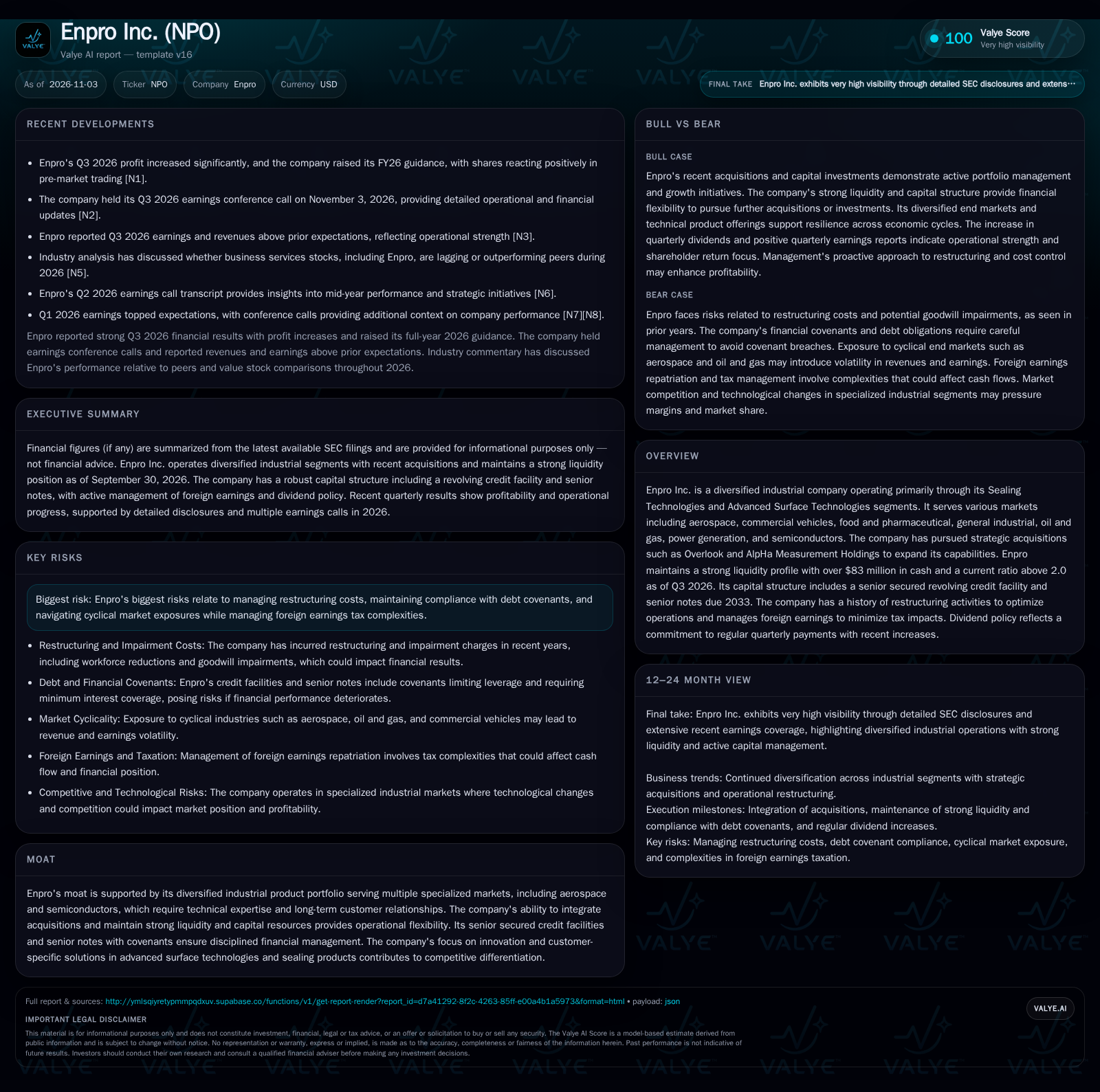
Enpro Inc. delivered above-expectation Q3 2026 earnings and raised FY26 guidance, reflecting operational momentum after recent acquisitions and capital investments. The next phase will test Enpro’s ability to integrate new businesses, maintain compliance with debt covenants, and manage through industrial cyclicality. [S1] [S2] [N1] [N3]
Enpro Inc. stands at a pivotal juncture, having capitalized on both acquisition-led growth and a disciplined approach to capital management in the face of industrial market volatility. The company’s Q3 2026 outperformance and raised forward guidance underscore operational momentum, but the durability of this trajectory will hinge on successful integration of new businesses, prudent leverage management, and resilience against cyclical downturns.
Recent Acquisitions and Earnings Beat: What’s Changed for Enpro’s Outlook?
Enpro Inc. reported Q3 2026 net income of $40.3 million, with both earnings and revenues surpassing prior expectations—a performance that triggered a positive pre-market share response and led management to raise full-year 2026 guidance [N1] [N3] [S2]. This momentum follows the completion of two strategic acquisitions in 2025 (Overlook and AlpHa Measurement Holdings), in which Enpro invested approximately $273.9 million. These moves signal a deliberate portfolio expansion and an intent to deepen technical capabilities across its Sealing Technologies and Advanced Surface Technologies segments [S1]. The company also increased its quarterly dividend to $0.32 per share starting March 2026, reflecting a willingness to return capital to shareholders amid operational gains [S1].
On the balance sheet, Enpro reported $83.4 million in cash and a current ratio of 2.12 as of September 30, 2026, while refinancing a portion of its debt by issuing $450 million in new senior notes due 2033 and redeeming $350 million of earlier notes [S2] [S1]. These actions collectively reshape Enpro’s near-term risk profile: the company is better positioned for growth and has extended its debt maturity, but it now faces heightened integration and operational execution challenges.
How Enpro Makes Money: Diversification, Margin Pressures, and Capital Requirements
Enpro generates revenue from engineered products and solutions for demanding environments, with the Sealing Technologies and Advanced Surface Technologies segments serving end markets such as aerospace, semiconductors, pharma, and oil & gas. Historically, such segments capture value through technical differentiation, reliability, and long-term customer relationships—often with custom or application-specific products that can command premium pricing if performance is critical.
The company’s business model tends to blend higher fixed costs (manufacturing, R&D, compliance, and technical sales) with a variable cost base linked to materials and labor. Operating leverage can be significant: incremental volume growth in established facilities may drive outsized margin expansion, but downturns in cyclical end markets can quickly erode profits. Capital needs are ongoing, as evidenced by $42 million in property, plant, and equipment investments in 2025, and further amplified by acquisition outlays [S1].
The company reported cash and liquidity metrics for the period; these figures do not by themselves establish operating runway, investment capacity, financial flexibility, or financing capacity. The cited source reports dividend-related activity; that disclosure alone does not establish dividend-policy continuity, management confidence, or a material constraint on capital flexibility.
Defensible Niches or Vulnerable Segments? Analyzing Enpro’s Position in Industrial Supply Chains
Enpro’s competitive strength stems from its specialization in high-performance sealing and advanced surface technologies—markets where technical expertise, engineered customization, and reliability could increase switching costs for customers in regulated or mission-critical industries. For example, aerospace and semiconductor clients often require rigorous qualification and long-term supplier relationships, which can defend pricing and margins.
However, competition in these segments is intense and includes both diversified industrial peers and specialized technology providers. Barriers to entry include technical certifications, longstanding customer relationships, and manufacturing know-how—but price competition, technological substitution (e.g., new materials or sealing alternatives), and changing procurement strategies by large OEMs remain persistent threats. The company’s acquisition strategy may offer scale and portfolio breadth, but also exposes Enpro to integration risk and potential dilution of niche advantages if not executed carefully.
The real question is whether Enpro’s recent moves have deepened its moat or simply increased complexity and exposure to industry cycles. Evidence of durable advantages would include rising customer retention, premium pricing, and recurring revenue streams—metrics not currently disclosed.
Integration Success and End-Market Expansion Drive Sustained Outperformance
In a favorable scenario, Enpro’s acquisitions of Overlook and AlpHa Measurement Holdings are integrated smoothly, yielding new cross-selling opportunities, higher technical differentiation, and improved operating margins. If the company leverages its larger scale to negotiate better procurement terms, optimize manufacturing footprints, and expand into higher-growth end markets (such as semiconductors or advanced pharma), revenue growth could accelerate beyond current projections.
Confirmation of this scenario would come from sequential improvements in segment margins, sustained outperformance versus industrial peers, and management commentary highlighting successful integration milestones and customer wins in strategic markets.
Falsification would be evident if acquisition synergies fail to materialize, integration costs outpace expectations, or if revenue growth in new segments disappoints relative to the company’s guidance.
Prudent Growth Amid Cyclical Exposure and Ongoing Restructuring
The most plausible outcome is that Enpro delivers steady—but not dramatic—growth, with performance closely tracking the health of its core end markets. The company continues to manage its balance sheet conservatively, maintaining compliance with leverage and interest coverage covenants, and incrementally integrates its new businesses while incurring manageable restructuring and integration costs.
Revenue and margins would show moderate improvement, aided by portfolio diversification and some operational efficiencies, but cyclicality in aerospace, oil & gas, and general industrial demand would cap upside.
Evidence for this scenario would include stable current ratios, modest quarterly earnings growth, and ongoing commentary about operational discipline and cost controls. A deviation from this path would be signaled by unexpected margin compression, missed synergy targets, or a breach of debt covenants.
Cyclical Downturns and Integration Missteps Threaten Financial Stability
In a negative scenario, one or more of Enpro’s major end markets—such as aerospace or oil & gas—enter a cyclical downturn, leading to sharp revenue contraction and underutilized manufacturing assets. If this coincides with unexpected challenges in integrating recent acquisitions, restructuring costs could spike, and operational disruptions could erode profitability.
Should cash flow decline materially, Enpro could face pressure to draw on its revolving credit facility, testing leverage covenants and potentially triggering more restrictive financing terms. Dividend growth would halt or reverse, and management could be forced to curtail investment in innovation or further acquisitions, impairing long-term competitiveness.
Confirmation of this scenario would include negative earnings surprises, covenant warnings, or a material decline in liquidity ratios. Conversely, resilience in margins and cash flow despite a downturn would refute the most severe downside fears.
Signals That Will Determine Whether Enpro’s Multi-Segment Strategy Can Deliver Consistent Value
Quarterly segment revenue and margin trends, especially in newly acquired business lines, to test whether integration is yielding the intended financial benefits.
Disclosure of customer retention rates or recurring revenue streams, if provided, to evaluate the depth and stickiness of Enpro’s relationships in critical end markets.
Progress updates on synergy realization from the Overlook and AlpHa acquisitions, including cost savings and cross-selling achievements.
Quarterly compliance with leverage and interest coverage covenants, as breaches would indicate stress under the current capital structure.
Restructuring and impairment charges, particularly whether one-time costs remain contained or escalate beyond initial estimates.
Capital expenditure levels and R&D investment trends, as sustained investment is required to protect technical differentiation and future growth opportunities.
Management commentary on end-market demand conditions, especially in the most cyclical segments, to assess real-time exposure to macroeconomic shifts.
Disclaimer: This is research-only, informational analysis and not investment advice. It may include AI-generated interpretation and general industry context. Always verify important details using primary sources.

Comments