
Marzetti’s Specialty Foods Platform: Margin Expansion, Portfolio Leverage, and the Challenge of Scaling Innovation
Recent margin gains and a disciplined acquisition strategy highlight Marzetti’s ability to drive operational improvement in a mature U.S. specialty food market. The company’s focus on optimization, product innovation, and selective M&A positions it for continued profit growth—but integration, cost inflation, and evolving consumer tastes remain persistent hurdles.
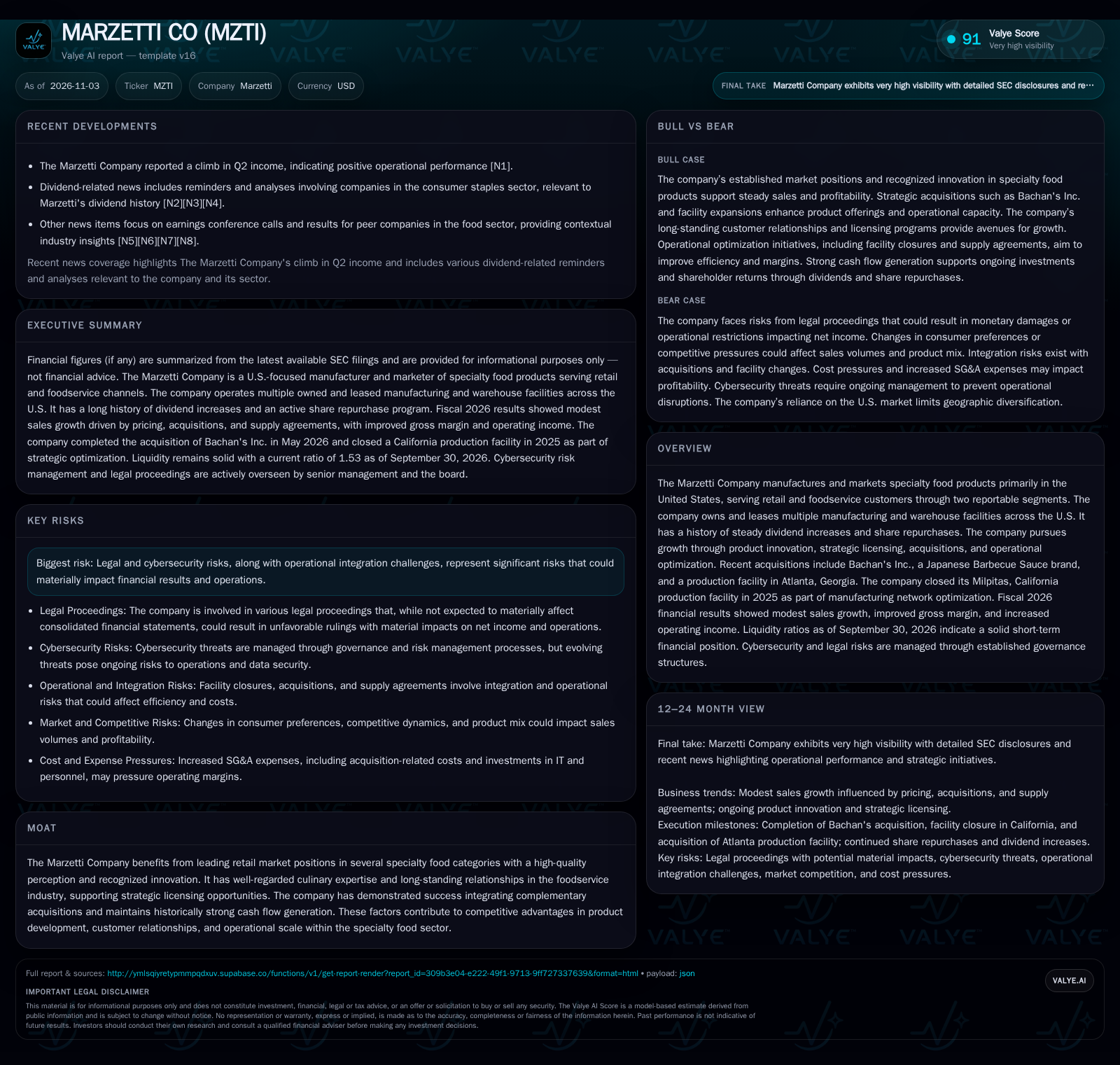
Marzetti Company reported a 1.1% sales increase to $1.93 billion for fiscal 2026, driven by higher pricing, the Bachan’s acquisition, and a temporary supply agreement. Gross margin improved to 24.7%, and operating income rose 8.3% despite a 10.6% increase in SG&A expenses. The company continues to optimize its manufacturing network and pursue targeted M&A, but faces integration and legal risks as well as cost and competitive pressures. Its long history of dividend growth and share repurchases underscores a stable capital allocation approach. Near-term performance will hinge on successful integration, sustained innovation, and the ability to manage input costs and legal exposures. [S1] [S2]
Marzetti Company’s 2026 results reflect a specialty food manufacturer navigating the classic tension between operational discipline, incremental growth, and the integration risks inherent to a mature U.S. market. Recent improvements in gross and operating margins, despite rising SG&A, highlight the company’s ability to capture value through pricing, supply agreements, and targeted acquisitions—most notably the addition of Bachan’s Inc. and a new Atlanta facility. However, the cost of integration, ongoing legal exposures, and the need for sustained innovation present tangible challenges. The next phase will test whether Marzetti can translate its platform advantages and optimization efforts into durable profit growth amid shifting consumer and competitive dynamics.
Margin Gains and Portfolio Actions Define Marzetti’s Recent Performance
For the fiscal year ended June 30, 2026, Marzetti reported consolidated net sales of $1.93 billion—a 1.1% increase over the prior year—driven by higher pricing, the acquisition of Bachan’s Inc. in May 2026, and incremental sales from a temporary supply agreement. Gross profit rose 4.7% to $477.3 million, with gross margin expanding to 24.7% from 23.9%. Operating income increased 8.3% to $238.7 million, reflecting improved operational leverage or favorable mix, even as selling, general, and administrative (SG&A) expenses climbed 10.6% to $254.6 million, largely due to acquisition-related costs and investments in IT and personnel. [S1]
The company completed two notable portfolio moves: acquiring Bachan’s, a Japanese Barbecue Sauce brand, and a sauce and dressing facility in the Atlanta area; simultaneously, it closed its Milpitas, CA plant in August 2025 as part of network optimization. [S2]
Marzetti’s 63-year history of increasing dividends and ongoing share repurchases (131,661 shares in Q4 2026; 823,584 shares authorized) further underscores a disciplined capital allocation policy. [S1]
How Marzetti’s Operating Model Translates Volume and Mix into Profits
Marzetti’s economic engine is built on the sale of branded and private-label specialty food products—primarily dressings, sauces, and related items—through both retail and foodservice channels. The company’s two reportable segments allow it to serve both high-volume, price-sensitive institutional buyers and higher-margin, brand-driven retail customers. Pricing power in specialty categories, especially for premium and ethnic sauces, can support gross margin expansion if product innovation resonates with consumers.
Recent results suggest that higher pricing and incremental sales from both the Bachan’s acquisition and a supply agreement contributed to top-line growth, while the gross margin improvement points to either a favorable shift in mix (toward higher-margin products) or operational gains from network optimization. However, the 10.6% rise in SG&A—driven by acquisition integration and IT/personnel investments—highlights the semi-fixed cost structure and the upfront costs required to scale new brands or modernize operations.
Fixed costs are substantial given Marzetti’s network of owned and leased facilities, but plant closures and acquisitions suggest a focus on asset utilization and scale. Operating leverage is evident in the 8.3% operating income growth outpacing sales, but further margin gains may require either sustained volume growth or continued mix/pricing improvement. Capital needs center on facility upgrades, M&A, and potential technology investments to maintain production efficiency and regulatory compliance.
Specialty Food Dynamics: Marzetti’s Defensible Niches and the Pressures of Scale
Marzetti’s strength lies in its leading positions within select specialty food categories, underpinned by a reputation for quality, culinary innovation, and long-standing relationships in the foodservice channel. The acquisition of Bachan’s—a differentiated, premium Asian-inspired sauce brand—demonstrates a willingness to add on-trend, high-growth brands to its portfolio, potentially capturing new consumer segments.
However, the U.S. specialty food market is intensely competitive, with peers ranging from multinational consumer packaged goods (CPG) conglomerates to agile emerging brands and private-label manufacturers. Barriers to entry in specialty categories can be moderate, but scale advantages in procurement, distribution, and marketing remain critical for cost control and shelf presence. Marzetti’s operational scale, broad customer relationships, and history of integrating acquisitions offer some moat-like features, but the risk of consumer preference shifts and private-label encroachment is ever-present.
Technology substitution is less of a direct threat in food than in digital categories, but rapid shifts in dietary trends (e.g., plant-based, clean label, ethnic flavors) mean that Marzetti must continually innovate and refresh its portfolio to maintain relevance.
If Integration and Innovation Unlock Margin Expansion
A favorable scenario emerges if Marzetti successfully integrates Bachan’s and the Atlanta facility, capturing targeted cost synergies and leveraging its distribution muscle to scale acquired brands. Should pricing discipline persist and input cost inflation moderate, gross margins could further expand, especially if new product launches or licensing deals unlock incremental volume in higher-margin specialty segments.
Evidence that would confirm this scenario includes sustained or accelerating gross and operating margin improvement, above-industry sales growth in acquired or newly launched brands, and a flattening or decline in SG&A as a percentage of sales as integration costs subside.
Portfolio Optimization and Incremental Growth in a Mature Market
The most plausible trajectory is one of modest organic sales growth, periodic bolt-on acquisitions, and ongoing operational optimization. Marzetti likely maintains or slightly improves gross margins through pricing and mix, but faces persistent SG&A pressures from integration and capability investments. Legal exposures and integration costs may create occasional volatility, but are not expected to materially disrupt the overall trajectory unless adverse outcomes materialize.
Confirmation would be continued low-single-digit sales growth, stable or gradually improving margins, and a steady cadence of portfolio actions—such as facility rationalization, selective M&A, and product innovation. Falsification would manifest as a sustained decline in margins (from cost inflation or failed integration), loss of shelf space to competitors, or a material legal or cyber incident impacting operations.
When Integration, Legal, or Cost Pressures Erode Profits
The negative case centers on one or more adverse developments materializing: integration of Bachan’s or the Atlanta facility proves costlier or slower than expected; legal proceedings result in substantial damages or operational restrictions; or input cost inflation outpaces pricing power, compressing margins. A consumer shift away from legacy categories (e.g., conventional dressings) or intensified private-label competition could also erode volume and mix.
Downside confirmation would be a reversal of margin gains, outsized SG&A growth relative to sales, negative surprises from legal proceedings, or evidence of lost distribution/customer contracts. A dividend cut or pause in share repurchases would also signal stress on cash flows.
What Will Prove Out Marzetti’s Margin and Growth Thesis in 2027
Sustained gross and operating margin trends: Continued improvement would indicate successful integration and pricing discipline; margin compression would flag cost or competitive pressures.
SG&A as a percentage of sales: A flattening or reduction post-integration would support the case for operating leverage; persistent growth would suggest structural cost challenges.
Sales performance of acquired brands (e.g., Bachan’s): If disclosed, strong growth would confirm acquisition thesis; underperformance would raise integration and category risk questions.
Legal and regulatory outcomes: Any material adverse ruling or settlement would directly undermine the earnings and cash flow profile.
Facility utilization and further network optimization: Announcements of additional closures, consolidations, or acquisitions would signal continued focus on efficiency.
Dividend and share repurchase activity: Continuity or growth in shareholder returns would reflect underlying cash flow strength; a pause or cut would raise red flags.
Volume and pricing trends in core categories: If disclosed, these would clarify whether growth is driven by true demand versus price/mix management.
Cybersecurity incidents or disclosures: Any operationally disruptive event would test the resilience of current risk management structures.
Disclaimer: This is research-only, informational analysis and not investment advice. It may include AI-generated interpretation and general industry context. Always verify important details using primary sources.

Comments