
Leidos Holdings: Contract Momentum, Government Reliance, and the Structural Economics of Mission-Critical Technology Services
Leidos’ recent surge in U.S. Cyber Command contracts and robust Q3 earnings underscore its position as a leading technology partner to government agencies. The company’s future trajectory hinges on its ability to sustain digital modernization leadership, balance fixed-cost leverage, and navigate the risks inherent in a customer base dominated by public sector funding cycles.
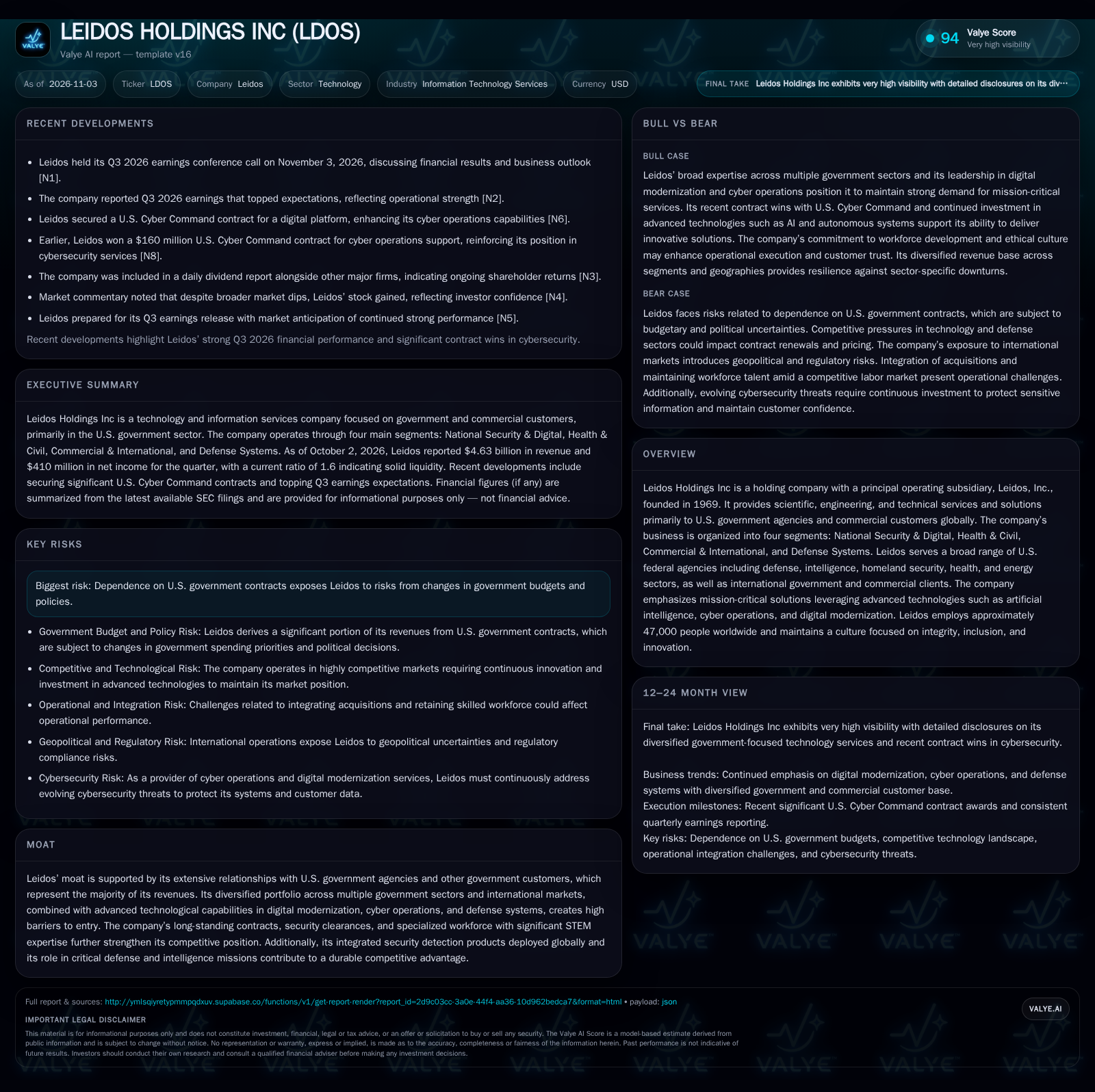
Leidos posted strong Q3 2026 results and won major U.S. Cyber Command contracts, reinforcing its status as a top government technology provider. [S2] [N2] [N6] [N8]
Leidos Holdings’ latest quarter showcased both operational strength and the strategic importance of its government-centric business model. With nearly nine out of every ten dollars earned from U.S. government contracts, the company’s performance is closely tied to federal priorities in digital modernization, cyber defense, and mission-critical systems. Robust Q3 earnings and high-profile contract wins in cyber operations signal continued momentum, but also reinforce the duality of Leidos’ opportunity and risk: its core customer is both its engine for growth and its primary vulnerability. As digital transformation accelerates across defense and civil agencies, Leidos’ ability to innovate and execute at scale remains the central question for long-term investors. [S2] [N2] [N6] [N8]
Recent Contract Wins and Earnings Outperformance Shape Leidos’ Market Standing
Leidos reported $4.63 billion in revenue and $410 million in net income for Q3 2026, topping consensus estimates and reinforcing operational momentum [S2] [N2]. The company secured a major $160 million U.S. Cyber Command contract for cyber operations support, as well as a digital platform award for the same agency [N6] [N8]. These wins highlight Leidos’ continued ability to capture mission-critical government technology work, particularly in the fast-growing cyber and digital modernization domains. With 87% of 2025 revenue sourced from U.S. government contracts and 44% of revenue from its National Security & Digital segment, these developments are highly material to both current performance and future visibility [S1]. The company reported cash and liquidity metrics for the period; these figures do not by themselves establish operating runway, investment capacity, financial flexibility, or financing capacity. [S2]
Government Program Economics: Fixed-Cost Leverage Meets Project Complexity
Leidos’ economics are fundamentally shaped by the project-based, multi-year contracting landscape of U.S. government procurement. Revenue visibility is often underpinned by long-standing customer relationships and periodic large contract wins, but true recurring revenue is rare outside of managed services or maintenance agreements. Pricing is generally negotiated on a cost-plus, time-and-materials, or fixed-fee basis, depending on customer and scope. This structure can create attractive operating leverage when contract volumes rise, as many indirect costs (such as compliance, security clearances, and specialized R&D) are largely fixed. However, project overruns, contract delays, and shifts in scope can erode margins—especially in complex digital or defense integration work.
The company’s segment mix—National Security & Digital (44% of 2025 revenues), Health & Civil (30%), Commercial & International (13%), and Defense Systems (13%)—offers some diversification, but the overwhelming reliance on federal budgets means that volume and mix are ultimately dictated by government funding cycles and procurement priorities [S1]. High labor intensity, ongoing investments in talent and technology, and the need for continuous upskilling (especially in AI and cyber) are structural cost drivers. Capital requirements outside of M&A and select hardware deployments are generally moderate, as most contracts are services- or integration-heavy rather than asset-intensive.
Barriers to Entry: Scale, Security, and Long-Term Agency Relationships
Leidos’ competitive position is anchored in its deep integration with U.S. federal agencies, scale, and ability to deliver on complex, classified, or mission-critical projects. High barriers to entry stem from the need for extensive security clearances, robust compliance infrastructure, and proven past performance on sensitive programs. The company’s portfolio—spanning digital modernization, cyber operations, advanced defense systems, and global security solutions—positions it to cross-sell and bundle offerings, increasing customer stickiness.
However, competition remains intense across all segments. Large defense contractors, specialized IT integrators, and emerging tech firms all vie for federal modernization dollars. Technology substitution is a real risk: as agencies become more comfortable with cloud, AI, and commercial off-the-shelf solutions, the locus of value may shift from bespoke integration to platform enablement and managed services. The question is whether Leidos can continue to outpace rivals in both innovation and execution while maintaining the trust and embeddedness that drive contract renewals and expansions.
Sustained Digital Modernization Wave Drives Multi-Year Growth
In a favorable scenario, federal agencies accelerate digital modernization and cyber resilience investments, triggering a wave of new and expanded contracts in Leidos’ core domains. Continued wins in areas like AI-enabled intelligence, autonomous systems, and integrated cyber platforms could drive segment growth and improve margin mix, as these offerings often command premium pricing and longer-term service components.
Confirmation of this scenario would require evidence of: (1) a rising backlog of large, multi-year digital and cyber contracts; (2) positive mix shift toward higher-margin managed services or proprietary solutions; (3) sustained hiring and retention of specialized talent in AI, cyber, and mission systems; and (4) limited contract re-compete losses to rivals or technology substitutes. Stronger-than-expected federal budget allocations for IT and defense modernization would also support the case.
Incremental Growth Anchored by Federal Budget Realities and Execution Discipline
The most plausible trajectory is for Leidos to deliver modest top-line growth in line with federal IT and defense outlays, punctuated by periodic large contract wins and competitive re-competes. Margins remain stable but are pressured by wage inflation, talent retention costs, and the need for ongoing technology investment to keep pace with evolving customer requirements. The company continues to diversify its segment mix, but the overwhelming weight of U.S. government contracts persists.
This scenario would be confirmed by: (1) revenue growth tracking federal budget trends for defense, intelligence, and civil IT modernization; (2) stable gross and operating margins despite competitive pricing; (3) contract win rates consistent with historical averages; and (4) continued recognition for ethical and operational excellence, which supports renewal and expansion opportunities.
Budget Shocks, Contract Erosion, or Talent Gaps Undermine Momentum
Adverse outcomes could arise if federal budget constraints, policy shifts, or political disruptions trigger a pause or reduction in agency technology spending. Contract delays, scope reductions, or outright losses to competitors would compress revenue and operating leverage, particularly given the fixed-cost base. Erosion of key customer relationships, failure to integrate recent acquisitions, or inability to recruit and retain specialized talent could further compound challenges.
Evidence supporting this scenario would include: (1) a declining federal IT/defense modernization budget; (2) material contract re-compete losses or unexpected project terminations; (3) margin compression due to wage pressures or project overruns; and (4) rising voluntary attrition among mission-critical technical staff. Negative headlines around cybersecurity breaches or performance shortfalls would also be a warning sign.
Thesis-Testing Developments for Leidos: What Could Shift the Outlook
Backlog growth and composition—especially the mix of multi-year digital and cyber contracts—would help clarify revenue visibility and the company’s competitive win rate, if disclosed.
Gross and operating margin trends: sustained or rising margins would indicate effective cost management and pricing power, while compression could signal project or talent cost pressures.
Federal budget allocations for IT, cyber, and defense modernization: shifts upward or downward in agency funding would directly impact Leidos’ addressable market.
Contract renewal and re-compete win rates: a decline here could suggest competitive displacement or technology substitution risk.
Attrition rates for technical and cleared personnel: higher-than-normal churn would raise questions about delivery capacity and execution risk.
Integration milestones and performance of recent acquisitions, such as Savanna Industries (Kudu Dynamics): evidence of synergy capture or operational disruption would test the integration thesis.
Disclosure of new proprietary or managed service offerings: a greater share of recurring, higher-margin business would support the upside scenario.
Incidents of cybersecurity breaches or publicized project failures: these would threaten customer trust and future contract opportunities.
Disclaimer: This is research-only, informational analysis and not investment advice. It may include AI-generated interpretation and general industry context. Always verify important details using primary sources.

Comments