
Gartner’s Financial Strength, AI Adaptation, and the Consulting Industry’s Evolving Playbook
Gartner’s solid Q3 profitability contrasts with a sub-1.0 current ratio, spotlighting near-term liquidity management just as AI-driven disruption accelerates across consulting. How Gartner navigates these pressures—and monetizes its advisory edge—will define its next chapter.
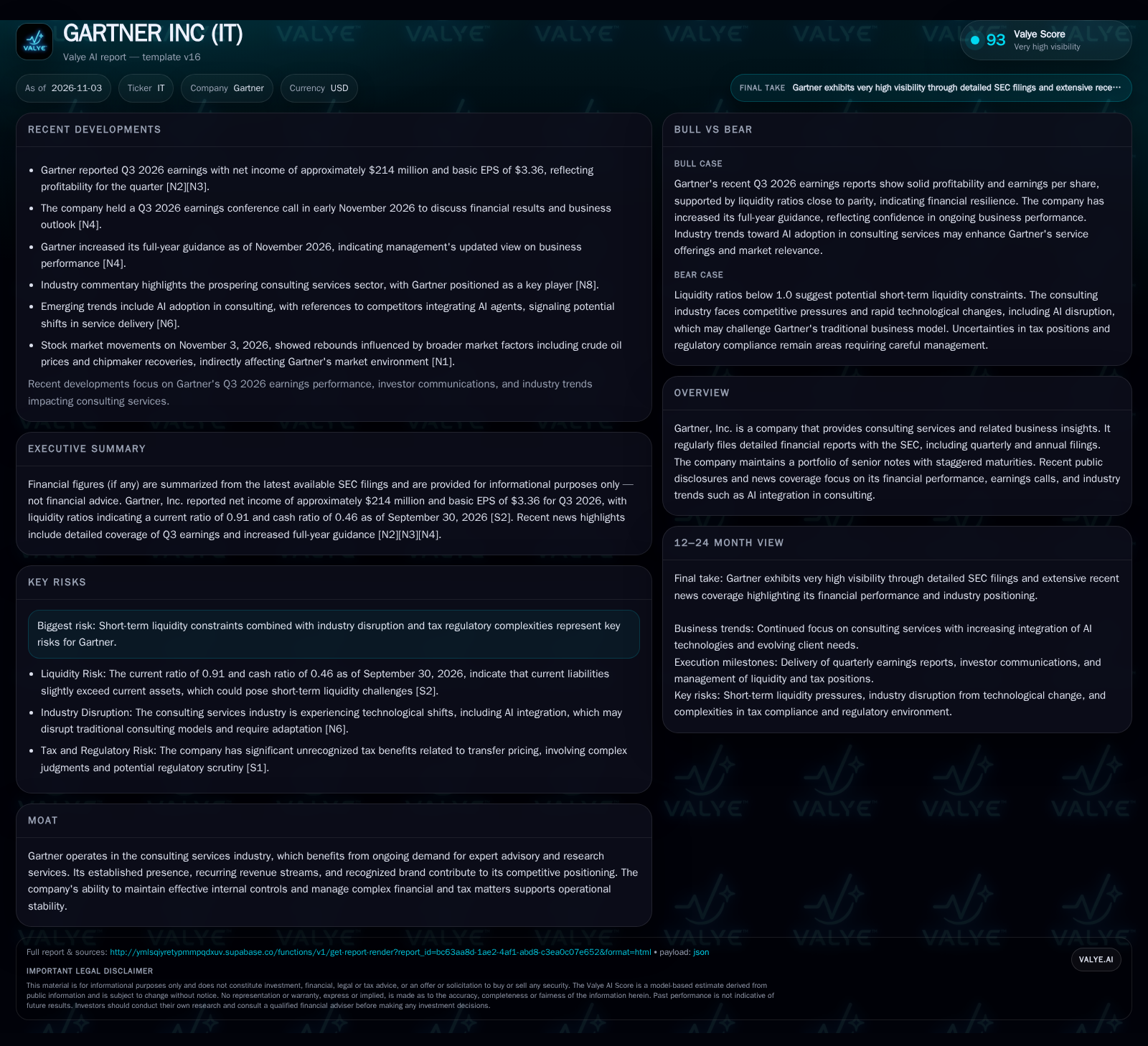
Gartner reported a strong Q3 net income of $214 million and basic EPS of $3.36, but its current ratio of 0.91 and cash ratio of 0.46 highlight near-term liquidity pressures [S2]. The consulting sector’s rapid adoption of AI, as seen in peer activity, is reshaping client expectations and business models. Gartner’s established reputation and recurring advisory income provide a competitive foundation, but the company’s ability to integrate AI into its offerings and manage short-term financial obligations will be critical to sustaining its position.
Gartner enters late 2026 at a crossroads: robust quarterly earnings and a respected advisory brand are offset by a current ratio below 1.0, highlighting the need for disciplined liquidity management. Meanwhile, the consulting industry’s shift toward AI-powered services is accelerating, with major firms piloting automation and analytics at scale. Gartner’s opportunity lies in leveraging its research credibility and client relationships to lead—rather than follow—this transformation. Success will depend on both financial agility and the speed of its strategic adaptation.
Q3 Results Spotlight Profitability Amid Liquidity Tightness
For the quarter ending September 30, 2026, Gartner reported net income of $214 million and basic earnings per share of $3.36, demonstrating continued profitability [S2]. [S2] [S1] This balance between earnings strength and liquidity vigilance forms the immediate backdrop for Gartner’s strategic decisions.
How Gartner’s Advisory Model Converts Insight Into Cash Flow
Gartner’s core business model centers on monetizing proprietary research, advisory services, and consulting engagements—primarily through recurring subscription contracts with enterprise clients. This model typically offers revenue visibility and high gross margins due to the scalable nature of intellectual property and content delivery. The company’s cost structure leans heavily toward fixed costs (analyst salaries, research production, digital platforms), with variable costs largely tied to sales commissions and incremental service delivery.
Operating leverage is a double-edged sword: incremental revenue growth can boost profitability rapidly, but sudden client attrition or pricing pressure can expose fixed-cost rigidity. Gartner’s staggered senior notes add a layer of predictable, though ongoing, interest expense, requiring steady cash generation. Capital needs are modest relative to asset-heavy industries, but reinvestment in talent, digital delivery infrastructure, and—critically—AI capabilities is increasingly non-negotiable to maintain relevance and pricing power.
The rapid evolution of client demand toward AI-enabled insights and automation could reshape Gartner’s revenue mix, pushing the company to accelerate investment in new service formats and platforms, potentially compressing margins during transition phases.
Gartner’s subscription-based revenue model inherently promotes a degree of predictability and resilience, but it also requires continuous innovation to maintain client engagement and justify recurring fees. The shift toward AI-enhanced advisory services introduces both opportunities and risks in this context. On one hand, AI tools can enable Gartner to offer more personalized and timely insights, potentially increasing client dependency and reducing churn. On the other hand, the initial investment in AI capabilities may necessitate a recalibration of pricing models, especially if clients expect lower costs due to automation. Balancing these dynamics will be critical to preserving margin structures while scaling new offerings.
Defending the Advisory Edge as AI Redraws the Consulting Map
Gartner’s competitive positioning rests on its established brand, deep client relationships, and reputation for independent, actionable research. These attributes have supported pricing power and recurring revenue, with switching costs rooted in the embeddedness of Gartner’s insights in client decision workflows.
However, the consulting landscape is in flux. Major industry peers are actively piloting AI agents and automation tools, signaling a new era of technology-driven advisory. While Gartner’s legacy scale and trust are assets, they are not insurmountable barriers—especially if rival platforms can deliver faster, more customized, or lower-cost advice. The rise of specialized SaaS analytics, generative AI, and even direct-to-executive knowledge platforms creates new categories of substitution risk.
The company’s ability to integrate AI into its offerings, enhance the value of its research, and potentially automate elements of its own service delivery will determine whether it can defend or expand its moat in the years ahead.
If AI Integration Drives a New Wave of Advisory Demand
The most favorable outcome for Gartner would see rapid, successful integration of AI and advanced analytics into its core offerings, enabling the company to deliver more actionable, real-time, and tailored insights at scale. If Gartner’s investments in AI-powered content creation, client-facing digital tools, and workflow automation pay off, the firm could both deepen existing client relationships and capture share from slower-moving competitors.
Evidence supporting this scenario would include: accelerating revenue growth in digital or AI-enabled service lines, positive client testimonials referencing AI-driven value, improved contract renewal rates, and margin expansion despite elevated technology investment. A visible uptick in cross-selling, upselling, or expansion into new client segments would further validate Gartner’s ability to monetize the consulting industry’s AI pivot.
Sustaining Core Strength While Managing Transition Pressures
The most plausible near-term scenario is one in which Gartner sustains its core recurring revenue streams and profitability, but faces margin and investment pressure as it adapts to evolving client expectations. The company’s established client base and effective internal controls support ongoing cash generation, but the need to accelerate AI integration and possibly restructure service delivery could lead to periods of higher operating expense and variable growth.
Confirmation of this scenario would come from stable or slightly growing revenue and net income, ongoing control over working capital and debt service, and incremental—but not transformative—progress in launching new AI-enabled offerings. Any signs of client churn or pricing pressure would signal transition friction, while steady internal control attestations would suggest continued operational discipline.
Liquidity Squeeze Meets Disruptive Shock
If the company cannot keep pace with technological change, it could face margin compression, increased client churn, and a need to discount services or invest heavily just to retain business.
Signs of this scenario would be deteriorating current and cash ratios, rising short-term borrowings, negative free cash flow, or missed debt service milestones. Externally, notable client defections, adverse pricing trends, or high-profile analyst departures would indicate franchise weakening. Regulatory or tax setbacks could exacerbate financial strain, especially if they coincide with operational disruption.
Benchmarks to Test Gartner’s Adaptation and Resilience
Quarterly trends in current ratio and cash ratio, to gauge whether liquidity management is tightening or stabilizing over time.
Revenue and margin performance for any newly launched AI-enabled or digital advisory services, if disclosed.
Retention and renewal rates among top enterprise clients, a key indicator of competitive stickiness and switching costs.
Gross and operating margin evolution, especially as AI investments ramp—does margin expand or contract through the transition?
Progress reports or management commentary on integrating AI and automation into core research, advisory, and client delivery processes.
Debt service coverage and maturity schedule updates—does Gartner maintain comfortable coverage of interest and principal payments?
Disclosure of material client losses or pricing concessions, which would signal competitive or technological pressure.
Any restatements or adverse auditor opinions related to internal controls, as a litmus test for operational discipline.
Disclaimer: This is research-only, informational analysis and not investment advice. It may include AI-generated interpretation and general industry context. Always verify important details using primary sources.

Comments