
Fabrinet’s Expansion in Optical Manufacturing: Can Scale and Demand Offset Concentration and Cost Risks?
Fabrinet’s recent surge in demand from AI and data center sectors has driven rapid revenue growth and capacity investments. Yet, the company’s high customer concentration, supply chain dependencies, and rising input costs pose structural risks. The critical question: will operational leverage and market tailwinds be enough to sustain margin expansion and resilience as industry cycles shift?
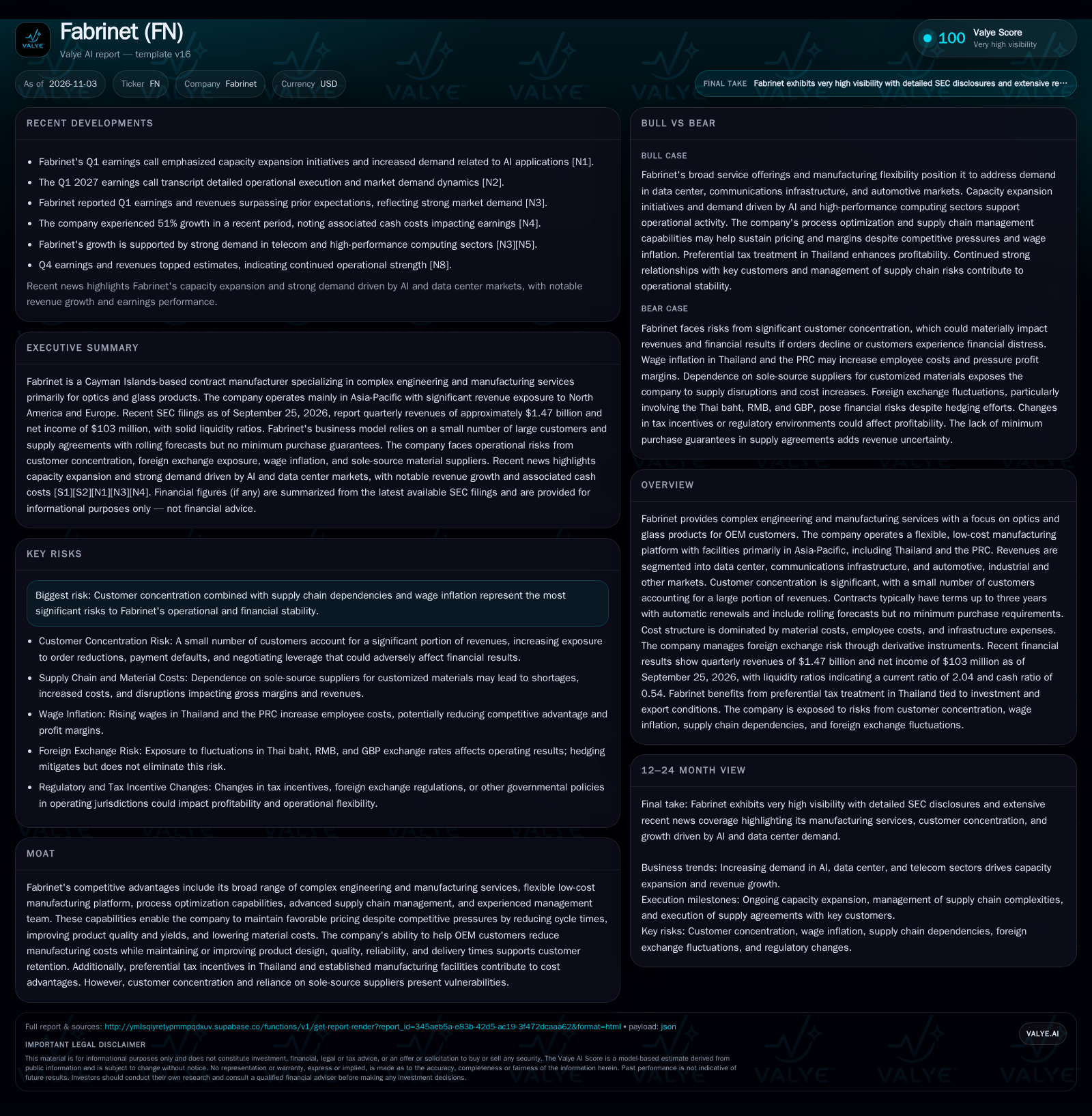
Fabrinet’s Q1 fiscal 2027 revenue reached $1.47 billion with net income of $103 million, fueled by AI and data center demand and capacity expansion. However, with a small number of customers driving most revenues, and contracts lacking minimum purchase commitments, revenue visibility remains limited. Margins are pressured by wage inflation in Asia and supply chain dependencies, even as the company benefits from preferential tax treatment in Thailand. The sustainability of recent growth depends on maintaining customer relationships, managing costs, and capitalizing on secular industry shifts.
Fabrinet’s aggressive expansion in complex optical and glass manufacturing has positioned it at the heart of the data center and AI hardware boom, driving a 51% surge in recent revenues. Yet, this growth comes with heightened exposure to a handful of large customers, volatile input costs, and the operational realities of labor inflation in Asia. As Fabrinet navigates a shifting industry landscape, the durability of its growth—and its ability to translate scale into defensible earnings—will be tested by both internal cost dynamics and the cyclical nature of its end markets.
AI and Data Center Demand Powers Recent Revenue Spike—But Customer and Cost Risks Persist
Fabrinet reported Q1 fiscal 2027 revenue of approximately $1.47 billion and net income of $103 million, reflecting a period of exceptional growth driven by demand from AI and data center markets [S2] [N1] [N3]. The company’s capacity expansion initiatives were highlighted in recent earnings calls, with management citing strong operational execution and continued market tailwinds [N1] [N2]. However, Fabrinet’s customer base remains highly concentrated, with a small number of OEMs responsible for a large portion of total revenues [S1]. This concentration amplifies the risk of order reductions, payment defaults, and increased negotiating leverage for its largest customers. At the same time, Fabrinet’s cost structure is increasingly pressured by wage inflation in Thailand and the PRC, as well as by the need to source customized, often sole-sourced materials—factors that have recently weighed on earnings despite top-line growth [S1] [N4].
How Fabrinet’s Manufacturing Model Converts Demand into Earnings—and Where the Leverage Lies
Fabrinet’s business model is built on providing complex engineering and manufacturing services—especially for optical and glass products—to a concentrated base of OEM customers. Revenues are now reported across three segments: data center, communications infrastructure, and automotive/industrial/other markets [S1]. The company operates on a flexible, low-cost manufacturing platform with a heavy footprint in Asia-Pacific, leveraging both scale and process optimization to keep costs competitive.
The economics hinge on volume throughput and material cost management. Material costs are the largest expense, driven by customized and frequently sole-sourced components. This structure means gross margins are highly sensitive to input price volatility, supplier disruptions, and yield optimization. Employee costs, particularly direct manufacturing wages and indirect engineering/quality staff, are the next largest expense, with wage inflation in Thailand and the PRC eroding some of the company’s historical cost advantages [S1].
Fabrinet’s contracts generally run up to three years with automatic renewals, but critically, they do not establish minimum purchase requirements—leaving revenue recognition dependent on customer order flow. This limits forward revenue visibility and can magnify the impact of customer inventory corrections or demand swings. On the upside, operational leverage is possible if volume growth outpaces fixed cost increases, especially as Fabrinet invests in new capacity to serve data center and AI markets. However, SG&A is expected to rise in fiscal 2027 due to increased R&D and IT investments, which may temper near-term margin expansion [S1].
Competitive Advantages and Vulnerabilities in the Optical Manufacturing Value Chain
Fabrinet’s core advantage lies in its ability to handle complex, high-mix manufacturing projects at scale, offering OEM customers lower unit costs, rapid cycle times, and high reliability. This is supported by advanced supply chain management, process optimization, and preferential tax treatment in Thailand, which together enable competitive pricing [S1]. The company’s established manufacturing footprint and engineering expertise could increase switching friction for customers who value continuity and quality for mission-critical components.
However, these advantages are counterbalanced by structural vulnerabilities. Customer concentration means that a single customer’s strategic shift or insourcing decision could materially impact revenues. The lack of minimum commitments in contracts increases negotiating leverage for large customers, who can flex order volumes in response to their own end-market volatility. Meanwhile, Fabrinet’s dependence on customized, sole-sourced materials exposes it to supplier power and potential disruption—risks exacerbated in a tight supply environment. Competitor categories include other contract manufacturers with optical and precision engineering capabilities, as well as vertically integrated OEMs and regional challengers capable of undercutting on labor or logistics costs. Technology substitution (e.g., advances in photonics integration or alternative packaging) could also threaten incumbent manufacturing volumes over time.
If AI and Data Center Tailwinds Persist, Operating Leverage Could Drive Margin Expansion
The most favorable scenario for Fabrinet is one where secular growth in AI, high-performance computing, and communications infrastructure continues to outpace broader industrial cycles. In this case, Fabrinet’s ongoing capacity investments would enable it to absorb rising demand, improving utilization rates and unlocking operating leverage. If the company can manage material and wage cost inflation through process efficiency, supply chain localization, or better contract terms, incremental margins on new business could expand.
Confirmation would come from sustained double-digit revenue growth in the data center and AI segments, stable or improving gross margins despite input cost pressures, and evidence of new or expanded multi-year relationships with leading OEM customers. Further, if Fabrinet demonstrates an ability to diversify its customer base—reducing concentration risk—its bargaining position and revenue visibility would improve. Conversely, a sharp slowdown in AI or data center hardware demand, or evidence of customer insourcing, would falsify this scenario.
Volume Growth Balances Cost Inflation, but Customer Concentration Keeps Volatility High
The most plausible outcome is that Fabrinet continues to benefit from elevated demand in its core markets, but faces offsetting pressures from rising input and labor costs. Revenue growth remains solid, driven by AI and data center projects, but gross margin expansion is limited by wage inflation and the need to secure hard-to-source materials. Customer concentration persists, leaving Fabrinet exposed to order volatility and pricing concessions in negotiations.
This scenario would be confirmed by continued top-line growth in line with recent quarters, but with gross margins fluctuating in response to cost headwinds and potentially higher SG&A as capacity and R&D investments ramp. Revenue diversification and new customer additions would help mitigate volatility, while any signs of customer consolidation or loss of key accounts would increase risk.
Order Reductions or Supply Disruptions Could Trigger Sharp Earnings Compression
The adverse scenario involves either a sudden reduction in orders from one or more of Fabrinet’s largest customers or a significant supply chain disruption—such as shortages or cost spikes in customized materials. Given the lack of minimum purchase commitments and high customer concentration, even a single OEM’s pullback could materially impact both revenue and earnings. At the same time, if wage inflation accelerates or regulatory/tax incentives in Thailand change unfavorably, cost pressures could outpace any operational flexibility.
Evidence supporting this scenario would include a notable sequential decline in revenues, margin compression outpacing revenue declines, or disclosures of lost or reduced business from major customers. Supply chain delays, inability to pass through cost increases, or a sudden increase in working capital requirements would further confirm downside risk.
What Will Really Test Fabrinet’s Resilience in the Next Industry Cycle?
Quarterly revenue growth and segment mix, especially in data center and AI applications, would help gauge whether secular demand is sustaining top-line momentum.
Gross margin trends relative to wage inflation and material cost indices—if disclosed—would clarify Fabrinet’s ability to manage input cost pressures.
Customer concentration metrics and disclosures of new or lost major customers would directly inform risk around order volatility and negotiating leverage.
Order backlog or forward-looking order commitments—if provided—would indicate revenue visibility and customer confidence.
Capital expenditure levels and timing of new capacity coming online would show whether Fabrinet is pacing investments in line with demand cycles.
SG&A and R&D expense growth versus revenue would highlight risks of margin dilution as the company invests for future growth.
Updates on supply chain disruptions, material shortages, or cost pass-through ability would flag near-term earnings risk.
Changes in effective tax rates or regulatory incentives in Thailand and other manufacturing locations could signal future net income volatility.
Disclaimer: This is research-only, informational analysis and not investment advice. It may include AI-generated interpretation and general industry context. Always verify important details using primary sources.

Comments