
Cinemark’s Premium Experience Strategy: Can Format Innovation and Geographic Reach Sustain Outperformance?
Cinemark’s Q3 2026 earnings rebound highlights the power of blockbuster-driven attendance, but the company’s future will hinge on its premiumization tactics, loyalty ecosystem, and ability to navigate capital intensity and regional volatility. The analysis explores how Cinemark’s evolving business mix and operational model could shape its trajectory in a shifting entertainment landscape.
Cinemark returned to strong profitability in Q3 2026, driven by a robust film slate and ongoing investments in premium formats and guest experience. The company’s extensive U.S. and Latin American footprint, focus on technology upgrades, and large loyalty base position it for continued relevance, but capital requirements and external risks remain material counterforces. Watch for evidence of sustained attendance, premium revenue mix, and resilience to content and economic cycles as key thesis tests. [N1] [S1]
Cinemark Holdings’ Q3 2026 results spotlight both the enduring draw of the theatrical experience and the company’s ability to harness blockbuster momentum. With a diverse footprint spanning the U.S. and Latin America, Cinemark is betting on premium formats, guest amenities, and loyalty-driven engagement to offset the secular pressures facing traditional moviegoing. Yet the company’s high fixed costs, exposure to content volatility, and capital intensity keep its margin structure and long-term returns in flux. This analysis unpacks how Cinemark’s business model, competitive positioning, and strategic investments could shape its resilience and upside as the entertainment landscape evolves.
Q3 Snapback, Premium Focus, and Geographic Breadth: What’s Changed for Cinemark?
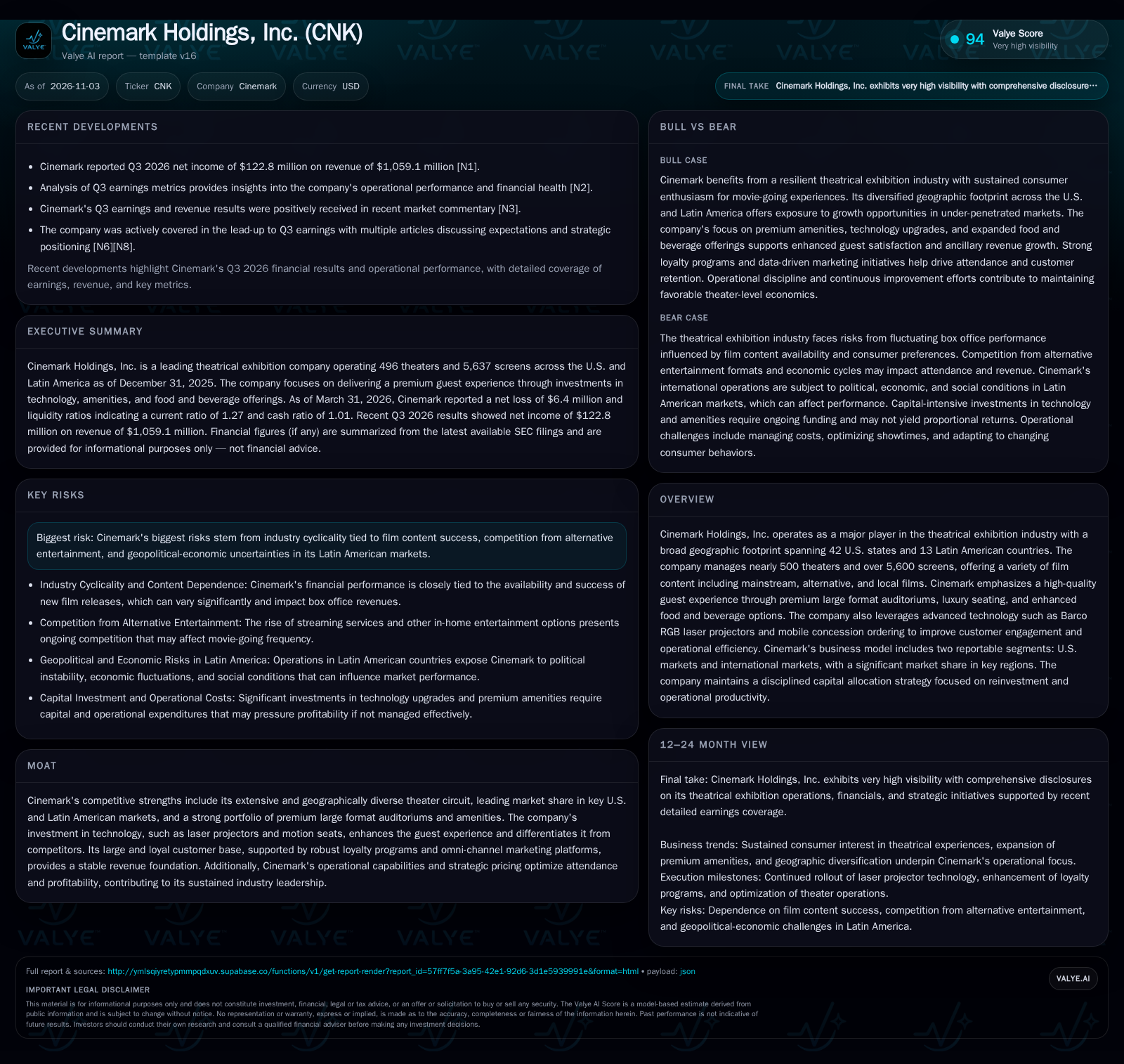
Cinemark reported a Q3 2026 net income of $122.8 million on revenue of $1,059.1 million, a marked improvement from its net loss of $6.4 million as of March 31, 2026. This swing demonstrates the company’s sensitivity to blockbuster-driven attendance and the outsized impact of a strong film slate on financials. [N1] [S2]
The company’s operational scope remains broad, with 496 theaters (303 in the U.S., 193 in Latin America) and 5,637 screens, cementing its leadership in major regions like Brazil and Argentina. [S1]
Cinemark is advancing its premiumization strategy: 301 XD premium auditoriums, 16 IMAX, 12 ScreenX, and motion seats in 548 auditoriums, with 22% of auditoriums now featuring Barco RGB laser projectors. [S1]
The loyalty program ecosystem includes 27 million global members—with 1.5 million paid U.S. Movie Club subscriptions—providing a direct channel for engagement and repeat attendance. [S1]
How Cinemark Makes Money: Box Office Leverage, Premiumization, and Ancillary Revenue Streams
Cinemark’s core revenue engines are box office ticket sales and concessions, both highly volume-driven and subject to large swings depending on film content and consumer sentiment. Premium formats (XD, IMAX, motion seating, luxury recliners) allow for higher ticket prices and potentially greater per-guest concession spend, amplifying revenue per attendee. The company’s food and beverage menu—ranging from alcohol to Pizza Hut and chef-inspired dishes—supports broader ancillary income, particularly as mobile ordering increases basket size and operational throughput.
The business is capital-intensive, with high fixed costs for real estate, projection technology, and amenities. This creates significant operating leverage: incremental attendance and premium product mix can sharply boost margins, but periods of weak box office performance risk rapid negative swings. Technology upgrades (e.g., Barco laser projectors) and luxury seating require ongoing capital outlays, with returns dependent on pricing power and sustained foot traffic.
Loyalty and subscription programs (notably the Movie Club) can smooth demand volatility by encouraging repeat visits and upsell opportunities, but their impact on long-term margin expansion versus cannibalization of full-price admissions remains a key variable.
Defending Share in a Shifting Landscape: Cinemark’s Moat and Its Limits
Cinemark’s scale—especially its dominant presence in Brazil, Argentina, and major U.S. markets—offers distribution leverage with studios and some local marketing advantages. Its broad geographic footprint helps mitigate localized shocks but introduces exposure to international risk factors.
Premium formats and guest amenities (motion seating, luxury recliners, advanced projection, expanded menus) differentiate the in-person experience from both traditional competitors and substitute formats like streaming. However, these features are increasingly table stakes among top-tier exhibitors and require continual reinvestment to maintain relevance.
The company’s loyalty ecosystem and omni-channel marketing are valuable tools for customer retention and targeted promotions, but barriers to switching are not insurmountable—especially if content supply weakens or alternative entertainment options accelerate innovation. The threat from streaming and in-home entertainment continues to cap industry volume, particularly among younger demographics and in mature urban markets.
Regional competitors in Latin America, local chains, and new entrants in premium formats represent ongoing sources of competitive pressure, while the overall market’s health remains tightly correlated with studio content output.
Premiumization and Content Tailwinds Drive Margin Expansion
If Hollywood and international studios sustain a robust pipeline of blockbuster releases, Cinemark could see multi-quarter attendance growth and pricing power for premium formats. Higher occupancy rates in XD, IMAX, and motion-enabled auditoriums would drive average ticket and concession revenue upward, leveraging the company’s fixed-cost base.
Continued conversion to Barco laser projectors and further rollout of luxury recliners could widen the gap with lower-investment competitors, while the loyalty program’s scale may enhance cross-selling and limit churn. Expansion of mobile ordering and high-margin menu items could further lift per-guest economics.
Confirmation would come from sustained growth in premium ticket mix, rising average revenue per patron, and consistent increases in Movie Club membership and engagement. Upside would be reinforced by evidence of operating margin expansion and stable or declining per-theater overhead despite capital outlays.
Box Office Cyclicality Balanced by Premium Mix and Operational Discipline
The most plausible outcome is a cyclical pattern where strong quarters (driven by major film releases) are offset by periods of weaker attendance, with overall revenue and margin trends modestly positive thanks to ongoing premiumization and cost management.
Cinemark is likely to continue investing in technology and amenities at a measured pace, matching capital intensity to observed demand trends. The loyalty program and subscription base may help smooth volatility, but will not fully insulate results from content droughts or macroeconomic shocks, particularly in Latin America.
This scenario would be confirmed by stable or gradually improving per-screen and per-patron metrics, moderate growth in premium format penetration, and consistent—if lumpy—profitability. Evidence against the base case would include sharp declines in attendance, margin compression despite capital investments, or visible erosion in loyalty/subscription engagement.
Capital Intensity and External Shocks Threaten Returns
In a negative scenario, a weak or inconsistent film slate—potentially compounded by accelerated streaming competition—could drive a sustained decline in attendance, particularly among younger and urban demographics. Underutilized premium auditoriums and amenities would lead to under-absorbed fixed costs and margin erosion.
If economic or political instability in Latin America intensifies, Cinemark’s international segment could see sharp revenue and profit volatility, with currency devaluation or regulatory shocks further pressuring results. High ongoing capital requirements for technology upgrades and amenities could strain cash flows if box office recovery stalls.
Signs of downside would include declining per-screen attendance, rising operating losses in one or both segments, negative trends in loyalty engagement, and evidence of deferred or curtailed capital projects.
What Will Determine Cinemark’s Long-Term Outperformance?
Quarterly box office attendance and average ticket/concession revenue per patron: Sustained growth would validate the premiumization strategy; stagnation or decline would challenge it.
Premium format penetration rate: The pace of XD, IMAX, ScreenX, and Barco laser projector adoption—if disclosed—will indicate competitive differentiation and pricing power.
Movie Club and loyalty membership trends: Growth, engagement, and retention rates would help assess recurring demand and customer stickiness.
Operating margin trends by segment: Expanding margins in the face of capital investment would signal effective execution; compression would raise concerns.
Capex as a percentage of revenue: A useful metric would be to monitor whether capital intensity is rising or falling relative to topline growth.
International segment volatility: Revenue and margin swings in Latin America—especially in Brazil and Argentina—will test Cinemark’s geographic risk management.
Content pipeline visibility: Forward-looking studio release schedules and anticipated blockbuster slates would help forecast demand cycles.
Per-theater productivity metrics: If disclosed, trends in revenue and profit per screen/theater would clarify the impact of ongoing investments.
Disclaimer: This is research-only, informational analysis and not investment advice. It may include AI-generated interpretation and general industry context. Always verify important details using primary sources.

Comments