
Pinnacle West Capital: Navigating Growth and Liquidity Tension in a Regulated Utility Landscape
Pinnacle West Capital's recent revenue and earnings outperformance reflect operational momentum and an expanding customer base, yet a sub-1 current ratio raises questions about liquidity management amid ongoing capital investment and regulatory complexity.
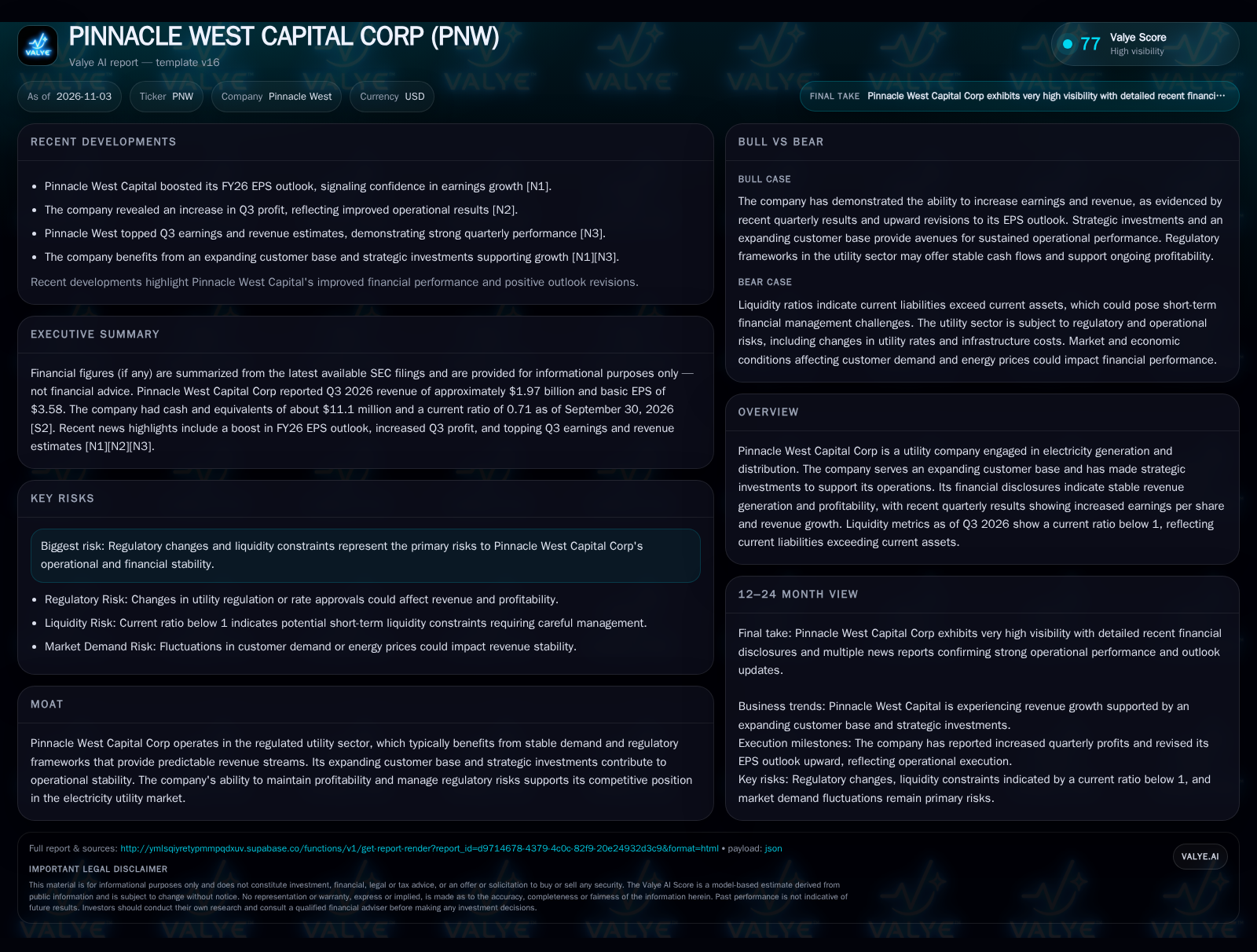
Pinnacle West Capital reported strong Q3 2026 revenue and EPS, exceeding market expectations and boosting its full-year outlook. The company continues to grow its customer base and invest strategically. Future performance will hinge on regulatory outcomes, capital efficiency, and the ability to sustain growth without compromising potential financial flexibility. [S2] [N1] [N2] [N3]
Pinnacle West Capital Corp’s latest quarterly results reinforce its position as a major regulated electric utility experiencing both growth and operational complexity. The company exceeded Q3 2026 revenue and profit expectations, benefiting from a larger customer base and targeted infrastructure investments. The next phase will test the company’s ability to translate operational wins into resilient, adaptable financial performance.
Recent Performance Highlights Operational Strength and Liquidity Constraints
Pinnacle West Capital reported Q3 2026 revenue of approximately $1.97 billion and basic earnings per share of $3.58, outperforming consensus expectations and prompting an upward revision to its full-year EPS outlook. This result reflects improved operational execution and the benefits of a growing customer base. While not unusual for capital-intensive utilities, this dynamic places a premium on effective short-term liquidity management, especially as Pinnacle West continues to invest in infrastructure to support customer and load growth. [S2] [N1] [N2] [N3]
Revenue Predictability and Capital Intensity Define the Utility’s Economic Model
Pinnacle West’s core business—regulated electricity generation and distribution—offers revenue visibility anchored by long-term rate structures approved by state utility commissions. Revenue is primarily a function of customer counts, usage volumes, and approved tariff rates, with limited pricing flexibility outside regulatory processes. The expanding customer base and strategic investments suggest volume growth, but the ability to translate this into margin expansion depends on regulatory recovery of costs and prudent capital allocation.
Cost structure is heavily weighted toward fixed costs: power generation assets, system maintenance, and regulatory compliance drive high operating leverage. Variable costs (fuel, purchased power, O&M) are meaningful but less volatile than in unregulated sectors. Capital expenditures for grid upgrades, generation capacity, and environmental compliance are ongoing and substantial, requiring external financing or reinvested cash flow. The reported current ratio highlights the need for careful timing of capital outlays and debt management to avoid liquidity crunches, especially during periods of rate-case lag or unexpected operational costs.
The interplay between regulatory approval cycles and capital deployment timing is critical in shaping Pinnacle West’s financial profile. Since capital expenditures often precede corresponding rate case approvals by months or even years, the company must carefully forecast cash flow needs to avoid liquidity shortfalls. This dynamic necessitates a conservative approach to leverage and working capital management, as premature or excessive spending without assured cost recovery can strain balance sheet flexibility. Moreover, the regulatory environment’s inherent lag creates a form of regulatory risk that is distinct from market risk, requiring specialized financial planning and contingency buffers to accommodate potential delays or disallowances in cost recovery.
Regulation Shields Market Share but Exposes Pinnacle West to Policy and Technology Shifts
As a regulated utility, Pinnacle West enjoys effective monopolistic positioning within its service territory, with geographic exclusivity and customer growth tied to population and economic trends. Regulatory frameworks provide revenue stability but also introduce significant risk: changes in rate-setting methodologies, delayed cost recovery, or adverse policy shifts could compress margins.
The primary competitive threats are indirect: distributed generation (e.g., rooftop solar), energy efficiency programs, and large customers seeking direct access to wholesale markets or developing their own on-site generation. Technological advances in storage, demand response, and grid management may gradually erode traditional utility advantages if not proactively integrated. The company’s strategic investments indicate recognition of these pressures, but the pace of adoption and regulatory response will determine the net impact.
Technological innovation in energy storage and grid digitization introduces both opportunities and risks for Pinnacle West. If the company can effectively integrate advanced grid management systems, it may enhance operational efficiency, reduce outage durations, and optimize asset utilization, thereby improving margins. Conversely, failure to adapt could accelerate customer migration to alternative energy solutions, eroding load growth and revenue stability. The regulatory stance on incentivizing such innovations will be pivotal; supportive policies can enable the utility to capitalize on modernization investments, while restrictive or slow-moving regulatory processes could hinder timely adoption and competitive positioning.
If Regulatory Alignment and Customer Growth Persist, Margin Expansion Is Achievable
The most favorable outcome for Pinnacle West is a continued alignment between regulatory frameworks and infrastructure investment needs. If the company successfully secures timely and favorable rate approvals to recover capital expenditures, and if load growth—potentially bolstered by data center expansion or population inflows—remains robust, then earnings and cash flow could outpace current expectations.
Confirmation of this scenario would come from additional upward revisions to EPS guidance, evidence of constructive regulatory outcomes (e.g., approved rate increases or accelerated cost recovery), and stable or improving liquidity metrics despite continued investment. Rapid adoption of utility-scale renewables or grid modernization projects—if included in rate base and supported by regulators—could further enhance returns.
Regulatory Lag and Capital Demands Likely Temper but Do Not Derail Growth
The most plausible trajectory is that Pinnacle West continues to grow its customer base and invest in infrastructure, but faces periodic regulatory lag—delays between capital outlays and recovery in rates. Margin growth is likely to be incremental rather than explosive, as ongoing capital expenditures are matched by periodic, but not always immediate, rate relief.
This scenario would be confirmed by steady revenue and EPS growth in line with historical trends, with occasional fluctuations tied to timing of rate cases and capital project completions. Liquidity remains a watchpoint, but no acute stress emerges as the company manages working capital through traditional utility financing tools (e.g., revolving credit, debt issuance).
Liquidity Shortfalls or Regulatory Setbacks Could Force Cost Cutting or Dilutive Financing
An adverse scenario would materialize if Pinnacle West encounters regulatory setbacks—such as denied or delayed rate increases—at the same time as capital and operating costs rise, or if unexpected operational disruptions (e.g., extreme weather, outages) drive up short-term liabilities. With a current ratio already below 1, any further liquidity pressure could force the company to seek expensive short-term financing, defer planned investments, or implement cost reductions that might impair service quality or growth.
Evidence for this scenario would include a material deterioration in liquidity metrics (e.g., further decline in cash balances), negative surprises in regulatory outcomes, or public disclosures of asset sales, dividend cuts, or emergency financing. Prolonged regulatory or market uncertainty could amplify these risks.
What Will Determine Pinnacle West’s Resilience and Upside in the Next 12–24 Months?
Approval, timing, and scope of upcoming rate cases—especially those tied to major capital projects or cost recovery.
Quarterly trends in cash and equivalents, as well as updates to the current ratio or liquidity facilities, if disclosed.
Customer growth rates and changes in usage patterns, including large-load additions such as data centers or industrial customers.
Pace and scale of capital expenditures, particularly in grid modernization, renewables, or reliability upgrades.
Regulatory or legislative developments impacting cost recovery mechanisms, allowed returns, or decarbonization mandates.
Operational performance metrics such as outage frequency/duration, if disclosed, and major service reliability events.
Evidence of competitive inroads from distributed generation or customer defection, if available.
Disclaimer: This is research-only, informational analysis and not investment advice. It may include AI-generated interpretation and general industry context. Always verify important details using primary sources.

Comments