
Ryman Hospitality Properties: Convention-Scale Lodging, Entertainment Diversification, and the Push-Pull of Cyclical Demand
Ryman Hospitality Properties, Inc. leverages a portfolio of large-scale, meetings-focused resorts managed by Marriott and a controlling stake in iconic entertainment assets to target group travel and event-driven demand. Recent acquisitions and refinancing have expanded its platform, but economic sensitivity, operational dependencies, and working capital constraints shape the risk/reward equation.
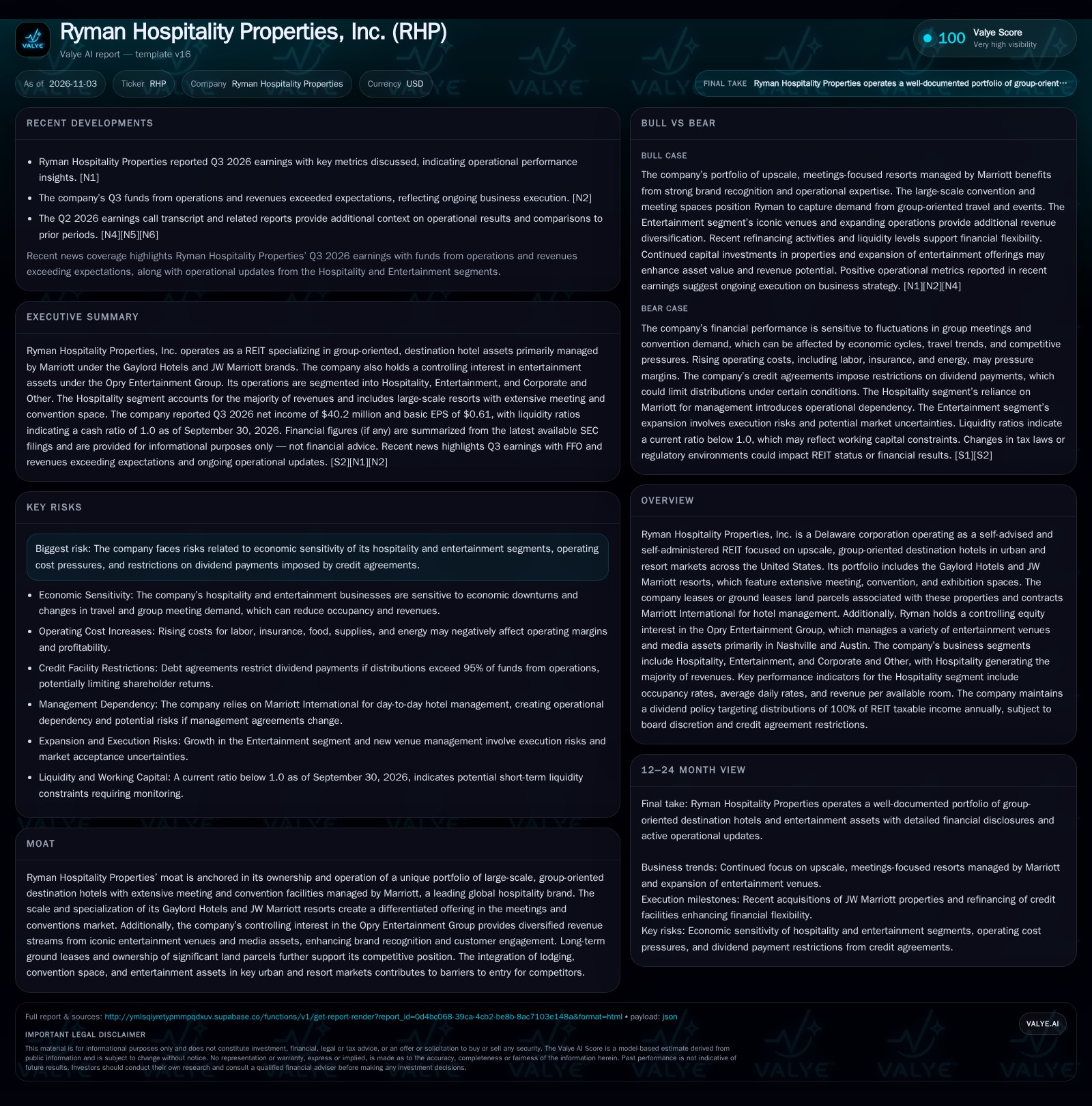
Ryman Hospitality Properties operates a unique mix of convention-scale hotels and entertainment assets, with recent results exceeding expectations and a larger credit facility in place. Future growth depends on sustained group travel demand, effective entertainment expansion, and careful capital management. [S1] [S2] [N1] [N2]
Ryman Hospitality Properties stands at the intersection of large-scale, meetings-focused lodging and branded entertainment, operating a network of destination resorts managed by Marriott and controlling iconic cultural venues through Opry Entertainment Group. Its recent financial results have outpaced expectations, and strategic moves—including refinancing and property acquisitions—signal a bid for long-term growth and diversification. Yet, the company’s heavy reliance on group event demand, operational leverage, and complex capital structure mean its fortunes will depend not just on execution, but on the resilience of the business travel and entertainment recovery cycles.
Recent Results, Expanded Credit, and a Diversified Asset Base
Ryman Hospitality Properties reported Q3 2026 net income of $40.2 million, with basic and diluted EPS of $0.61 and $0.58, respectively, and both funds from operations (FFO) and revenues exceeding analyst expectations. The company reported a cash ratio of 1.0 for the period. The company completed a refinancing and upsizing of its revolving credit facility to $850 million in January 2026, increasing its potential financial flexibility. The portfolio now comprises 11,869 upscale hotel rooms in urban and resort markets, including five Gaylord Hotels and two JW Marriott properties acquired in 2023 and 2025. The hospitality segment contributed 83% of 2025 revenue, while the entertainment segment—anchored by the Grand Ole Opry, Ryman Auditorium, and other venues—accounted for 17%. [S1] [S2] [N1] [N2]
How Scale, Mix, and Group Demand Drive Ryman’s Top Line and Margin Structure
Ryman’s business model is predicated on capturing large group and convention business—a segment with higher average daily rates (ADR) and stable booking windows compared to transient travel. The company’s hotels, each with at least 240,000–400,000 square feet of meeting and exhibition space, are designed to attract major events that can fill rooms and generate significant food, beverage, and ancillary spending. This scale creates operating leverage, as incremental group bookings can drive disproportionate margin expansion once fixed costs are covered.
Revenue mix is heavily weighted toward hospitality, but the Opry Entertainment Group (OEG) provides diversification via ticket sales, venue rentals, media rights, and branded experiences. While the REIT structure imposes minimum payout requirements, Ryman manages cash flows through its taxable REIT subsidiaries, which lease hotel assets and contract Marriott for management. This arrangement means Ryman’s core economics depend on the spread between hotel-level cash flow (after Marriott’s management fees and operating costs) and the REIT’s overhead and financing costs.
The company’s capital needs are substantial, with ongoing property maintenance, periodic renovations, and growth investments—particularly for new entertainment venues or hotel acquisitions. The company reported cash and liquidity metrics for the period; these figures do not by themselves establish operating runway, investment capacity, financial flexibility, or financing capacity. [S1] [S2]
Barriers and Counterforces in Convention Lodging and Branded Entertainment
Ryman’s competitive edge stems from its unique portfolio of large-scale, meetings-focused resorts with extensive convention facilities—an offering that is difficult for most hotel REITs or operators to replicate due to high capital requirements, long entitlements, and the need for destination-scale land parcels. The company’s exclusive management agreements with Marriott also provide brand strength, loyalty program access, and operational expertise.
However, this positioning is not without vulnerabilities. Competition for group and convention business comes from other national convention hotels, integrated resorts, and emerging hybrid event formats that may reduce in-person demand. Substitutes for large-scale events—such as virtual conferencing—remain a structural headwind post-pandemic. On the entertainment side, Ryman’s venues are iconic but exposed to consumer discretionary cycles, execution risk in new venue rollouts, and the challenge of scaling branded experiences beyond core geographies.
The company’s reliance on Marriott for hotel management introduces dependency risk: any change in Marriott’s brand strategy, fee structure, or operational standards could impact Ryman’s economics. Additionally, while controlling iconic entertainment assets provides differentiation, the segment’s smaller revenue base and higher volatility mean it is not yet a full counterweight to hospitality cyclicality. [S1]
If Group Demand Recovers and Entertainment Expands, Margin and Valuation Upside Could Materialize
A favorable scenario for Ryman would see a sustained recovery and expansion in group travel and convention demand, leading to higher occupancy, ADR, and total revenue per available room (Total RevPAR) at its flagship hotels. This would allow the company to leverage its fixed cost base, expand EBITDAre margins, and produce outsized growth in funds from operations (FFO) and distributable cash flow. Concurrently, successful expansion of the Opry Entertainment Group—through new venue management contracts, increased ticket sales, and higher-margin branded entertainment—could further diversify revenue and reduce overall cyclicality.
Evidence confirming this scenario would include rising net definite room nights booked, sequential growth in ADR and RevPAR above industry benchmarks, increasing entertainment revenues as a percentage of total, and management commentary highlighting robust group booking pipelines. Upward revisions to FFO guidance, continued outperformance versus consensus, and positive trends in non-GAAP profitability metrics (EBITDAre, FFO) would further support the upside case. [N1] [N2]
What a Normalized Operating Environment Would Likely Mean for Ryman
The most plausible trajectory is a return to steady, but not spectacular, growth in group and convention demand—matching or modestly exceeding inflation and industry averages. Ryman’s hospitality segment benefits from its scale and Marriott partnership, supporting stable occupancy and moderate pricing power, but faces ongoing cost inflation in labor, energy, and property taxes. The entertainment segment grows incrementally, driven by core venue performance and selective new contracts, but does not yet materially offset hospitality cyclicality.
In this scenario, Ryman continues to generate sufficient cash flow to meet REIT distribution requirements and service debt, but working capital remains tight and operating leverage is balanced by the risk of revenue volatility. Evidence supporting this base case would include stable or slightly rising occupancy and ADR, hospitality segment margins tracking historical averages, entertainment growth in line with past years, and continued reliance on credit facilities for liquidity. Signs that would falsify this scenario include a sharp drop in group bookings, cost inflation outpacing revenue growth, or major operational disruptions at key venues. [S1] [S2] [N4] [N5] [N6]
How Economic Shocks or Event Weakness Could Pressure Results and Capital Structure
A negative scenario would be triggered by a downturn in business travel, group meetings, or convention activity—driven by macroeconomic weakness, geopolitical risk, or a structural shift toward remote or hybrid events. This would result in lower hotel occupancy, reduced ADR, and compressed RevPAR, with fixed costs creating rapid operating deleverage. In parallel, entertainment segment revenues could fall as discretionary spending contracts and new venue initiatives face slower ramp or market resistance.
Such a scenario would be confirmed by declining net definite room nights booked, falling occupancy and ADR, margin compression, and negative FFO or dividend coverage ratios. Liquidity risks could be exacerbated if the company is forced to draw heavily on its credit facility or if credit agreements restrict distributions. A sustained current ratio below 1.0, negative cash flow from operations, or management guidance cuts would further validate a downside thesis. [S1] [S2]
Testing Ryman’s Thesis: Group Bookings, Entertainment Traction, and Capital Flexibility
Trends in net definite room nights booked for future periods—if disclosed—would provide forward visibility on group demand and meeting recovery.
Quarterly changes in average daily rate (ADR), occupancy, and total revenue per available room (Total RevPAR) across the Gaylord and JW Marriott properties.
Growth in entertainment segment revenues, especially from new managed venues (e.g., Ascend Amphitheater, CCNB Amphitheatre) and branded experiential platforms.
Hospitality segment margin trends and operating leverage as a function of revenue growth versus cost inflation in labor, energy, and property taxes.
Utilization and availability of the $850 million revolving credit facility, as well as any changes in debt covenants or credit agreement restrictions.
Capital expenditures for maintenance, renovations, and new venue development, and their impact on free cash flow and liquidity.
Disclaimer: This is research-only, informational analysis and not investment advice. It may include AI-generated interpretation and general industry context. Always verify important details using primary sources.

Comments