
Pfizer’s Strategic Reset: Navigating Post-Pandemic Headwinds and Pricing Reform in Global Pharma
Stronger-than-expected Q3 results and a raised 2026 outlook highlight Pfizer’s resilience, but the company faces intensifying regulatory, pricing, and competitive pressures that challenge the durability of its core business model.
Pfizer delivered robust Q3 2026 financials and raised its full-year guidance, largely driven by price gains in Eliquis and ongoing cost discipline. However, the company faces a shifting regulatory landscape—including new U.S. and EU reforms—that could constrain future pricing power and revenue growth. Competitive pressure in oncology and vaccines, as well as ongoing legal and patent risks, add further uncertainty to Pfizer’s long-term earnings trajectory. Near-term execution and adaptation to these headwinds remain critical.
Pfizer’s latest quarter reveals a company balancing solid core execution with mounting external pressures. While Q3 2026 results and a raised annual outlook demonstrate strong operational control and the ability to leverage pricing in key drugs like Eliquis, the post-pandemic environment is growing more challenging. Major regulatory reforms in the U.S. and EU threaten to tighten pricing and reimbursement, just as legacy COVID product revenues wane and patent cliffs approach. Pfizer’s ability to manage product lifecycles, defend intellectual property, and innovate in competitive therapeutic areas will determine whether its recent resilience can persist.
Recent Financial Results and Regulatory Shifts Reshape Pfizer’s Risk-Reward Profile
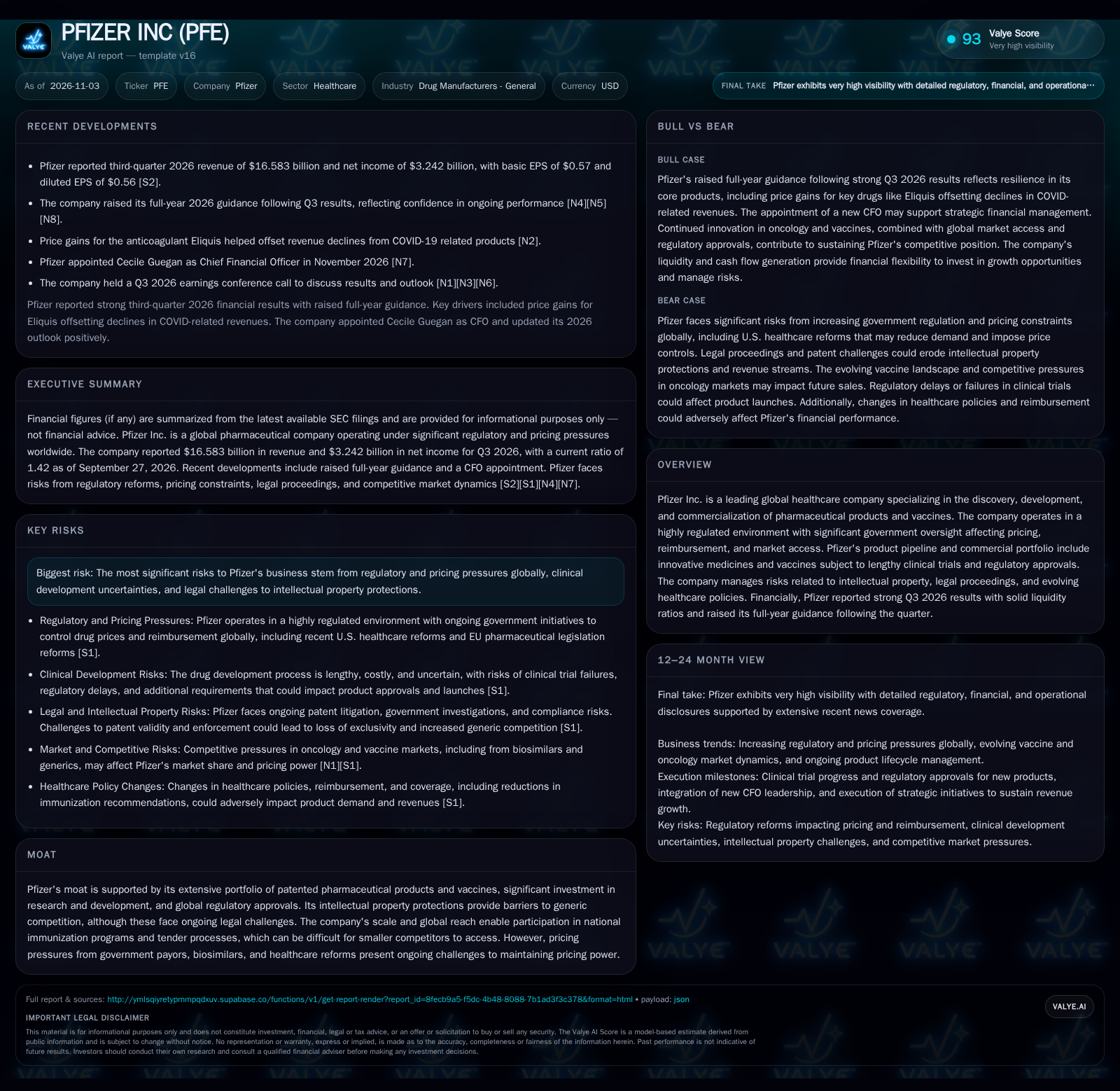
Pfizer reported third-quarter 2026 revenue of $16.583 billion and net income of $3.242 billion, with basic EPS of $0.57 and diluted EPS of $0.56 [S2]. Following these results, the company raised its full-year guidance, signaling confidence in its near-term outlook [N4] [N8]. Price gains for Eliquis, a leading anticoagulant, helped offset declining contributions from COVID-related products, highlighting a shift back to core portfolio drivers [N2].
The operating context is changing rapidly: U.S. healthcare reforms enacted with the OBBBA in 2025 introduced new pricing constraints and funding cuts to Medicare and Medicaid, while the EU Pharma Package and Health Technology Assessment Regulation are set to alter market access and pricing from 2026 onward [S1]. These regulatory shifts are likely to have an outsized impact on future revenue growth and margin structure.
Pfizer also announced the appointment of Cecile Guegan as CFO in November 2026, suggesting renewed attention to financial stewardship and possible capital allocation changes in response to a more challenging external environment [N7].
How Pfizer’s Revenue Model Faces Volume, Price, and Mix Pressures
Pfizer’s core economics are built around high-margin, patent-protected pharmaceuticals and vaccines, but the company’s ability to sustain premium pricing is under increasing threat. Historically, blockbuster drugs like Eliquis and innovative vaccines have supported strong gross margins, with scale helping to spread fixed R&D and SG&A costs. However, as COVID-related revenues recede and generic/biosimilar competition intensifies, the mix is shifting toward older products and markets with tighter pricing controls.
The company’s pricing power is being eroded by government payors and regulatory reforms, which can force rebates, price reductions, and delayed market access. In the U.S., the OBBBA’s new price negotiation mechanisms and Medicare/Medicaid funding cuts could sharply limit future price increases or even require rollbacks on existing products [S1]. In Europe, the new Pharma Package and Health Technology Assessment Regulation may result in longer approval timelines and stricter cost-effectiveness thresholds, further squeezing margins.
Pfizer’s fixed-cost structure—driven by ongoing R&D, regulatory compliance, and manufacturing investments—means that volume declines or price compression can have outsized effects on profitability. The company reported cash and liquidity metrics for the period; these figures do not by themselves establish operating runway, investment capacity, financial flexibility, or financing capacity. [S2]
Defending Market Share Amid Patent Expiry and Therapeutic Crowding
Pfizer’s competitive moat has historically relied on scale, a diversified portfolio, and strong intellectual property protections. However, several forces are eroding these advantages. Patent cliffs threaten exclusivity for key products, exposing Pfizer to generic and biosimilar competition that can rapidly compress both price and volume. In therapeutic areas like oncology and vaccines, the company faces not only large-cap pharmaceutical rivals but also nimble biotech firms and biosimilar manufacturers.
Government cost containment initiatives and health technology assessments are shifting negotiating leverage toward payors, undermining the traditional pricing power of branded pharma. The rise of biosimilars in the EU and other markets is accelerating this trend, particularly in complex biologics where regulatory pathways have matured. Pfizer’s ability to sustain premium pricing and access depends on continued innovation—either through new molecular entities, lifecycle management, or strategic partnerships.
Legal and compliance risks further complicate the landscape. Ongoing patent litigation, product liability claims, and government investigations raise the risk of sudden revenue losses or reputational damage, especially as regulators globally step up scrutiny on drug pricing and marketing practices [S1].
If Pipeline Execution and Pricing Leverage Outpace Regulatory Drag
In a favorable scenario, Pfizer’s late-stage pipeline delivers several high-value approvals in oncology, vaccines, or specialty care, driving new revenue streams that offset losses from patent expirations and COVID product declines. Effective lifecycle management of existing blockbusters—such as label expansions or new formulations—could prolong exclusivity and slow generic erosion. The company may also leverage its global scale to secure preferred access in national immunization programs and tenders, particularly in emerging markets less affected by Western pricing reforms.
If regulatory headwinds prove less severe than feared—perhaps due to successful industry lobbying or slower-than-expected implementation—Pfizer could maintain above-market pricing on core assets. Strong cost discipline under new CFO leadership might also improve operating leverage. Concrete evidence for this scenario would include accelerating approvals for late-stage assets, sustained or rising prices for key products despite policy changes, and margin improvement in subsequent quarters.
Falsification would occur if the pipeline underdelivers, regulatory pricing controls are implemented aggressively, or cost inflation erodes operating margins despite new product launches.
Adapting to a Post-COVID Plateau While Managing Regulatory and Patent Pressures
The most plausible near-term outcome is that Pfizer stabilizes its revenue base as COVID-driven sales normalize and pricing reforms gradually take hold. Price gains in legacy products like Eliquis may continue to soften the blow from pandemic-era revenue declines, but incremental volume growth will be limited by payor policies and competitive encroachment. The company will likely rely on a combination of targeted pipeline launches, cost containment efforts, and selective business development to defend its earnings base.
Regulatory headwinds in the U.S. and EU will likely cap price realization and slow new product uptake, but not uniformly across the portfolio. Some specialty and orphan drugs may retain pricing power, while mainstream assets see more pressure. Ongoing legal and patent challenges will continue to sap resources and create uncertainty, but are unlikely to trigger existential risk absent a major litigation or regulatory loss.
This scenario would be confirmed by relatively stable operating margins, a gradual decline in top-line growth, and continued management focus on pipeline execution and cost controls. It would be challenged if pricing pressure accelerates or the pipeline fails to deliver meaningful new launches.
When Regulatory and Competitive Shocks Converge: Risks to Profitability and Pipeline Value
In a bearish scenario, the combination of aggressive regulatory implementation (such as rapid Medicare price negotiations, deep EU cost controls, or global reference pricing) and accelerating generic/biosimilar competition could drive a sharp contraction in Pfizer’s revenue and margins. If key pipeline assets face clinical setbacks or regulatory delays, the company could struggle to replace lost exclusivity revenue and maintain R&D productivity.
Legal setbacks—such as adverse patent rulings or significant product liability judgments—could further undermine the IP moat and erode market share. In this environment, fixed costs become a burden, and management may be forced to undertake restructuring, divestitures, or radical cost cuts that could impair long-term innovation capacity.
Evidence for this scenario would include a steep decline in operating margins, negative revenue surprises, major patent or legal losses, and pipeline failures. It would be falsified by sustained pricing and volume in core franchises, or by successful new product launches that offset external shocks.
Milestones That Will Determine Pfizer’s Resilience in a Shifting Pharma Landscape
Progression and regulatory approval timelines for late-stage pipeline assets in oncology, vaccines, and specialty therapeutics—if disclosed—will be critical for future revenue replacement.
Quarterly pricing and volume trends for Eliquis and other core blockbusters, especially in markets affected by new price controls, would help test the durability of legacy franchises.
Implementation pace and scope of U.S. (OBBBA) and EU Pharma Package reforms, including any early evidence of forced price concessions or delays in market access.
Gross margin and operating margin evolution in the coming quarters, indicating management’s ability to offset top-line pressures through cost discipline or mix improvement.
Frequency and outcome of major patent litigation or product liability cases, which could signal further erosion of the IP moat.
Cash flow from operations and R&D reinvestment levels, as a gauge of both potential financial flexibility and long-term innovation capacity.
If disclosed, new business development activity—such as bolt-on acquisitions or licensing deals—that could supplement organic pipeline growth.
Disclaimer: This is research-only, informational analysis and not investment advice. It may include AI-generated interpretation and general industry context. Always verify important details using primary sources.

Comments