
Tennant Co: Robotics Ambition, Earnings Volatility, and the Shifting Economics of Industrial Cleaning
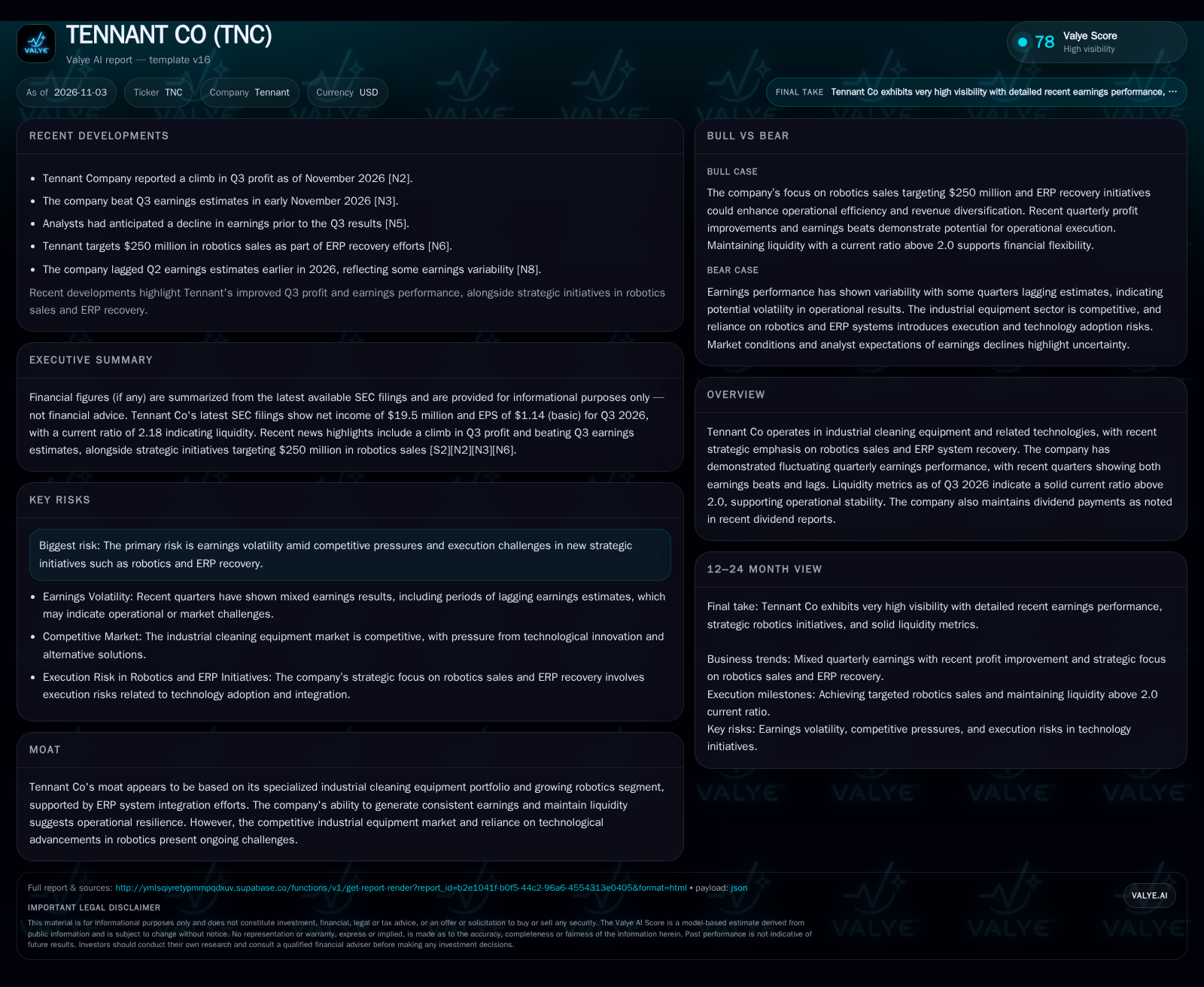
Tennant’s Q3 earnings beat and a $250 million robotics sales target anchor its renewed push into automation, but mixed recent quarters and execution risk in ERP-driven transformation raise questions about the durability and scalability of its competitive edge.
[S2] [N6] However, recent earnings volatility and the challenge of integrating new technology suggest the path to sustained margin and revenue growth remains uncertain.
Tennant Company’s recent Q3 results highlight both renewed momentum and persistent uncertainty. With a notable earnings beat and a strategic push toward $250 million in robotics sales, Tennant is signaling a pivot toward automation and digital transformation in industrial cleaning. Yet, the company’s recent history of mixed earnings and the inherent risks of large-scale ERP and robotics integration underscore that operational resilience will be tested by both internal execution and external competition. The next phase hinges on whether Tennant can translate technological ambition into durable, scalable economics.
Earnings Rebound and Robotics Ambitions Define Tennant’s Latest Moves
[S2] The company also beat Q3 earnings estimates, surprising analysts who had expected a decline [N2] [N3] [N5]. Importantly, Tennant has publicly targeted $250 million in robotics sales as part of its ERP recovery and strategic transformation, signaling a major bet on automation as a growth lever [N6]. However, recent quarters have shown earnings variability, with Q2 2026 results lagging expectations [N8]. These facts set the stage for a company at a strategic crossroads: operationally stable but facing the challenge of turning technology investment into sustained growth and margin improvement.
The interplay between robotics adoption and ERP system stabilization is critical to Tennant's near-term operational narrative. While robotics sales growth indicates market acceptance, the underlying ERP system's maturity will influence how well the company can scale these new offerings without operational bottlenecks. If the ERP platform fails to integrate smoothly with robotics sales and service workflows, it could create inefficiencies that negate the benefits of automation. Conversely, a robust ERP foundation could enable more agile inventory management, faster customer response times, and better data-driven decision making, all of which are essential for sustaining growth in a technology-driven product line.
How Automation Could Reshape Tennant’s Revenue and Margin Profile
Tennant’s core business revolves around the design, manufacture, and sale of industrial and commercial cleaning equipment—traditionally a capital-intensive, cyclical sector with moderate gross margins and significant aftermarket/service revenue potential. The company’s push into robotics aims to capture a segment with higher potential unit economics: autonomous cleaning machines can command premium pricing, offer recurring software or maintenance revenue streams, and may lower service costs for end-users. If Tennant succeeds in scaling its robotics segment, the business mix could shift toward a more software- and service-heavy model, potentially increasing gross margins and smoothing cyclical volatility.
The company’s ERP recovery initiative is also critical to economics. A successful ERP overhaul could reduce SG&A costs through better process automation and inventory management, supporting operating leverage. However, capital expenditures for robotics R&D and ERP implementation are likely to be elevated in the near term, with payback dependent on adoption rates and pricing discipline. The risk is that if robotics adoption is slower than expected or price competition intensifies, Tennant could face margin compression and lower returns on invested capital.
The transition toward a robotics-augmented business model also introduces new capital allocation and risk considerations. Robotics development and deployment require upfront R&D and manufacturing investments that may not yield immediate returns, especially if customer adoption cycles lengthen due to budget constraints or skepticism about new technology. Additionally, the shift toward software and service revenue streams typically involves longer sales cycles and requires building customer trust in ongoing subscription or maintenance contracts. If Tennant can successfully manage this transition, it could reduce revenue cyclicality and increase customer lifetime value. However, failure to balance upfront costs with recurring revenue growth could pressure free cash flow and constrain reinvestment capacity.
Competitive Dynamics: Can Robotics and Integration Offset Sector Pressures?
The industrial cleaning equipment market is mature and highly competitive, with established multinational peers, regional manufacturers, and new entrants leveraging automation and IoT. Tennant’s historical moat has relied on brand reputation, product reliability, and a broad service network. The pivot to robotics and ERP-driven integration could differentiate Tennant if it delivers superior automation, uptime, and lifecycle cost advantages for customers.
However, barriers to entry in robotics are falling as sensor, AI, and navigation technologies become more commoditized. Larger diversified equipment manufacturers and pure-play automation startups are also targeting the autonomous cleaning segment, which could erode pricing power and force Tennant to compete more aggressively on total cost of ownership and integration services. The key question is whether Tennant can translate its legacy customer relationships and distribution into a defensible robotics platform with sticky software or data-driven services.
Tennant's ability to leverage its existing service network and customer relationships to cross-sell robotics solutions will be a key competitive lever. In markets where customers prioritize total cost of ownership and operational uptime, integrated offerings that combine hardware, software, and service contracts can increase switching costs and improve customer retention. However, the commoditization of core robotics components means that differentiation increasingly depends on proprietary software capabilities, data analytics, and seamless integration with customer workflows. If Tennant cannot accelerate innovation in these areas or fails to establish a platform approach that locks in customers, it risks losing ground to more agile or specialized competitors who can offer superior automation ecosystems.
If Robotics Adoption Accelerates and ERP Delivers Efficiency Gains
In a favorable scenario, Tennant’s robotics sales ramp faster than anticipated, validating the $250 million target and driving a mix shift toward higher-margin automation products and recurring software/service revenue. Successful ERP implementation unlocks cost savings and improves working capital efficiency, enabling Tennant to expand margins even as topline grows. This would likely be confirmed by consecutive quarters of robotics segment revenue acceleration, rising gross and operating margins, and sustained outperformance versus analyst expectations.
A confirming signal would be new customer wins in large, multi-site facilities (such as logistics, healthcare, or airports), with contract structures that bundle hardware, software, and ongoing support. Evidence of improved customer retention and positive feedback on automation ROI would further reinforce the upside case. Conversely, if robotics revenue stalls or margin gains fail to materialize despite topline growth, the upside thesis would be undermined.
Mixed Execution: Gradual Robotics Uptake Amid Sector Headwinds
The most plausible scenario is that Tennant’s robotics segment grows, but adoption is gradual due to customer trial cycles, integration complexity, and capital budgeting constraints in key end markets. ERP improvements yield modest efficiency gains, but implementation challenges and learning curves limit the immediate margin impact. Core equipment sales remain stable or grow modestly, while competitive pricing and technology upgrades pressure gross margins.
This scenario would be confirmed by steady but unspectacular robotics revenue growth, continued earnings variability quarter-to-quarter, and margin improvement that lags initial expectations. Analyst estimates may oscillate based on execution milestones and macro demand. The thesis would be challenged if robotics adoption remains niche or if ERP disruptions offset operational benefits.
When Execution Risk and Competitive Intensity Collide
In a negative outcome, Tennant’s robotics initiative underdelivers, with uptake hampered by technical issues, customer resistance, or aggressive competitor pricing. ERP recovery efforts stall or introduce operational disruptions, leading to higher costs, inventory imbalances, or service lapses. Core equipment sales face intensified competition from both traditional and automation-first rivals, compressing margins and eroding share.
This scenario would be confirmed by missed robotics revenue milestones, declining overall margins, and repeated earnings misses relative to consensus. Customer attrition, delayed product launches, or negative feedback on automation reliability would further validate the downside.
Milestones That Will Define Tennant’s Robotics and ERP Transformation
Quarterly robotics sales (if disclosed): Tracking progress toward the $250 million target will clarify adoption velocity and revenue mix shifts.
Gross and operating margin trends: Sustained improvement would indicate successful execution on robotics and ERP efficiency, while stagnation or declines would point to cost or pricing headwinds.
ERP implementation milestones: Updates on project timelines, cost savings, and operational disruptions (if any) will help assess risk to core operations.
Customer win announcements in automation: New contracts—especially with large, multi-site operators—would signal market traction for robotics offerings.
Recurring revenue from software or services (if disclosed): Evidence of bundled contracts or SaaS-like models would support the thesis of improving margin quality.
Competitive product launches or pricing moves: Announcements from major rivals in autonomous cleaning could reshape the pricing environment or customer expectations.
Disclaimer: This is research-only, informational analysis and not investment advice. It may include AI-generated interpretation and general industry context. Always verify important details using primary sources.

Comments