
Palisades Venture Inc.: Cloud Continuity Ambitions Face Solvency and Scale Barriers
The company’s current structure—relying on consultants rather than employees and lacking active market trading—limits operational resilience and strategic flexibility.
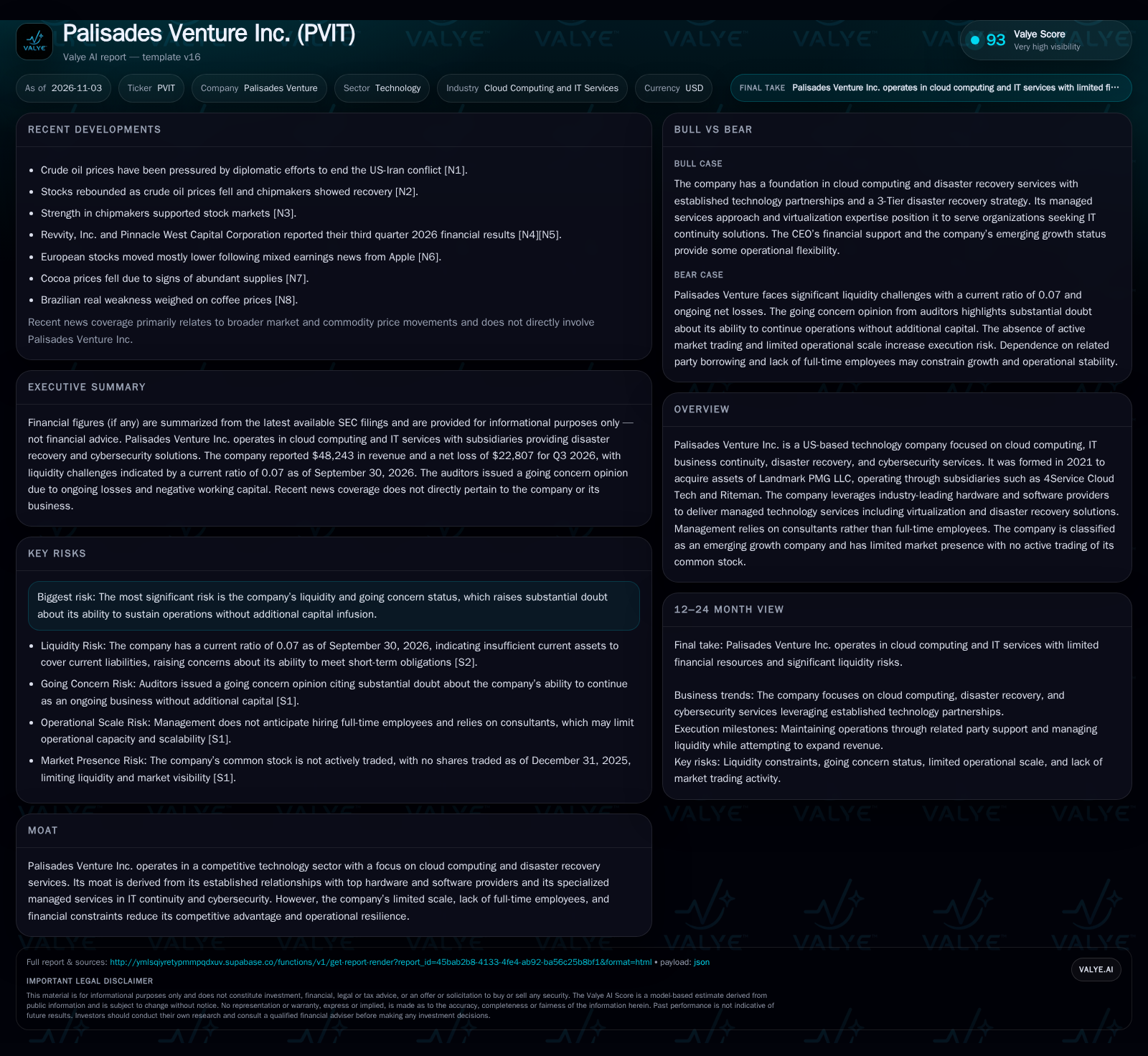
The company’s current structure—relying on consultants rather than employees and lacking active market trading—limits operational resilience and strategic flexibility. Future viability hinges on securing additional capital and demonstrating scalable, recurring revenue in a highly competitive sector. [S1] [S2]
Palisades Venture Inc. embodies the promise and peril of small-scale cloud computing providers operating in a capital-intensive, trust-driven sector. Formed in 2021 to absorb the assets of Landmark PMG LLC, the company delivers managed IT continuity, disaster recovery, and cybersecurity services through subsidiaries with a decade-long track record. However, Palisades’ current financials reveal a business at a crossroads: revenue remains modest, operating losses persist, and a severe liquidity shortfall is compounded by a going concern warning from auditors. The company’s ability to survive—and eventually thrive—depends on both immediate capital infusion and its capacity to execute in a crowded, credibility-driven market.
Acute Liquidity Pressure and Going Concern Warning Define the Present
As of September 30, 2026, Palisades Venture Inc. reported $48,243 in quarterly revenue and a net loss of $22,807, continuing a pattern of unprofitability [S2]. The company’s current assets totaled just $6,661 against current liabilities of $92,337, yielding a current ratio of 0.07—well below thresholds generally considered viable in the sector [S2]. Auditors have issued a going concern opinion, explicitly warning there is substantial doubt about the company’s ability to continue as an ongoing business unless additional capital is secured [S1]. The CEO has provided some financial support, but no formal funding commitment exists [S1].
Managed Services in Cloud Continuity: Revenue Structure and Cost Pressures
Palisades Venture’s business model centers on providing managed IT services, focusing on business continuity, disaster recovery, and cybersecurity—segments where reliability and trust are paramount. The company leverages industry-standard hardware and software from vendors like Cisco, Dell, HP, and Microsoft, suggesting a capital-light approach to infrastructure but also a reliance on third-party platforms, which may compress gross margins if the company cannot capture value through proprietary differentiation or high-margin service contracts [S1].
In the broader managed IT continuity sector, recurring revenue is often structured around service agreements, but the report does not specify Palisades’ contract mix, pricing model, or renewal rates. This leaves uncertainty about the company’s revenue visibility and customer retention. The reliance on consultants, rather than full-time employees, may reduce fixed costs but can introduce higher per-unit labor expense, limit organizational learning, and impede the development of scalable, repeatable processes. In capital-intensive IT services, upfront investment in sales, support, and security is often necessary to build trust and win larger contracts—requirements that may be difficult to meet given Palisades’ reported liquidity position and negative working capital.
A critical dimension to assess in Palisades’ business model is the balance between fixed and variable costs inherent in managed IT services. While reliance on consultants reduces fixed payroll obligations, it may increase variable labor costs and limit the company’s ability to standardize service delivery. This dynamic can constrain margin expansion and inhibit the development of proprietary processes or automation tools that typically drive scalability in IT continuity firms. Furthermore, the absence of a stable, full-time workforce may hinder knowledge retention and customer relationship depth, both essential for upselling and contract renewals in a trust-dependent sector.
Another relevant factor is the competitive pressure on pricing models within the managed services market. Palisades’ dependence on third-party vendor technology platforms means it must compete largely on service quality, customization, and responsiveness rather than technological differentiation. In a market where larger providers leverage economies of scale to offer bundled, cost-effective packages, Palisades faces the challenge of justifying premium pricing or securing long-term contracts that provide predictable revenue streams. Without clear evidence of differentiated service capabilities or niche specialization, sustaining profitable growth under these cost and pricing pressures remains uncertain.
Sector Headwinds: Limited Scale and Organizational Depth in a Crowded Market
Palisades faces formidable competition from both established managed service providers and cloud hyperscalers offering bundled IT continuity, disaster recovery, and cybersecurity solutions. Its relationships with leading technology vendors enable access to best-in-class tools but do not confer exclusive advantage or meaningful pricing power. In IT continuity, switching costs can be high for entrenched providers, but Palisades’ lack of scale, minimal direct employees, and uncertain financial footing may deter enterprise customers who demand stability, rapid response, and regulatory compliance.
The company’s operational model—consultant-driven and asset-light—could provide flexibility, but it also raises concerns about consistency, security, and knowledge retention. Without clear proprietary technology, unique intellectual property, or robust platform effects, Palisades’ moat appears narrow. The absence of active share trading and limited brand presence further constrain its ability to attract talent, customers, and partners relative to larger, better-capitalized peers.
If Capital Arrives: Pathways to Stabilization and Niche Growth
With adequate funding, the company could focus on deepening its managed services for small and mid-sized enterprises (SMEs) that value personalized support and industry-specific disaster recovery expertise.
Signs that this scenario is unfolding would include new capital commitments, expanded sales activity, and evidence of multi-year service contracts. Improved gross margins, driven by higher utilization of existing technology assets and a more predictable revenue base, would further validate the thesis. If Palisades secured a handful of anchor customers willing to commit to multi-year continuity and cybersecurity solutions, it could achieve sufficient scale to invest in specialized offerings or automation, supporting a modest but defensible niche.
Survival Mode: Scramble for Capital and Incremental Revenue While Risks Persist
Absent immediate external funding, Palisades is likely to remain in a state of financial triage, relying on ad hoc support from its CEO or related parties to cover operating expenses while seeking new business. The most plausible near-term trajectory involves continued pursuit of small-scale, project-based contracts, with little capacity for substantive investment in sales, marketing, or product development.
In this scenario, the company may keep operating but risks further erosion of credibility and operational quality as liquidity tightens. Confirmation would come from continued small revenue streams, further net losses, and no material change in the current ratio or working capital position. Falsification would require disclosure of a transformative contract, capital raise, or strategic partnership that materially alters the balance sheet or revenue outlook.
Liquidity Exhaustion Leading to Service Disruption or Dissolution
If Palisades fails to secure additional capital or generate sufficient cash flow, the company’s acute liquidity deficit could force it to cease operations, disrupt customer service, or enter restructuring. The lack of formal funding commitments, combined with ongoing net losses and a going concern warning, makes this a tangible risk.
Early warning signs would include further deterioration in current assets, default on payables, loss of key consultant relationships, or public disclosure of efforts to sell assets or wind down operations. A forced exit could erode any remaining brand equity and leave customers seeking more stable alternatives, particularly in a sector where trust and continuity are critical.
Milestones That Would Shift the Palisades Venture Thesis
Disclosure of new capital commitments (equity, debt, or strategic investment) that materially improve liquidity and solvency.
Announcement of multi-year, recurring service contracts with anchor customers—particularly those in regulated or mission-critical sectors.
Evidence of improved gross margins or reduced net losses, indicating progress toward cost discipline or pricing power.
Transition from consultant-only operations to building a core team of full-time employees, signaling investment in organizational depth.
Expansion of branded service offerings or proprietary IP that differentiates Palisades from commodity managed service providers.
Material increase in active market trading of Palisades shares, improving potential financial flexibility and market visibility.
If disclosed, customer retention and renewal rates that would signal early traction and stickiness in core service lines.
Any new auditor opinion or SEC disclosure that updates the company’s going concern status or highlights changes in risk profile.
Disclaimer: This is research-only, informational analysis and not investment advice. It may include AI-generated interpretation and general industry context. Always verify important details using primary sources.

Comments