
Strata Critical Medical: Integrated Transplant Logistics, Clinical Expansion, and the Challenge of Sustainable Profitability
Strata Critical Medical’s sharp revenue acceleration and asset-light logistics model reflect growing demand and operational leverage in U.S. organ transplant services. Yet, persistent net losses, complex regulatory demands, and competitive threats from internal hospital offerings and specialty providers pose real questions about the durability and scalability of its business model.
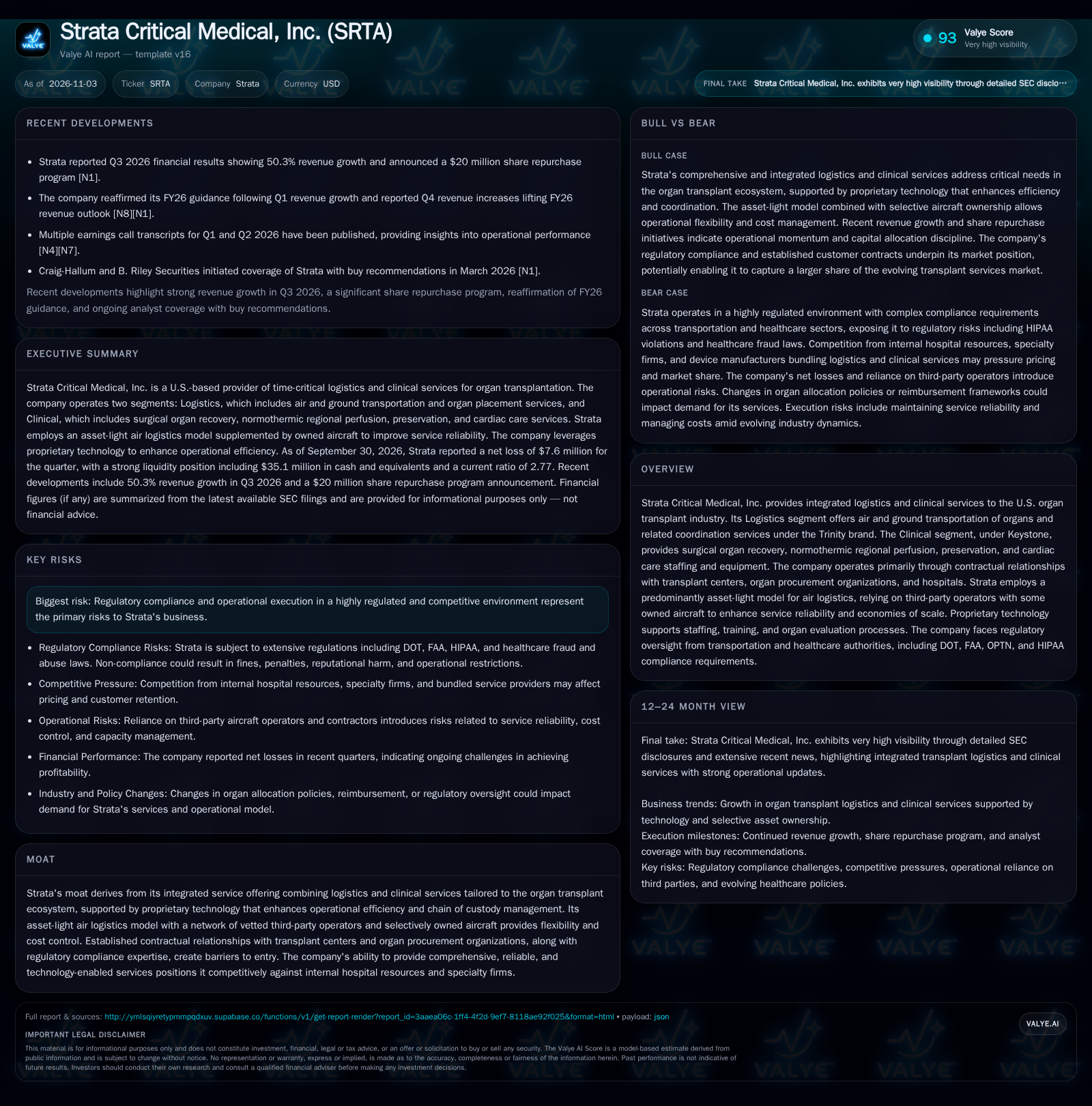
Strata Critical Medical, Inc. delivers integrated logistics and clinical services for organ transplantation, reporting 50.3% revenue growth in Q3 2026 and reaffirming FY26 guidance. While the company’s mix of proprietary technology and selective asset ownership has driven operational momentum, it continues to report net losses and faces regulatory, competitive, and execution risks in a complex healthcare ecosystem. Sustainable profitability and market share gains will hinge on Strata’s ability to scale its differentiated model amid intensifying industry pressures. [N1] [S2] [N8]
Strata Critical Medical, Inc. sits at the intersection of urgent medical logistics and clinical expertise, servicing the intricate U.S. organ transplant ecosystem. Its reported 50%+ revenue growth in Q3 2026 demonstrates accelerating demand for integrated, technology-enabled logistics and clinical services. Yet, the company’s persistent net losses and the realities of a highly regulated, competitive market cast doubt on the near-term path to profitability. Strata’s ability to sustain growth, manage costs, and defend its position against hospital in-sourcing and specialty competitors will determine whether recent momentum translates into lasting value.
Recent Financial Acceleration, Capital Moves, and Persistent Losses
Strata Critical Medical reported a striking 50.3% year-over-year revenue increase in Q3 2026, bolstered by Q1 and Q4 outperformance that led management to reaffirm and later raise FY26 revenue guidance [N1] [N8]. This topline expansion comes alongside a $20 million share repurchase program announcement, suggesting a proactive stance on capital allocation. However, the company remains in the red, with a Q3 2026 net loss of $7.6 million and negative EPS, highlighting that robust revenue momentum has not yet translated into profitability [S2]. Balance sheet data as of September 30, 2026, shows $35.1 million in cash and a current ratio of 2.77, indicating reported liquidity position but not resolving the structural earnings question [S2].
Integrated Service Model and the Economics of Asset-Light Medical Logistics
Strata’s value proposition is rooted in its dual-segment approach: the Logistics segment (Trinity) provides rapid air and ground organ transport, while the Clinical segment (Keystone) offers surgical organ recovery, preservation, perfusionist staffing, and related services [S1]. The company’s asset-light model—primarily relying on third-party aircraft and contractors—enables variable cost structures and mitigates the capital intensity typical of aviation logistics. Selective ownership of fixed-wing aircraft, initiated in 2024, is intended to capture economies of scale and improve service reliability, though it introduces higher fixed costs and potential utilization risk if volumes falter [S1].
Pricing power in this industry is complex. Urgency and regulatory scrutiny often grant providers some latitude, but competition from internal hospital teams and niche specialists tempers this. The mix of contractual relationships with transplant centers, organ procurement organizations, and hospitals likely provides some revenue visibility, yet the degree of multi-year or recurring contract stability remains unconfirmed in disclosures. Technology-driven efficiencies—in staffing, chain-of-custody, and organ evaluation—could drive operating leverage if Strata scales further, but the path to margin expansion depends on both sustained volume growth and disciplined cost management.
Defending Share in a Fragmented, High-Stakes Transplant Ecosystem
Strata’s competitive environment is defined by fragmentation and specialization. It contends with Part 135 jet operators for logistics, asset-light medical transport firms, internal hospital logistics resources, and specialist clinical service providers [S1]. Its integrated offering—combining logistics with clinical and perfusion services—aims to differentiate via a one-stop solution supported by proprietary technology. This integration can increase switching friction for large transplant centers, especially when combined with regulatory expertise and chain-of-custody assurances.
However, several counterforces threaten share and pricing. Hospitals retain incentives to in-source logistics and clinical functions where possible, particularly as cost pressures mount. Device manufacturers may bundle logistics and clinical support with equipment sales, eroding standalone service demand. Niche competitors with narrow focus (e.g., perfusion staffing, specialty air transport) can undercut on price or service depth. Regulatory changes—such as shifts in organ allocation or reimbursement—could also alter the competitive calculus overnight. Strata’s moat, if it endures, will rely on deep integration, demonstrated reliability, and regulatory fluency rather than price leadership.
Pathways to Margin Expansion and Share Gains in Organ Transplant Services
Strata’s best-case scenario involves leveraging its integrated logistics and clinical platform to drive both scale and operating leverage. If the company continues to capture share from fragmented competitors and in-sourced hospital teams—enabled by its proprietary technology and selective asset ownership—volume growth could outpace cost inflation, pushing the business toward profitability. Further, as transplant volumes rise nationwide (driven by demographic trends and policy shifts expanding organ eligibility), demand for reliable, end-to-end logistics and clinical support may accelerate.
Confirmation of this scenario would require evidence of sustained double-digit revenue growth, sequential improvement in gross and operating margins, and clear disclosures of multi-year contract wins or renewals with major transplant centers. Disclosures of customer retention rates or expansion of proprietary technology adoption would further bolster the bullish thesis.
Maintaining Growth Amid Execution and Margin Headwinds
The most plausible trajectory for Strata is continued revenue growth in line with industry demand and incremental share gains, but with persistent profitability challenges. The asset-light model and proprietary technology likely enable some operating leverage, yet rising labor, compliance, and logistics costs may offset scale benefits. Selective aircraft ownership could improve service reliability, but also risks underutilization if demand is episodic or regionally concentrated.
In this scenario, Strata’s revenue growth remains robust but net income stays negative or only marginally improves, as seen in recent quarters. Evidence supporting this view would include ongoing top-line expansion without a commensurate rise in net or operating margins, continued reliance on third-party providers, and limited disclosures of long-term, high-visibility contracts. Analyst coverage with buy recommendations suggests optimism about growth, but not necessarily about near-term profitability [N1]. Any improvement in cash flow or margin trends would need to be sustained over several quarters to shift the core thesis.
Regulatory Shocks, In-Sourcing, and Margin Compression Threaten the Model
The adverse path for Strata involves a confluence of regulatory tightening, hospital in-sourcing, and competitive price pressure. Should regulators increase scrutiny or change organ allocation/reimbursement rules, Strata could face higher compliance costs or reduced demand for outsourced services. Hospitals, under fiscal strain, may accelerate the build-out of internal logistics or clinical teams, eroding Strata’s addressable market.
Simultaneously, specialist competitors may undercut on price or bundle services more effectively, forcing Strata to make margin-eroding concessions to retain customers. If owned aircraft and equipment are underutilized, fixed costs could weigh further on the bottom line. Confirmation of this scenario would include a slowdown or reversal in revenue growth, deteriorating margins, regulatory fines or investigations, and disclosures of major customer attrition.
Milestones That Will Define Strata’s Competitive and Financial Outcomes
Quarterly gross and operating margin trends: Sustained improvement would suggest scale benefits and operating leverage; stagnation or decline would indicate cost pressures are outpacing growth.
Disclosure of multi-year or recurring contract wins: Confirmation of high-visibility, sticky revenue streams would help test the durability of customer relationships.
Aircraft and equipment utilization rates (if disclosed): Rising utilization would support the selective asset-ownership strategy; underutilization would signal overcapacity risk.
Customer retention and expansion rates: High retention or wallet-share growth would validate switching frictions and integrated value proposition.
Regulatory or reimbursement changes impacting transplant logistics: Any announced or implemented policy shifts could materially affect service demand and margin structure.
Net income and operating cash flow progression: Movement toward break-even or positive cash flow would confirm the path to profitability.
Evidence of competitive displacement or hospital in-sourcing: Announcements of lost contracts, major customer insourcing, or new specialty entrants would pressure the thesis.
Adoption and impact of proprietary technology on efficiency: Tangible metrics or case studies demonstrating improved cycle times, error rates, or cost savings would help confirm the technology edge.
Disclaimer: This is research-only, informational analysis and not investment advice. It may include AI-generated interpretation and general industry context. Always verify important details using primary sources.

Comments