
Huntsman’s Polyurethanes Platform: Margin Challenges and the Search for Differentiation in Global Chemicals
Huntsman’s scale, global reach, and specialty focus in polyurethanes create both opportunity and exposure—recent losses underscore the tension between product mix, raw material volatility, and cyclical demand. The company’s integrated approach and downstream presence offer levers, but profitability and resilience hinge on navigating industry headwinds and capturing value from technical solutions.
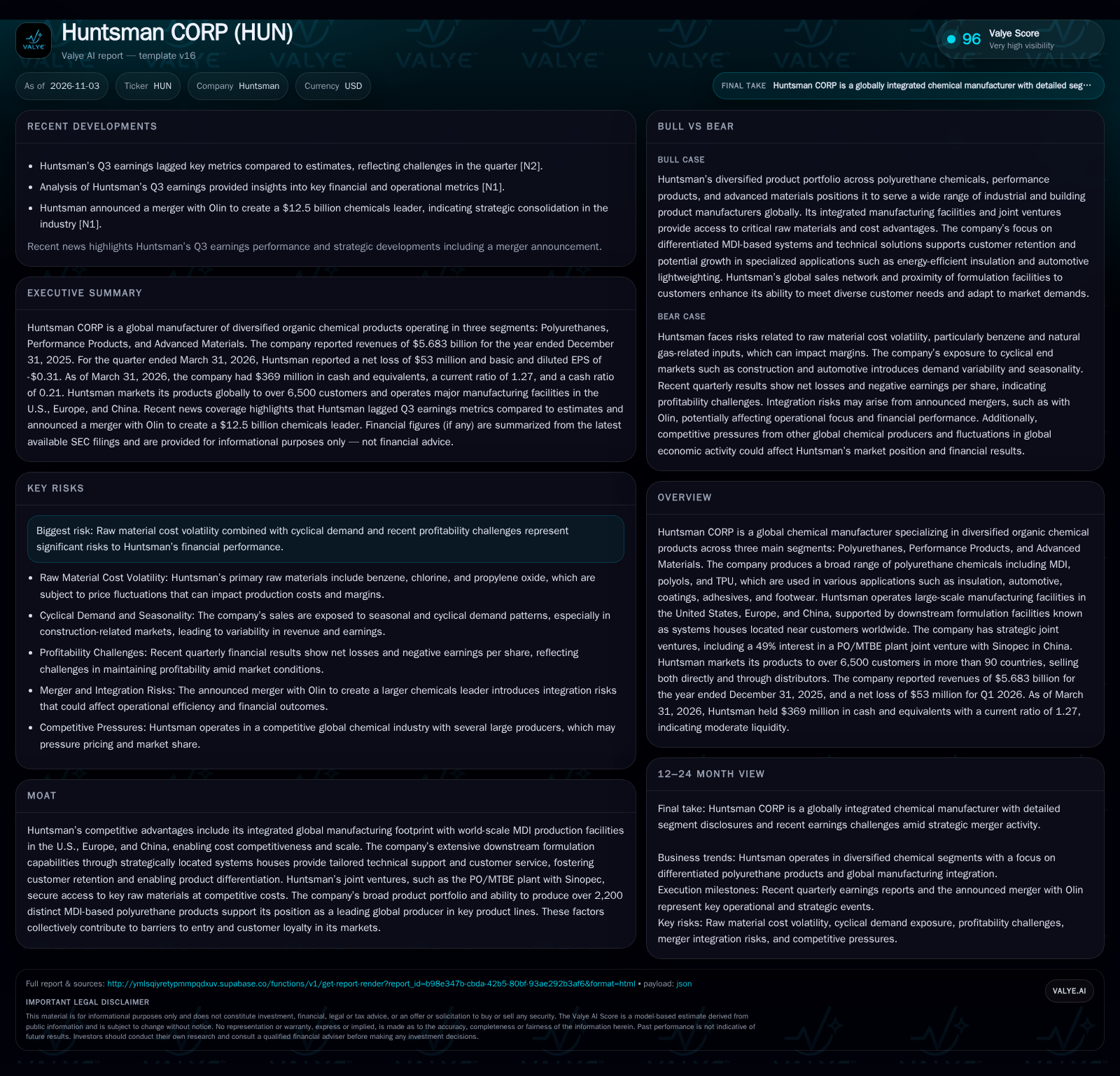
Huntsman CORP, a leading global manufacturer of organic chemical products, reported $5.7B in 2025 revenue but posted a Q1 2026 net loss of $53M amid margin and demand pressures. Its scale in polyurethanes and downstream 'systems houses' offer competitive advantages, but cyclical end markets and raw material volatility test its ability to sustain profitability. The company’s future hinges on mix improvements, cost discipline, and capturing value from differentiated offerings like energy-efficient insulation and technical MDI systems. [S1] [S2]
Huntsman CORP stands as a global force in polyurethanes and specialty chemicals, leveraging scale, integration, and a broad product portfolio to serve industrial, construction, and consumer markets. Yet, its Q1 2026 net loss—and a broader pattern of earnings pressure—highlights the structural tension between differentiated technical offerings and the commodity-like volatility of raw material inputs and end-market demand. The company’s ability to harness its downstream footprint, joint ventures, and specialty focus to drive margin improvement and resilience will be pivotal as cyclical and competitive pressures intensify.
Recent Losses and Margin Pressures Define the Current Operating Backdrop
Huntsman reported a net loss of $53 million for Q1 2026, with basic and diluted EPS of -$0.31, on the back of $5.683 billion in 2025 revenue [S1] [S2]. This negative result comes amid a period when the company’s earnings have lagged expectations and highlights the acute impact of margin compression and demand softness in core end markets [N2]. The company’s cash and equivalents were $369 million as of March 31, 2026, with a current ratio of 1.27—indicative of moderate near-term liquidity but not a robust reported cash balance [S2].
Huntsman’s global manufacturing network remains a key asset, with major polyurethane production facilities in the U.S., Europe, and China, and 21 downstream 'systems houses' enabling proximity to customers and formulation customization [S1]. The company’s 49% stake in a PO/MTBE joint venture with Sinopec provides partial insulation from propylene oxide price volatility—a critical feedstock for polyurethane production [S1].
How Huntsman’s Product Mix, Scale, and Integration Shape Earnings Power
Huntsman’s economics are driven by a blend of scale-driven cost efficiencies in core MDI production and the value-added potential of downstream formulation and technical services. The company’s 2.9 billion pounds of MDI capacity underpins its ability to supply global OEMs and formulators, while systems houses enable tailored, higher-margin offerings for insulation, automotive, and industrial applications [S1].
The business is highly sensitive to raw material costs, including benzene, chlorine, and propylene oxide. While integrated production and joint ventures can buffer some input volatility, pass-through pricing to customers is often subject to lag and competitive dynamics. This creates a cyclical margin structure: when feedstock prices rise quickly or end-market demand falls, gross margins compress and operating leverage turns negative.
Volume growth is typically tied to broader industrial and construction cycles, while product mix shifts—such as increased adoption of spray polyurethane foam insulation or specialty MDI systems—can support incremental pricing power. However, capturing this mix benefit requires sustained R&D, technical service, and capital investment. Fixed costs are substantial in the upstream production network, amplifying both upside and downside swings in utilization and pricing.
Competing on Scale, Proximity, and Technical Differentiation—But Facing Global Pressures
Huntsman’s competitive position rests on its global manufacturing scale, integrated supply chain, and the breadth of its polyurethane product portfolio. Its downstream 'systems houses' are strategically located near major customers, supporting rapid formulation, technical support, and customization—factors that can drive customer stickiness, particularly in specialized applications.
However, the company operates in a fiercely competitive global chemicals landscape. Large diversified peers and regional specialists exert pricing pressure, especially in commoditized MDI and polyol products. Substitution risks persist in key end markets: alternative insulation materials, evolving automotive lightweighting approaches, and regulatory changes could shift demand away from polyurethane solutions.
Huntsman’s joint venture with Sinopec provides a raw material supply hedge in China, but also exposes the company to geopolitical and partner-related risks. The company’s ability to defend and grow share will depend on sustaining technical differentiation, cost discipline, and customer relationships in the face of both global and local competitors.
Mix Shift Toward Technical Solutions Unlocks Margin Expansion
A favorable scenario for Huntsman involves a sustained shift in demand toward higher-value, differentiated polyurethane systems—such as energy-efficient spray foam insulation and automotive lightweighting solutions. If the company leverages its technical service network and downstream proximity to customers to drive adoption of these products, incremental pricing power and margin expansion could follow.
Confirmation would come from rising segment margins, growing sales of specialty or differentiated products, and evidence of customer stickiness—such as multi-year supply agreements or increased share of wallet in key OEM relationships (if disclosed). In this scenario, Huntsman’s global network and R&D investments translate into both volume growth and improved unit economics, partially buffering raw material volatility.
A falsification of this thesis would be persistent stagnation or decline in specialty product sales, flat or declining margins despite stable raw material costs, or customer migration to alternative materials and suppliers.
Navigating Cyclicality with Incremental Mix Improvement and Cost Control
The most plausible near- to medium-term outcome is that Huntsman continues to experience cyclical swings tied to construction, automotive, and industrial demand, with moderate improvements in product mix as technical solutions gain slow traction. Earnings and cash flow remain volatile, with margin recovery dependent on both end-market stabilization and ongoing cost management.
Evidence for this scenario would include gradual improvement in segment operating margins, stable or slightly increasing revenue in differentiated products, and maintenance of reported liquidity position. The company’s share repurchase authorization may remain largely unused unless free cash flow improves materially [S2].
A shift away from this base case would be signaled by either a structural decline in end markets (driving sustained losses) or a step-change in margin profile due to successful technical innovation and mix shift.
Raw Material Spikes and End-Market Weakness Drive Prolonged Profitability Erosion
In a negative scenario, Huntsman faces simultaneous raw material cost inflation and weak demand in construction and automotive markets, leading to sustained margin compression and operating losses. If the company is unable to offset input cost pressures through price increases or mix shift, negative operating leverage could erode both profitability and cash flow.
Confirmation would come from continued net losses, declining gross and segment margins, and deterioration in liquidity metrics—such as a falling current ratio or reduced cash balance. Signs of customer attrition, underutilized capacity, or forced asset sales would further validate this scenario.
Falsification would require stabilization or improvement in margins despite adverse raw material trends, or evidence that differentiated products are offsetting declines in core commodity segments.
Testing Huntsman’s Thesis: What Would Signal a Structural Turn or Persistent Pressure?
Quarterly segment operating margins and gross margin trends—especially in Polyurethanes and Advanced Materials—would help reveal whether mix and pricing initiatives are gaining traction.
Volume and revenue growth in differentiated technical solutions (e.g., spray polyurethane foam insulation, automotive specialty systems) would support the case for margin improvement if disclosed.
Trends in raw material costs—especially benzene, chlorine, and propylene oxide—and Huntsman’s ability to pass through these costs to customers should be closely monitored.
Utilization rates at major MDI and polyol manufacturing facilities, if disclosed, would indicate the balance between fixed-cost absorption and market demand.
Customer retention metrics, contract renewals, or share of wallet in key OEM relationships (if disclosed) would provide insight into the durability of Huntsman’s downstream advantage.
Progress or setbacks in the Sinopec joint venture—such as changes in volume, pricing, or strategic alignment—could materially impact Huntsman’s cost base in China.
Disclaimer: This is research-only, informational analysis and not investment advice. It may include AI-generated interpretation and general industry context. Always verify important details using primary sources.

Comments