
DuPont’s Strategic Refocus: Specialty Chemicals, Portfolio Shifts, and the Resilience Test
DuPont emerges from a period of major portfolio realignment—shedding electronics and aramids, deepening in healthcare and water technologies, and acquiring targeted capabilities—into a specialty-chemicals landscape marked by operational risks and opportunities for margin improvement. The company’s ability to translate its streamlined structure into durable growth and defend profitability against external shocks will be the core test ahead.
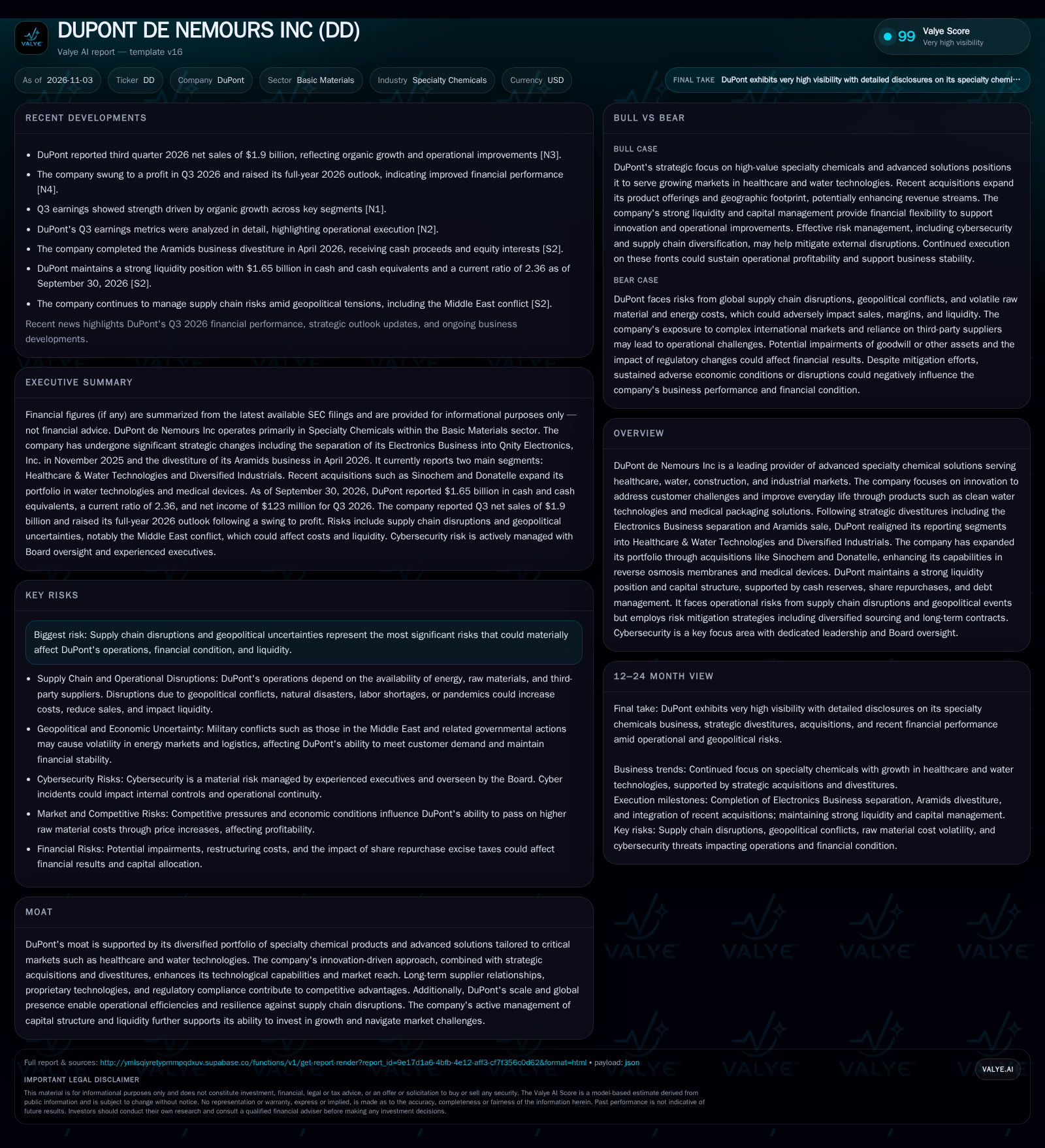
DuPont’s Q3 2026 swing to profit and raised full-year outlook follow major divestitures and acquisitions that reshape its specialty chemicals portfolio. The answer will hinge on the integration of new assets, execution in core markets, and real pricing power against persistent cost risks. [S2] [N1] [N4]
DuPont de Nemours has radically reconfigured its business over the past two years, exiting electronics and aramids to double down on higher-value specialty chemicals for healthcare, water, and select industrial markets. The company’s Q3 2026 results—marked by a return to profitability and a raised outlook—signal early momentum for the new, more focused DuPont. Yet, this phase also exposes the company to classic specialty chemicals risks: cyclical demand, input cost volatility, and supply chain fragility. Whether DuPont can deliver sustained margin improvement and innovation-driven growth now depends on its execution post-divestitures, the integration of recent acquisitions, and its ability to insulate earnings from external shocks.
DuPont’s Portfolio Realignment Marks a New Phase After a Strong Quarter
DuPont’s transformation into a more focused specialty chemicals company is now complete, following the separation of its Electronics business in November 2025 and the divestiture of Aramids in April 2026. These moves remove two large, technically demanding segments from the portfolio, shifting the company’s exposure toward healthcare, water, and diversified industrial end-markets. In Q3 2026, DuPont reported $1.9 billion in net sales and a swing to $123 million in net income, with basic EPS of $0.92, supporting a raised outlook for the remainder of 2026. [S2] [N1] [N3] [N4]
The company’s reported liquidity position, with $1.65 billion in cash and a current ratio of 2.36 as of September 30, 2026. This provides a buffer for integrating acquisitions and addressing operational volatility. [S2]
Recent portfolio additions—such as Sinochem’s reverse osmosis business and Donatelle Plastics in medical devices—signal a strategic commitment to advanced solutions in water and healthcare. The question is whether these assets can deliver higher-margin, defensible revenue streams as legacy segments recede.
Specialty Chemicals Earnings: Navigating Margins and Cost Challenges
DuPont’s revenue now concentrates in two segments: Healthcare & Water Technologies and Diversified Industrials. Specialty chemicals typically offer higher margins than commodity chemicals, owing to proprietary technology, customer intimacy, and customized solutions. However, they also carry higher R&D, regulatory, and capital requirements. The company’s Q3 results—returning to profitability after a period of restructuring—suggest that operating leverage is improving as the business streamlines and legacy drag is removed. [N1] [N4]
Recent acquisitions in water and medical devices may provide higher-value product lines with potential for recurring revenue, especially if DuPont can lock in long-term supply contracts or embed its materials into critical customer platforms. However, the economics will depend on DuPont’s ability to pass through raw material and energy cost increases—an ongoing risk in the sector, especially under current geopolitical tensions.
Fixed costs remain significant, given the capital intensity of specialty chemical production and the need to maintain compliance and innovation pipelines. If volume growth in healthcare and water outpaces fixed cost growth, margin expansion is plausible. Conversely, any sustained input cost inflation or operational disruption could quickly erode profitability.
Carving Out Competitive Advantages in a Diverse Specialty Chemicals Market
DuPont’s competitive position rests on several pillars: proprietary technology, regulatory expertise, and established customer relationships across regulated and mission-critical markets. In healthcare and water technologies, switching costs can be material—medical OEMs and water utilities are often reluctant to substitute approved materials or systems due to qualification requirements and performance risks.
However, specialty chemicals is a fragmented industry with intense competition from both global conglomerates and focused regional players. DuPont’s scale and global reach allow it to serve multinational customers and absorb shocks, but this advantage is countered by nimble competitors who may undercut on price or innovate rapidly in niches.
Recent acquisitions expand DuPont’s addressable market but also bring integration challenges, especially in culturally and technically distinct businesses. The durability of its moat will hinge on the company’s ability to leverage cross-segment synergies, sustain innovation, and maintain pricing power even as raw material volatility and geopolitical risk persist.
Margin Growth Fueled by Integration and Innovation Success
The most favorable outcome for DuPont hinges on successful integration of Sinochem and Donatelle, yielding new proprietary products and expanded market access in water treatment and medical devices. If DuPont can leverage its R&D and regulatory expertise to develop differentiated solutions, win share in emerging markets, and secure long-term contracts, the company could see sustained double-digit margin expansion and above-market growth.
Evidence supporting this scenario would include sequential improvements in segment margins, new product launches with visible customer adoption, and disclosures of multi-year supply agreements in healthcare and water. Further, a stable or improving gross margin despite raw material inflation would suggest real pricing power and operational discipline.
Falsification would be evident if integration costs persistently drag on margins, if acquired businesses underperform initial expectations, or if competitive pressures force price concessions in core segments.
Maintaining Growth Momentum Despite Market Fluctuations
The most plausible near-term outcome is a period of modest, steady growth as DuPont digests its recent transactions and builds operational discipline in its new structure. Revenue growth is likely to track end-market trends in healthcare and water, with occasional step-ups from new product introductions or contract wins.
Share repurchases and dividends may continue but are unlikely to accelerate until integration is complete and earnings quality is more predictable.
Confirmation of this scenario would come from stable quarterly margins, incremental improvement in segment performance, and continued cash flow generation sufficient to fund capex and returns to shareholders. If cost volatility or integration missteps drive sustained margin compression, the base case would need to be reconsidered.
Operational Risks from Supply Chain and Cost Pressures
In an adverse scenario, persistent supply chain disruptions or a sharp escalation in geopolitical tensions—such as a widening Middle East conflict—could drive up raw material and energy costs, disrupt logistics, and force production curtailments. If DuPont is unable to pass through these costs or faces plant outages, both revenue and margins could contract sharply.
Further downside could come from unsuccessful integration of recent acquisitions, leading to goodwill impairments or restructuring charges. Additionally, if key end-markets like healthcare or water infrastructure experience demand slowdowns, the company’s volume leverage would erode, amplifying the impact of fixed costs.
This scenario would be confirmed by declining sales, margin compression, negative cash flow, or disclosures of significant operational or restructuring charges. Early warning signs would include widening inventory buildups, missed deliveries, or contract losses to competitors.
Factors Influencing DuPont’s Specialty Chemicals Performance in 2027
Quarterly gross and segment-level margin trends: Sustained improvement would indicate successful integration and pricing power; deterioration would signal rising cost pressures or operational missteps.
Organic revenue growth in Healthcare & Water Technologies and Diversified Industrials: Outperformance versus industry benchmarks would suggest successful portfolio repositioning.
Integration progress and cost disclosures for Sinochem and Donatelle: Any signs of unexpected delays, cost overruns, or underperformance would challenge the upside scenario.
Customer win announcements or multi-year contract disclosures in healthcare and water: These would provide evidence of market traction and recurring revenue potential.
Raw material and energy cost trend commentary: Management’s ability to pass through or hedge against cost inflation will be key for margin defense.
Supply chain disruption incidents or plant downtime: Any reported impacts from geopolitical or logistical shocks would test operational resilience.
If disclosed, segment backlog or order book trends: Would help assess forward visibility and demand stability in core markets.
Disclaimer: This is research-only, informational analysis and not investment advice. It may include AI-generated interpretation and general industry context. Always verify important details using primary sources.

Comments