
Dream Finders Homes After Beazer: Debt, Integration, and the Economics of Scale in a Cyclical Market
Dream Finders Homes’ $2.2 billion acquisition of Beazer Homes transforms its scale and market presence, but exposes the company to heightened debt risk, integration complexity, and margin pressure amid a volatile housing environment. The next phase will test whether increased operational breadth can deliver sustainable advantage or simply magnify exposure to sector headwinds.
Dream Finders Homes has materially expanded its scale and geographic reach through the $2.2 billion Beazer Homes acquisition, but now faces elevated debt, integration risks, and persistent margin headwinds as affordability and demand remain challenged. The thesis pivots on whether synergy realization and operational discipline can offset higher leverage and industry cyclicality in a tough housing market [S2] [N2].
Dream Finders Homes’ acquisition of Beazer Homes marks a defining moment in its corporate evolution, instantly boosting its operational scale but also introducing a heightened level of financial and strategic complexity. The move positions Dream Finders among the larger U.S. homebuilders by active community count and geographic reach, yet it comes at the cost of substantial new debt and the need to integrate a major peer in a challenging housing market. The company’s near-term performance will hinge on its ability to realize promised synergies, manage leverage, and navigate ongoing headwinds in affordability and demand, all while maintaining discipline in inventory and pricing.
Beazer Acquisition Reshapes Scale, Balance Sheet, and Strategic Risk
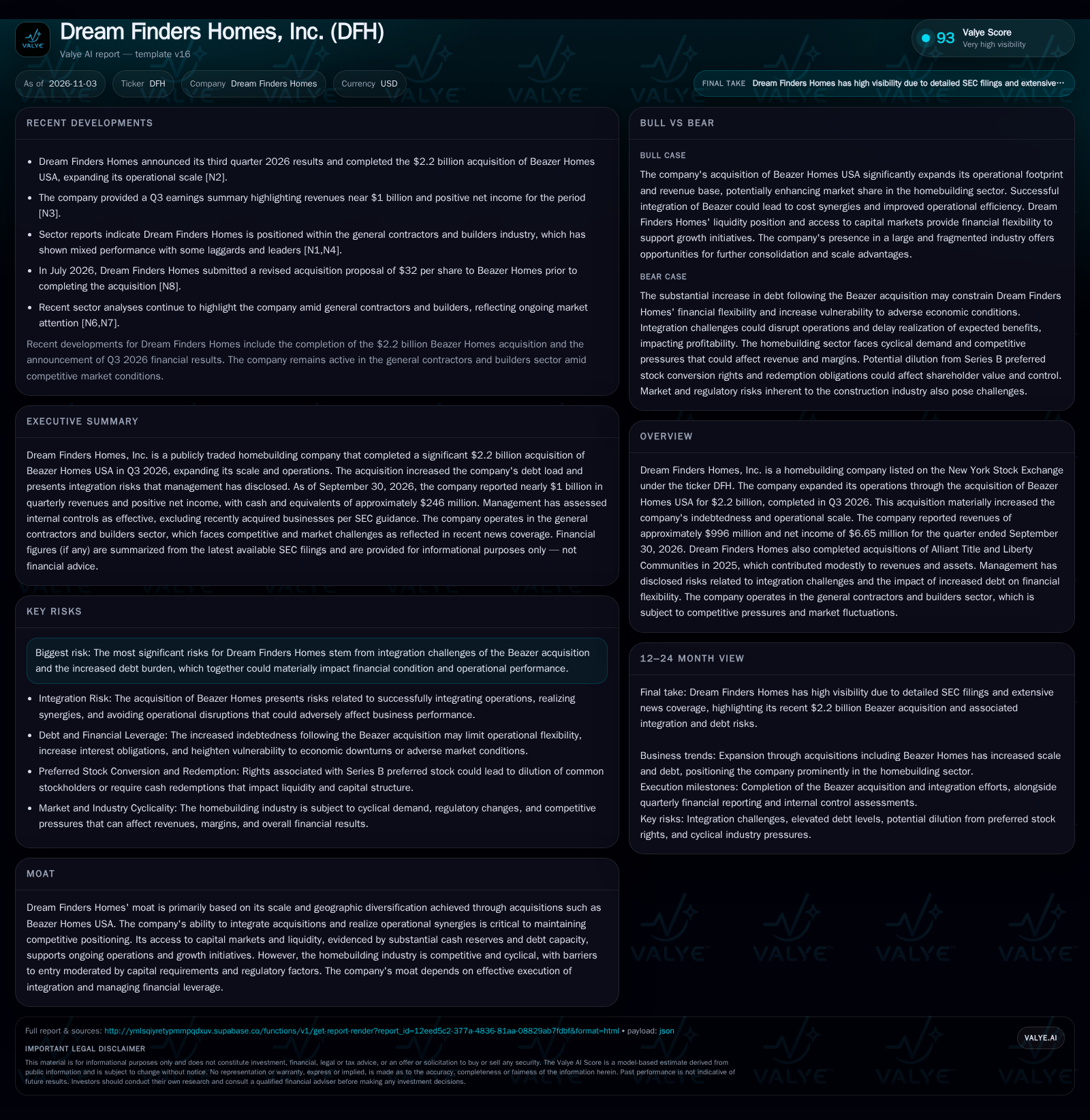
Dream Finders Homes completed the $2.2 billion acquisition of Beazer Homes USA in Q3 2026, materially expanding its operational footprint and indebtedness [N2] [S2]. This transaction increases the company’s active community count and geographic reach, making it a more prominent player in the homebuilding sector. As of September 30, 2026, the company reported $996 million in quarterly revenue and net income of $6.65 million, but earnings per share were effectively zero—suggesting margin compression or high integration costs [S2]. Cash and equivalents stood at $245.6 million, but management flagged that debt levels are now significantly higher, potentially constraining operational flexibility [S2]. Integration risks—including disruption, cost overruns, and uncertain synergy realization—are explicitly cited by management as material near-term challenges [S2].
How Scale and Debt Shape Unit Economics and Margin Dynamics
Dream Finders’ revenue model remains volume-driven, with homes sold through both retail channels and built-for-rent contracts with institutional investors. The acquisition of Beazer increases the company’s active community count to 365 as of September 2026, up from 283 a year earlier, positioning the business to capture greater volume across a wider geographic base [S2].
The cost structure is heavily weighted toward land (30-35%), materials (30-35%), and labor (20-25%), with the remainder consisting of interest, commissions, and closing costs (5-10%) [S2]. Fixed costs—such as corporate overhead—should benefit from scale, but the incremental debt service from the Beazer deal is likely to offset some of these advantages, at least in the near term. The company’s ability to realize operating leverage depends on integration efficiency, absorption of Beazer’s backlog, and stabilization of market demand.
Homebuilders like Dream Finders are acutely exposed to fluctuations in input costs, labor availability, and local demand elasticity. In the current environment, rising mortgage rates and weak consumer confidence have forced builders to use price incentives and mortgage buydowns, placing downward pressure on average selling prices and gross margins [S2]. The company has acknowledged that these pressures are likely to persist absent meaningful relief in affordability or interest rates.
Integration, Scale, and the Realities of Homebuilding Competition
With the Beazer acquisition, Dream Finders is now among the larger U.S. homebuilders by active community count. However, the sector remains fragmented, with regional and national competitors continually adjusting pricing, incentives, and product mix in response to market conditions. Scale can provide bargaining power with suppliers and land sellers, as well as the ability to spread fixed costs, but the moat in homebuilding is modest—capital requirements and local regulatory barriers limit new entrants, but do not eliminate price-based competition.
The company’s built-for-rent channel, serving institutional investors, offers some diversification, but these contracts are episodic and highly sensitive to capital market conditions. Ancillary businesses such as mortgage, title, and insurance services could enhance margin and customer retention, provided they are effectively integrated. However, the most immediate challenge is seamless operational integration: failure to harmonize systems, culture, and processes could erode any intended advantage from scale.
Peer homebuilders face similar macro headwinds—rising rates, labor shortages, and input cost volatility. The question is whether Dream Finders’ expanded scale post-Beazer will allow it to outperform on cost control and absorption, or simply magnify exposure to sector-wide cyclicality.
If Synergies and Scale Deliver: Margin Expansion and Market Share Gains
A favorable outcome would see Dream Finders rapidly and efficiently integrating Beazer, extracting cost synergies (e.g., procurement, back-office consolidation), and leveraging its broader footprint to capture market share in both retail and built-for-rent channels. If absorption rates stabilize and incentives can be dialed back, margins could recover toward historical norms, particularly if mortgage rates moderate and affordability improves.
Confirmation of this scenario would include sequential improvement in gross and operating margins, disciplined SG&A as a percent of revenue, and evidence of successful backlog conversion from Beazer communities. Ancillary service revenues (mortgage, title, insurance) would rise as a share of total, and debt metrics would stabilize or improve as free cash flow is used to deleverage. Evidence of above-market absorption rates or market share gains in key regions would further validate the thesis.
Integration Headwinds, Margin Pressure, and Incremental Progress
The most likely outcome is a period of incremental progress mixed with persistent headwinds. Integration of Beazer proceeds, but at a cost—realizing some, but not all, anticipated synergies as management juggles cultural and operational consolidation. Margin pressure remains elevated as the company and sector continue to deploy incentives to maintain sales pace amid weak affordability and high rates.
Revenue benefits from increased scale, but net income and cash flow are constrained by higher interest expense and ongoing integration costs. The company remains focused on inventory discipline and prudent land investment, with no major deterioration but also little near-term margin relief. Confirmation would come from flattish or modestly improving financial metrics, stable or slightly declining debt levels, and ongoing management commentary about the integration process and the external demand environment.
If Integration Falters or Housing Weakens: Debt and Disruption Amplify Risk
In an adverse scenario, integration of Beazer proves disruptive—whether due to system incompatibility, culture clash, or inability to realize expected cost savings. This is compounded by further deterioration in housing demand, forcing even steeper price cuts and incentives to move inventory. Debt service becomes a growing burden as cash flow is squeezed, and management is forced to prioritize liquidity over growth.
Early warning signs would include rising SG&A as a percent of revenue, sequential declines in gross margin, missed synergy targets, or negative operating cash flow. If debt metrics worsen—due to either weak EBITDA or unforeseen integration costs—the company could face pressure from creditors or rating agencies. Any evidence of market share losses, community closures, or delays in backlog conversion would further support the downside thesis.
Milestones and Metrics That Will Determine Whether Scale Becomes Strength
Gross margin trends and the level of incentives/price buydowns used to support sales across the expanded community base.
Quarterly progress on integration milestones, including cost synergy realization and SG&A as a percent of revenue (if disclosed).
Debt-to-EBITDA and interest coverage ratios, particularly as Beazer’s results are consolidated and as free cash flow is allocated between deleveraging and growth.
Absorption rates and backlog conversion in both legacy and acquired Beazer communities—a key signal of sales momentum and integration success.
Revenue and margin contribution from ancillary businesses (mortgage, title, insurance) as a share of total, which would indicate success in cross-selling and service integration.
Community count and geographic diversification metrics—are new markets being successfully penetrated, or is scale leading to operational dilution?
Any changes in Series B preferred stock conversion or redemption activity, which could affect capital structure and common shareholder value.
Disclaimer: This is research-only, informational analysis and not investment advice. It may include AI-generated interpretation and general industry context. Always verify important details using primary sources.

Comments