
Marathon Petroleum’s Post-Divestiture Playbook: Margin Strength, Debt Constraints, and the Realities of Third-Party Supply
Marathon Petroleum’s sharp refining margin gains and $4.2B asset divestiture spotlight a refocused refining and marketing giant—but with heavy debt and persistent supply-chain vulnerabilities, the company’s future will hinge on capital discipline, margin resilience, and its ability to withstand commodity and operational shocks.
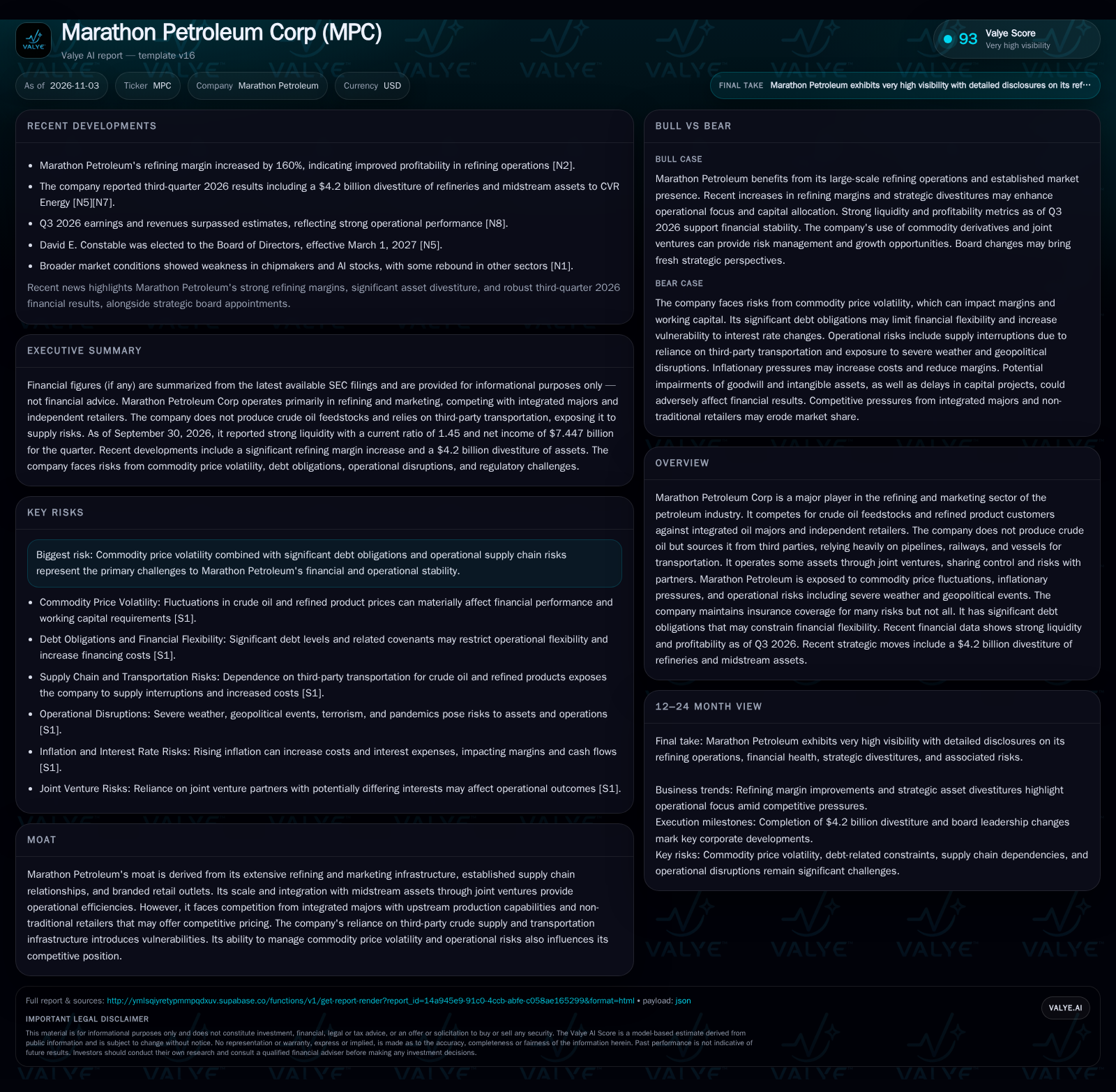
Marathon Petroleum’s recent 160% refining margin surge and $4.2 billion divestiture have boosted near-term profitability and sharpened operational focus. Yet, with $33.31 billion in debt and total reliance on third-party crude supply and transportation, the company’s long-term performance will depend on maintaining margin strength, navigating supply-chain and cost inflation risks, and managing its balance sheet in a volatile market environment. [S1] [S2] [N2] [N5] [N8]
Marathon Petroleum’s most recent quarter delivered headline-grabbing profitability, powered by a dramatic 160% leap in refining margins and a major $4.2 billion asset divestiture. These moves underscore both the cyclical strength of refining in a tight margin environment and the company’s drive to sharpen its operational focus. Yet beneath the strong results, Marathon’s lack of upstream integration, reliance on third-party supply chains, and a heavy debt load shape a business model that remains highly exposed to commodity swings, operational shocks, and the cost of capital. How Marathon navigates these structural realities will define its ability to convert near-term margin windfalls into durable shareholder value.
Refining Margin Surge, Strategic Divestiture, and Balance Sheet Realities
Marathon Petroleum’s Q3 2026 results were marked by a 160% increase in refining margins, propelling net income to $7.447 billion and basic EPS to $26.66. This surge in profitability coincided with a $4.2 billion divestiture of refineries and midstream assets to CVR Energy, signaling a move toward a more focused refining and marketing footprint. As of September 30, 2026, the company reported cash and equivalents of $12.805 billion, current assets of $42.002 billion, and current liabilities of $29.055 billion, yielding a current ratio of 1.45 and a cash ratio of 0.47. However, Marathon closed 2025 with $33.31 billion in debt, a level that may restrict operational flexibility and amplify risk during market downturns. With no upstream crude production, Marathon remains entirely dependent on external suppliers and transportation networks, exposing it to supply chain interruptions and cost inflation. [S1] [S2] [N2] [N5] [N7] [N8]
Decoding Marathon’s Margin Model: Volume, Pricing, and Capital Demands
Marathon Petroleum’s earnings are fundamentally driven by the spread between the cost of crude oil inputs and the market price of refined products—a dynamic that can swing sharply with shifts in supply, demand, and global energy policy. The recent 160% jump in refining margins highlights the sector’s operating leverage: small changes in the crack spread can drive outsized earnings swings. However, without upstream production, Marathon is a price taker on crude, and must manage both input volatility and the challenge of passing through costs in a competitive product market.
Fixed costs—including labor, maintenance, and regulatory compliance—are high, but once baseline utilization is achieved, incremental throughput can deliver strong margins, exemplifying classic refining business operating leverage. Large-scale capital projects, whether for maintenance or upgrades, require substantial upfront investment and are vulnerable to delays and cost overruns from regulatory, supply chain, or weather disruptions. The company’s $33.31 billion debt load increases sensitivity to interest rates and limits financial agility for future acquisitions or major capital outlays.
Marathon’s recent divestiture may reduce capital intensity and operational complexity, potentially boosting return on invested capital if the remaining asset base can maintain high utilization and margin realization. Yet, sustained profitability will depend on the company’s ability to optimize feedstock sourcing, manage working capital amid commodity price swings, and control inflationary pressures on input and operating costs.
Where Marathon Stands: Scale, Supply Chain Vulnerabilities, and Shifting Rivals
Marathon Petroleum’s competitive advantages rest on its large-scale refining and marketing infrastructure, established supply chain relationships, and branded retail presence. However, the lack of upstream production capacity places it at a structural disadvantage versus integrated majors, which can self-supply crude and better manage feedstock volatility.
The company also faces competition from independent refiners and non-traditional fuel retailers, including big-box chains and convenience store operators that may prioritize fuel as a traffic driver rather than a margin center. Marathon’s joint ventures can provide operational flexibility and risk-sharing, but also introduce potential misalignment of interests and operational complexity.
The divestiture of certain refineries and midstream assets narrows Marathon’s asset base, potentially sharpening operational focus but also reducing diversification and geographic reach. In a market increasingly shaped by regulatory shifts, electrification trends, and alternative fuels, the long-term defensibility of the refining-centric model may be challenged by both demand-side shifts and new forms of competition.
What It Would Take for Margin Expansion to Drive Sustainable Value
Marathon could convert current margin strength into durable value if several favorable dynamics persist. Sustained high refining margins—driven by tight global capacity, disciplined industry supply, or persistent demand for refined products—would allow the company to generate strong cash flows and accelerate debt reduction. The $4.2 billion divestiture, if redeployed into high-return projects or used to strengthen the balance sheet, could further improve capital efficiency.
Operational excellence in sourcing, logistics, and cost management could mitigate some of the structural supply-chain risks. If Marathon successfully leverages its scale and retail network to capture market share or premium pricing, it may partially offset its lack of upstream integration. Evidence supporting this scenario would include continued outperformance versus peers on margin realization, visible progress on debt paydown, high asset utilization rates, and disciplined capital allocation to high-ROI projects.
Additionally, if regulatory changes or energy transition policies prove less disruptive than feared, or if global demand for refined products remains resilient longer than consensus expectations, Marathon’s core business could enjoy an extended period of above-average profitability.
Refining Cyclicality and the Tug-of-War Between Margins and Costs
The most plausible trajectory for Marathon involves a normalization of refining margins as industry supply and demand rebalance, with profitability reverting toward historical averages. The company’s ability to maintain stable cash flows will depend on efficient operations, effective hedging, and prudent management of working capital in the face of commodity volatility.
Marathon is likely to use proceeds from the asset divestiture to reduce debt and maintain a moderate investment pace in maintenance, regulatory compliance, and incremental efficiency improvements. Competitive pressures from integrated majors and evolving retail channels will persist, limiting pricing power in the absence of sustained tightness in refining supply.
This scenario would be confirmed by margin and earnings performance tracking close to industry averages, gradual but steady debt reduction, and a stable asset base with few major disruptions. Signs of cost inflation eroding margins, or persistent supply chain interruptions, would challenge the base case.
How Commodity Shocks, Debt Loads, or Supply Disruptions Could Unravel the Thesis
Marathon’s exposure to commodity price volatility and reliance on third-party supply chains create multiple pathways to downside. A sharp drop in refining margins—due to overcapacity, regulatory changes, or sudden demand destruction—would compress earnings and strain cash flows. If combined with cost inflation (labor, energy, or regulatory compliance) or major supply disruptions from weather or geopolitical shocks, the company could face operational interruptions and working capital stress.
With $33.31 billion in debt, a prolonged period of weak margins could challenge compliance with debt covenants, restrict access to financing, or force asset sales at unattractive prices. Impairment of goodwill or intangibles, or significant delays/cost overruns in required capital projects, would further erode potential financial flexibility.
This scenario would be evidenced by negative working capital trends, credit rating downgrades, asset impairments, or the need for emergency financing. Persistent underperformance on margin relative to peers, or a material operational disruption, would accelerate downside risks.
What Will Reveal Whether Marathon’s Margin Cycle Can Be Sustained
Trends in refining margin realization versus industry benchmarks: sustained outperformance would support the upside case.
Pace and magnitude of debt reduction following the $4.2 billion asset divestiture: a rapid decline in leverage would demonstrate improved potential financial flexibility.
Asset utilization rates and downtime (if disclosed): high utilization and minimal unplanned outages would indicate operational discipline.
Exposure to and management of supply chain interruptions—from weather, labor, or geopolitical events—as evidenced by reported disruptions or cost spikes.
Progress on cost control and inflation management, especially in labor and energy inputs; a useful metric would be reported operating expense per barrel.
Capital allocation discipline: proportion of divestiture proceeds reinvested in high-return projects versus returned to shareholders or used for debt reduction.
Any regulatory or environmental compliance developments that materially alter cost structure or operational flexibility.
Board and management actions post-divestiture—strategic direction, further asset sales, or changes in capital allocation—would help test the durability of the current business model.
Disclaimer: This is research-only, informational analysis and not investment advice. It may include AI-generated interpretation and general industry context. Always verify important details using primary sources.

Comments