
Metallus Inc.: Defense Steel Supply, Contract Concentration, and the Implications of Labor Dynamics
Metallus Inc. enters a new phase of visibility and operational risk with a $995 million defense steel contract, recent earnings growth, and a hard-won labor agreement. The company’s ability to convert contract scale into sustainable margins—and to navigate the challenges of concentrated customer exposure and workforce tensions—will determine its forward trajectory.
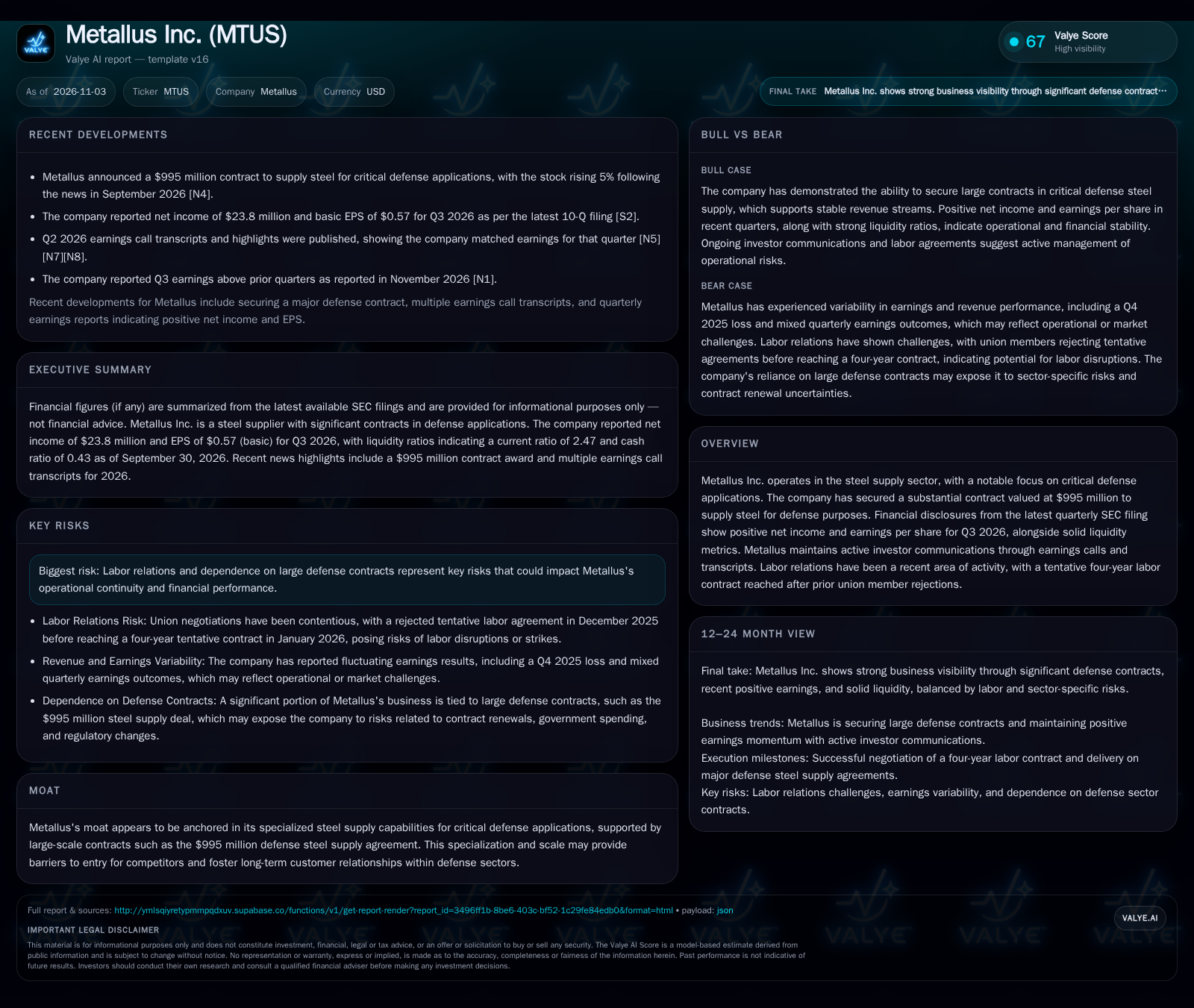
Metallus Inc. has secured a $995 million contract in defense steel supply, reported strong Q3 2026 earnings, and reached a four-year labor agreement after prior union tensions. While its financial position appears stable, the company faces risks from contract concentration and labor relations. Sustained performance will depend on execution, contract renewal, and continued workforce stability. [N4] [S2] [S1]
Metallus Inc. stands at a strategic crossroads after winning a nearly $1 billion defense steel supply contract and posting improved Q3 earnings. With a recently ratified four-year labor pact following a contentious negotiation, the company enjoys near-term revenue visibility and operational continuity. However, its fortunes are tightly linked to the execution and renewal of large defense contracts, and the labor situation underscores a persistent source of operational risk. The next phase for Metallus will be defined by its ability to translate contract scale into durable cash flow and to manage the structural risks of customer and labor concentration.
Recent Milestones Reshape Metallus’s Operating Landscape
Metallus Inc. has secured a $995 million contract to supply steel for critical defense applications, announced in September 2026, providing multi-year revenue visibility and positioning the company as a key supplier to the defense sector. [N4]
The company reported Q3 2026 net income of $23.8 million, with basic EPS of $0.57 and diluted EPS of $0.55, reflecting earnings momentum and potential margin improvement. [S2]
Labor relations remain a live issue: after a rejected tentative agreement in December 2025, Metallus and United Steelworkers Local 1123 reached a new four-year contract in January 2026, mitigating immediate strike risk but highlighting underlying workforce tensions. [S1]
Contract Scale, Fixed Costs, and Margin Leverage in Steel Supply
Metallus’s economics are shaped by the scale of its contracts, particularly in defense, where large, multi-year supply agreements can provide production stability and operating leverage. The $995 million contract likely secures a base level of plant utilization and revenue visibility, but the economics will depend on input cost management, pricing terms (which are not disclosed), and the ability to absorb fixed manufacturing and labor costs into higher output volumes.
Steel supply for defense typically involves stringent quality and certification requirements, potentially allowing for higher-than-commodity margins if Metallus can differentiate on reliability and compliance. However, cost-plus or competitively bid contract structures are common, which may limit pricing power and expose margins to raw material and energy cost fluctuations.
The company’s reported net income and EPS growth suggest that recent volumes and/or pricing have been favorable, but without contract margin disclosure, it is unclear how much of this is structural versus cyclical. Labor costs are a major fixed expense; the new four-year union contract provides cost predictability but could embed higher wage or benefit costs, affecting future margin flexibility.
The interplay between fixed and variable costs in Metallus’s production model means that scaling contract volume can disproportionately improve profitability, but only up to the limits imposed by capacity constraints and labor efficiency. If contract volumes increase without corresponding improvements in operational efficiency or input cost control, margin expansion could be limited or even reversed. Conversely, any disruption in contract flow or labor productivity could expose the company to under-absorption of fixed costs, compressing margins sharply. Therefore, the company’s ability to optimize production scheduling, maintain high utilization rates, and negotiate cost-effective labor terms will be critical to sustaining margin leverage in a capital- and labor-intensive environment.
Specialization in Defense Steel: Barriers and Substitution Risks
Metallus’s competitive position appears anchored in its ability to meet demanding defense-grade steel specifications at scale—a capability that creates barriers to entry for generic steel producers. Long-term relationships with defense customers and compliance with complex procurement processes may further limit direct competition.
However, the company is exposed to substitution risk from alternative materials (such as composites or advanced alloys) if defense contractors or the Department of Defense seek lighter, stronger, or more cost-effective solutions. In addition, other qualified steel suppliers could compete for future contracts, particularly if Metallus’s cost structure becomes less competitive due to labor or input inflation.
Customer concentration is a latent vulnerability: if a small number of large contracts drive a disproportionate share of revenue, the loss or non-renewal of a single agreement could materially impact results. The company’s moat is thus functional but not unassailable, as it depends on continued execution and contract renewal.
The defense steel market’s procurement cycles and certification processes create a complex competitive environment where incumbency and proven compliance offer significant advantages. However, these same factors can slow the onboarding of new suppliers, potentially limiting Metallus’s ability to rapidly scale or diversify its customer base beyond current contracts. Additionally, the evolving technological landscape in defense materials necessitates continuous investment in R&D and quality assurance to maintain relevance. Failure to anticipate or adapt to shifts toward alternative materials or changing defense specifications could erode Metallus’s competitive moat. Thus, sustained investment in capabilities that align with defense sector innovation trajectories is essential to mitigate substitution risks and maintain contract competitiveness.
Sustained Contract Wins and Margin Expansion Drive Outperformance
The most favorable outcome for Metallus would involve consistently winning and executing large defense contracts, converting scale into durable margin expansion. If the company can leverage its capacity utilization, maintain disciplined cost management, and negotiate labor agreements that balance stability with productivity, it could see both top-line and bottom-line growth.
Confirmation of this scenario would be visible in further contract announcements, backlog growth, and upward trends in gross and operating margins. Evidence would also include minimal labor disruption, positive cash flow from operations, and continued EPS growth. Early signs—such as the $995 million contract and recent earnings beats—suggest this path is plausible, but it would be reinforced by disclosure of contract pipeline, margin trends, and successful delivery milestones. [N4] [S2] [N1]
Execution Anchored to Existing Contracts, with Incremental Progress and Persistent Risks
The most likely scenario is that Metallus executes on its current major contracts, sustaining revenue and moderate profitability over the next several years. Earnings could remain stable, with some volatility driven by input costs, periodic contract renegotiation, and the need to manage labor relations proactively.
This scenario would be confirmed by steady quarterly earnings, absence of major labor disruptions, and timely fulfillment of contractual obligations. Falsification would come from missed delivery milestones, unexpected margin compression (for example, due to higher labor or input costs), or indications that contract renewal prospects are weakening. The company’s ability to maintain positive operating cash flow and renew or expand key agreements will be critical.
Contract Loss or Labor Disruption Exposes Earnings Volatility
The adverse scenario for Metallus would result from the loss, delay, or non-renewal of a major defense contract, or from a significant labor disruption such as a strike or protracted negotiation impasse. Given the company’s dependence on a small number of large contracts, even a single contract loss could lead to a sharp drop in plant utilization, negative operating leverage, and earnings volatility.
This scenario would be confirmed by news of contract termination, public labor disputes, or material increases in labor or raw material costs that cannot be offset by pricing. Early warning signs would include rising labor tensions, missed deliveries, or negative commentary from defense customers. Persistent cash burn, covenant stress, or the need for emergency financing would further corroborate a downside path.
Signals That Will Shape Metallus’s Defense-Driven Thesis
The timing and value of new contract wins or extensions, especially in defense steel supply, would help test the company’s ability to sustain or grow its revenue base.
Quarterly gross and operating margin trends—if disclosed—would clarify whether recent earnings strength is structural or cyclical.
Updates on labor relations, including any early renegotiation talks or signs of workforce dissatisfaction, could provide early warning of operational risk.
Progress against delivery milestones on the $995 million defense contract would indicate execution quality and customer satisfaction.
Disclosure of customer concentration or revenue mix by contract would help assess the risk of contract loss or non-renewal.
Operating cash flow trends, particularly in relation to capital expenditures and working capital needs, would reveal underlying business health.
Any commentary or data on input cost pass-through or hedging strategies would illuminate margin risk management.
Monitoring Metallus’s capital expenditure patterns relative to revenue growth would provide insight into whether the company is investing sufficiently to support future contract demands and technological upgrades. Underinvestment could signal potential capacity bottlenecks or obsolescence risks, while overinvestment without commensurate contract wins might pressure potential financial flexibility. Furthermore, tracking the company’s approach to input cost volatility—whether through contractual pass-through clauses, hedging instruments, or supplier diversification—would clarify its resilience to commodity price swings. Together, these operational and financial metrics would offer a nuanced view of Metallus’s ability to sustain growth and margin stability amidst sector-specific uncertainties.
Disclaimer: This is research-only, informational analysis and not investment advice. It may include AI-generated interpretation and general industry context. Always verify important details using primary sources.

Comments