
Invesco’s Strategic Recalibration: Navigating Asset Flows, Intangible Headwinds, and Capital Allocation
Invesco’s recent impairment of U.S. retail mutual fund intangibles, continued capital actions, and market-exposed AUM highlight the evolving pressures and opportunities in global asset management. The interplay of revenue sensitivity, risk management, and product mix will shape the firm’s next phase.
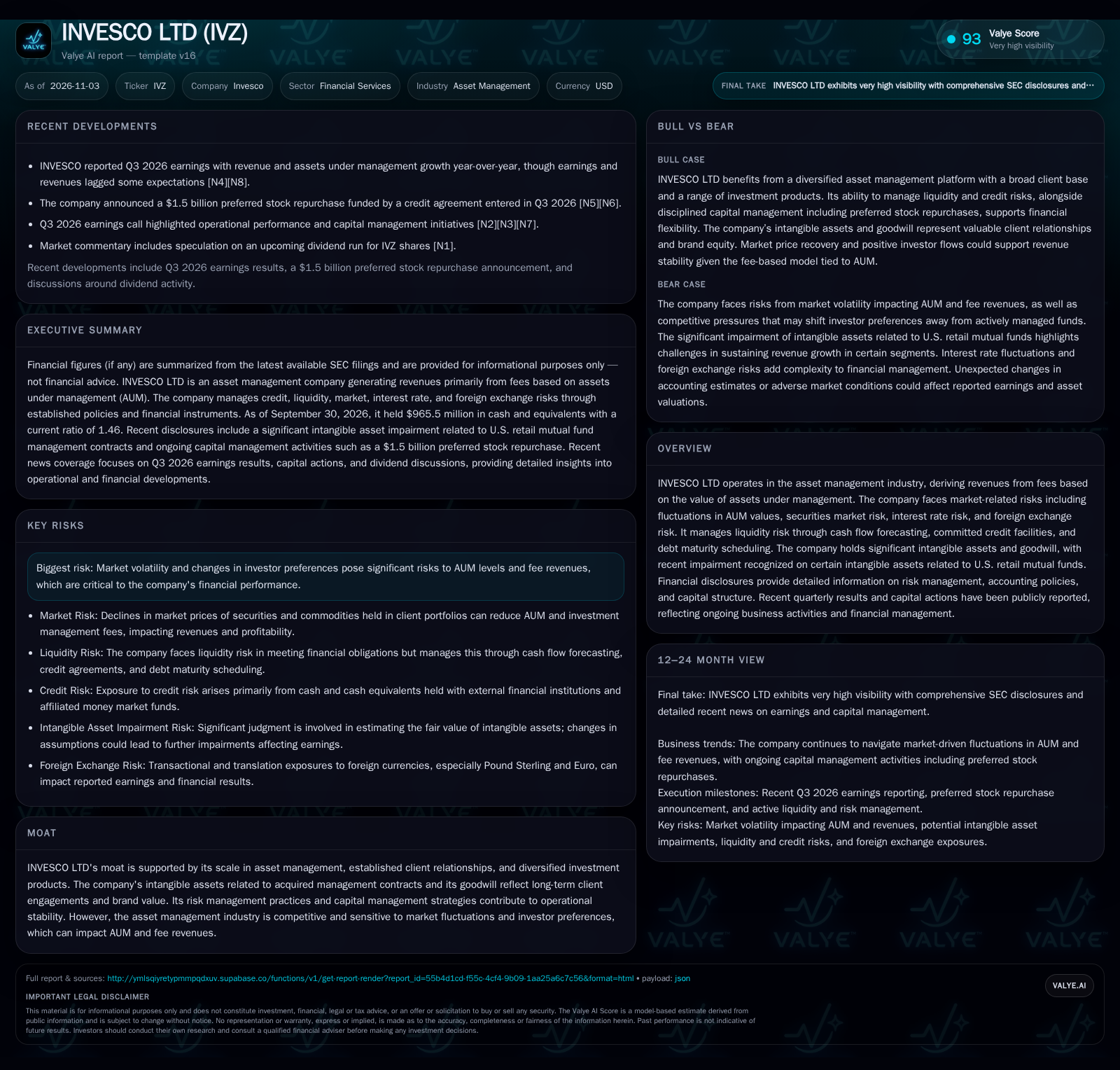
Invesco reported Q3 2026 year-over-year AUM and revenue growth, but missed earnings expectations and recognized a $1.79 billion impairment on U.S. retail mutual fund intangibles. These developments underscore the firm’s exposure to market-driven AUM swings, the challenge of legacy retail products, and a focus on active capital management [S2] [N4] [N5] [N6] [N8].
Invesco’s latest quarter highlights the central paradox of modern asset management: while asset and revenue growth persist year-on-year, legacy business lines face structural erosion and capital allocation grows more complex. The $1.79 billion impairment on U.S. retail mutual fund intangibles underscores the mounting challenge of defending margins in a shifting investor landscape, even as the company pursues balance sheet optimization through a $1.5 billion preferred stock buyback. With fee revenues tightly tied to market valuations and asset flows, Invesco’s next chapter will depend on its ability to reposition its product mix, manage risk exposures, and sustain operational flexibility in an environment of persistent market and competitive uncertainty.
Recent Financial Moves Signal Strategic Inflection
Three developments define Invesco’s current positioning: First, the company reported Q3 2026 year-over-year growth in both AUM and revenues, yet missed analyst earnings estimates, reflecting mixed momentum and the ongoing challenge of translating asset growth into bottom-line performance [N4] [N8]. Second, Invesco recognized a $1.79 billion impairment on indefinite-lived intangibles related to U.S. retail mutual fund management contracts, reducing their carrying value to $2.78 billion and signaling lower revenue forecasts and growth expectations for this business [S1] [S2]. Third, the firm announced a $1.5 billion preferred stock repurchase, funded by a new credit agreement, indicating an active approach to capital structure and shareholder returns [N5] [N6].
As of September 30, 2026, Invesco held $965.5 million in cash and cash equivalents and reported a current ratio of 1.46, providing snapshot liquidity coverage [S2]. These facts collectively underscore the company’s sensitivity to market-driven asset flows, the urgency of adapting legacy product lines, and a willingness to deploy leverage for capital returns.
How Fee-Based Revenues and Operating Leverage Shape Invesco’s Economics
Invesco’s core economics are predicated on fee income derived from AUM—management fees, performance fees, and ancillary services—making the top line highly sensitive to market valuations and net client flows. The basic equation is volume (AUM) times price (fee rate) minus cost. Most costs—compensation, distribution, technology—have a substantial fixed or semi-fixed component, so changes in AUM translate disproportionately into earnings volatility, especially in periods of market stress or large outflows.
Over the last decade, industry fee compression—driven by the rise of passive products, regulatory scrutiny, and client bargaining power—has pressured margins, particularly for traditional active mutual funds. This is mirrored in Invesco’s recent intangible impairment: lower growth and revenue prospects for U.S. retail mutual funds reduce the present value of acquired management contracts [S1] [S2].
Capital allocation is a secondary profit lever. The recent $1.5 billion preferred repurchase, financed with debt, may optimize the capital structure and lower dividend obligations, but introduces incremental financial risk and reduces cash flexibility. The company reported cash and liquidity metrics for the period; these figures do not by themselves establish operating runway, investment capacity, financial flexibility, or financing capacity.
Product Breadth, Brand, and Scale Versus the Pressures of Commoditization
Invesco remains one of the largest global asset managers, with strengths in product breadth (active, passive, alternatives), international reach, and established brand relationships. These attributes confer scale advantages in distribution and operational efficiency, and support cross-selling across institutional and retail channels.
However, the asset management industry is undergoing structural transformation. Passive vehicles and ETFs continue to gain share, pricing power for traditional active funds erodes, and digital platforms lower switching frictions for clients. Invesco’s recent impairment of U.S. retail mutual fund intangibles reflects these secular trends—legacy products are increasingly commoditized, and the firm’s ability to generate excess returns or defend premium pricing is under pressure [S1] [S2].
Peer competition comes not only from other large diversified managers but also from digital-first platforms, low-cost ETF providers, and niche alternatives specialists. Long-term differentiation may depend on delivering consistent investment performance, innovating in product design, and leveraging technology for client engagement and operational scale.
If Market Recovery and Product Mix Shift Drive Positive Asset Flows
The most favorable scenario for Invesco would involve a sustained market recovery, which lifts AUM and fee income, combined with a successful shift in product mix toward higher-growth, higher-fee strategies (such as alternatives or differentiated ETFs). If client flows turn net positive—driven by performance, innovation, or distribution wins—operating leverage would amplify earnings growth.
Confirmation would come from several fronts: reported net inflows into newer product lines, stabilization or growth in fee rates, and margin expansion despite industry headwinds. A reversal or slowdown in intangible impairments would suggest improved long-term revenue visibility for legacy businesses. Evidence of successful cross-selling, new mandates, or technology-enabled client engagement would further support the case.
Falsification would occur if AUM growth is purely market-driven without positive net flows, if fee rates continue to compress, or if further impairments and restructuring dominate financial disclosures.
Managing Through Volatility While Adapting to Structural Industry Change
The most plausible near-term scenario is one of continued adaptation: Invesco manages through market-driven volatility in AUM and fee revenues, with periodic episodes of both positive and negative flows across product categories. Earnings remain sensitive to market swings, while management pursues incremental product innovation and cost discipline.
Periodic impairments or restructuring charges may persist as legacy U.S. retail mutual fund economics deteriorate further, but these are offset by growth in other business lines.
It would be challenged by unexpected large outflows, further significant impairments, or an inability to stabilize fee rates in core segments.
Potential for Structural Outflows, Further Impairments, and Margin Squeeze
Adverse conditions could see Invesco facing persistent net outflows, especially from its traditional active mutual fund business, as client preferences shift more rapidly toward passive and alternative providers. This would drive down AUM, compress fee rates, and trigger further impairments of intangible assets and possibly goodwill.
Lower revenues, combined with a high fixed cost base, would pressure operating margins. If capital returns outpace earnings recovery or if market shocks hit asset valuations, leverage and liquidity positions could become more precarious, forcing a pullback on capital actions or even necessitating asset sales or restructuring.
Evidence supporting this scenario would include multi-quarter net outflows, continued or accelerated intangible and goodwill impairments, declining margins, and adverse liquidity or credit events. Falsification would require a reversal of outflows, stabilization of legacy business economics, or strong growth in new products offsetting declines elsewhere.
Milestones That Will Define Invesco’s Course in a Shifting Asset Management Landscape
Net client asset flows by product and geography—if disclosed—would clarify whether market gains are translating into sustainable business growth.
Fee rate trends across major business lines, with attention to compression in active management and stability or improvement in alternatives and ETFs.
Frequency and magnitude of intangible asset impairments, particularly in mutual funds, as a barometer for the future profitability of legacy segments.
Reported operating margins and cost/income ratios, which test the company’s ability to flex costs in line with revenues.
Level and structure of debt following the preferred stock repurchase, and any changes to liquidity arrangements or credit facility utilization.
Management commentary on product innovation, technology investments, and competitive positioning in earnings calls or investor presentations.
Foreign exchange impacts on reported earnings, especially given exposure to Pound Sterling and Euro-denominated businesses.
Disclaimer: This is research-only, informational analysis and not investment advice. It may include AI-generated interpretation and general industry context. Always verify important details using primary sources.

Comments