
AMETEK’s Acquisition-Led Expansion: Precision Instrumentation, Integration Complexity, and the Search for Sustainable Margin Gains
AMETEK’s 2026 results reflect robust top-line growth from both organic initiatives and a sequence of strategic acquisitions, but the challenge now shifts to successful integration and sustained margin improvement as the company navigates industrial cyclicality and evolving global supply chains.
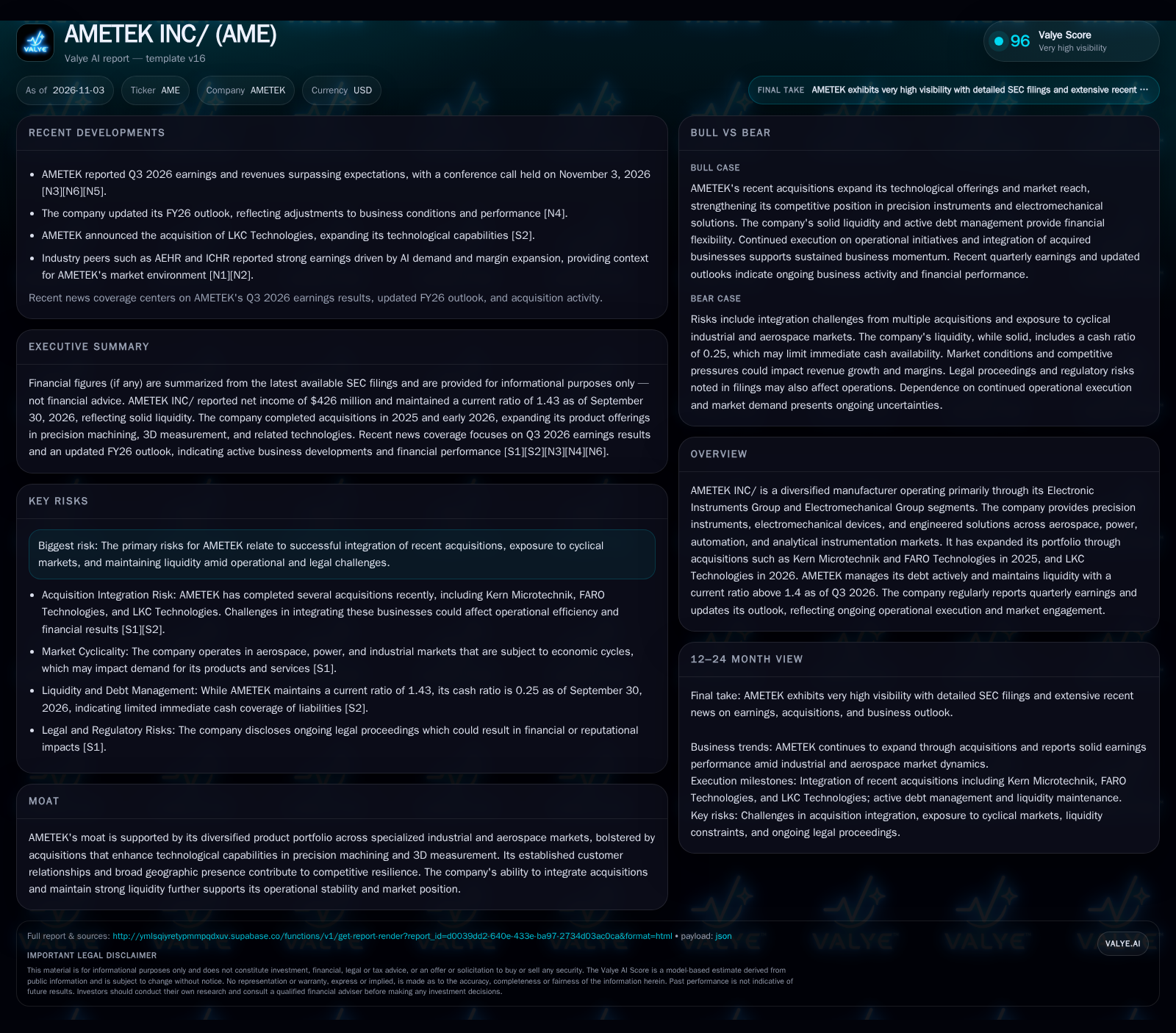
AMETEK reported record Q3 2026 sales of $2.22 billion, with organic sales up 10% and acquisitions contributing an additional 7%. Recent acquisitions—FARO Technologies, LKC Technologies, First Aviation Services, and Indicor Instrumentation—have significantly broadened AMETEK’s portfolio in precision measurement and instrumentation. The company’s operating margins remain strong, but integration costs and exposure to industrial and aerospace cycles present ongoing challenges. Liquidity is supported by a current ratio of 1.43, but immediate cash coverage is limited, highlighting the importance of efficient acquisition execution and ongoing cash generation. [S2]
AMETEK’s latest financials highlight a company in the midst of active transformation. The combination of organic growth and a string of recent acquisitions has propelled both revenue and earnings to new highs, with Q3 2026 marking a record for the company. Yet, beneath the headline numbers, the true test for AMETEK will be its ability to extract value from its broadened portfolio, manage the complexities of integration, and sustain operational excellence in the face of industrial cyclicality and ongoing global uncertainty. The next phase will reveal whether AMETEK’s acquisition strategy translates into lasting margin expansion and market leadership.
Recent Acquisitions and Record Sales Redefine AMETEK’s Scale
AMETEK reported record net sales of $2.22 billion for Q3 2026, a 17.3% increase compared to the prior year’s quarter, with organic sales up 10% and a further 7% growth coming from acquisitions. These acquisitions—FARO Technologies (July 2025), LKC Technologies (January 2026), First Aviation Services (May 2026), and Indicor Instrumentation (August 2026)—have materially expanded AMETEK’s technological and geographic footprint in precision measurement, 3D inspection, and aerospace instrumentation. Integration costs related to these deals reached $27.8 million pre-tax in Q3, including $9.8 million in fair-value inventory adjustments and $18.1 million in transaction-related expenses. International sales accounted for nearly half of total revenues, underscoring the company’s global exposure. As of September 30, 2026, AMETEK’s current assets were $3.78 billion, current liabilities $2.64 billion, and cash/equivalents $666 million, yielding a current ratio of 1.43 and a cash ratio of 0.25. [S2]
How AMETEK’s Growth Model Creates (and Consumes) Value
AMETEK’s business model relies on a blend of organic innovation and targeted acquisitions to drive revenue growth and expand addressable markets. The company’s core segments—Electronic Instruments and Electromechanical—supply precision devices and solutions to industries such as aerospace, power, automation, and analytical instrumentation. Pricing power is typically strongest in specialized, high-specification niches, where switching costs can be moderate to high given the integration of AMETEK’s devices into customers’ workflows and systems.
The recent surge in acquisition activity diversifies AMETEK’s portfolio into higher-value, less commoditized measurement and inspection domains. This has the potential to support higher gross margins, but the economics hinge on successful integration—synergy capture, cross-selling, and avoidance of operational redundancies. Integration costs, as evidenced by the Q3 2026 pre-tax charge, are a real drag in the near term, and the company must balance acquisition-driven growth with disciplined cost management to avoid margin erosion.
Operating leverage is plausible as scale increases, particularly if AMETEK can rationalize overlapping functions and standardize processes across its expanded portfolio. However, the capital intensity of its manufacturing operations and the need for ongoing R&D investment to sustain technical differentiation mean that fixed costs remain substantial.
Diversification, Technical Depth, and the Challenge from Global Rivals
AMETEK’s competitive position is anchored in its breadth of offerings across precision measurement, electromechanical devices, and engineered solutions. The company’s acquisition strategy has enabled it to enter or deepen its presence in segments with higher technical barriers and more specialized customer needs, such as 3D measurement and advanced optical inspection. These areas typically feature smaller, more defensible markets with lower price sensitivity and higher customer retention.
However, AMETEK operates against a backdrop of well-capitalized global competitors in instrumentation, automation, and aerospace supply. Many of these peers are also pursuing acquisition-led growth and digital transformation, compressing the window for differentiated returns. Technology substitution—such as the shift to integrated digital sensor platforms or AI-driven measurement systems—could erode traditional hardware margins if AMETEK fails to keep pace. Furthermore, AMETEK’s rising international exposure increases vulnerability to global supply chain disruptions, tariffs, and regulatory changes.
The real test of AMETEK’s advantage will be its ability to integrate acquired capabilities, leverage cross-segment synergies, and maintain customer intimacy as it scales.
Unlocking Margin Expansion Through Seamless Integration and Innovation
In a favorable scenario, AMETEK successfully integrates its recent acquisitions, extracting both cost and revenue synergies. The company leverages cross-selling opportunities—offering bundled solutions across its expanded portfolio—to drive wallet share gains within existing accounts. Operational excellence initiatives and the harmonization of manufacturing and supply chain processes yield incremental margin expansion, helping offset one-time integration charges.
Sustained investment in R&D and rapid assimilation of advanced capabilities from acquired businesses enable AMETEK to stay ahead of technological shifts, particularly in digital measurement and analytics. This could support premium pricing and sticky customer relationships in high-specification verticals. If AMETEK can maintain organic growth in the high single digits while holding or expanding margins, the result could be a step-change in free cash flow and return on invested capital.
Evidence supporting this scenario would include a declining trend in integration expenses as a percentage of acquired revenue, margin expansion above historical averages, and disclosure of new multi-product customer wins or expanded recurring revenue streams from digital solutions.
Sustaining Growth Amid Cyclicality and Integration Demands
The most plausible outcome is that AMETEK continues to deliver solid, mid- to high-single digit top-line growth, with acquisitions contributing meaningfully but with some operational and margin drag from ongoing integration. Organic growth remains robust in core industrial and aerospace markets, but the overall margin profile sees only modest improvement as integration costs and portfolio complexity persist for several quarters.
The company’s global footprint and product diversification help buffer against regional or sectoral downturns, yet earnings volatility remains tied to the broader industrial capital expenditure and aerospace cycles.
Confirmation of this scenario would be evidenced by steady revenue growth, stable but unremarkable margin progression, and periodic reporting of integration-related charges. Falsification would come from either a sharp deterioration in margins or a material slowdown in acquisition-driven growth.
Integration Stumbles or Macro Shocks Could Derail Momentum
The primary risk is that AMETEK’s aggressive acquisition pace leads to significant integration challenges—operational disruptions, loss of key personnel, or failure to realize anticipated synergies. Integration costs could remain elevated, eroding margins and absorbing management attention at the expense of organic innovation. Customer dissatisfaction or attrition could occur if acquired businesses are not smoothly assimilated.
A secondary risk is a pronounced downturn in industrial or aerospace capital spending, potentially triggered by global macroeconomic shocks, supply chain instability, or geopolitical tensions. This would compress both volumes and pricing power, further straining the company’s ability to service short-term obligations given the limited immediate cash coverage.
Evidence for this scenario would be sequential margin contraction, persistent or rising integration expenses, negative free cash flow, or indications of missed operational milestones or customer losses in acquired businesses.
Benchmarks for Testing AMETEK’s Acquisition-Led Value Creation
Track quarterly integration costs as a percentage of acquired revenues to assess progress in synergy realization and operational absorption.
Monitor gross and operating margin trends, especially in the segments most impacted by recent acquisitions, for signs of sustainable uplift or margin dilution.
Follow organic revenue growth rates in core and newly acquired business lines to distinguish between acquisition-driven and underlying momentum.
Watch for disclosures on cross-selling wins or bundled solution contracts, which would evidence successful portfolio integration.
Observe the pace and nature of new product launches or digital service offerings, as these will test AMETEK’s ability to innovate within its expanded portfolio.
If disclosed, examine customer retention and churn rates in acquired businesses to gauge integration quality and customer acceptance.
Stay alert to any regulatory, legal, or geopolitical developments that could impact AMETEK’s international supply chains or demand environment.
Disclaimer: This is research-only, informational analysis and not investment advice. It may include AI-generated interpretation and general industry context. Always verify important details using primary sources.

Comments