
Henry Schein: Segment Diversification, Integration Complexity, and the Next Margin Inflection
Henry Schein’s recent sales growth and earnings momentum highlight the power—and challenge—of its multi-segment model. With restructuring and acquisition integration still underway, the next phase will test whether specialty and technology bets can offset margin pressures in a fiercely competitive healthcare distribution landscape.
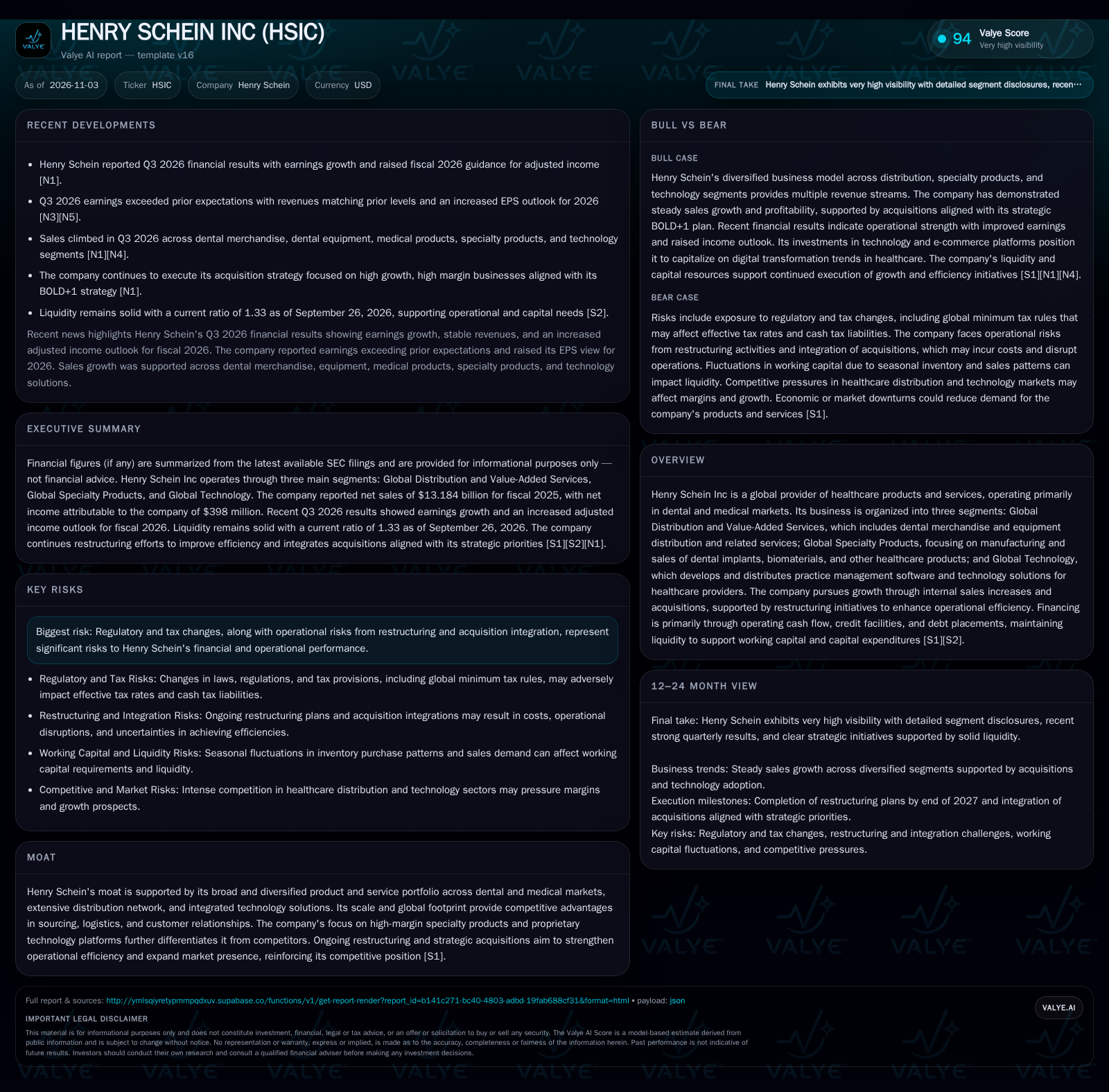
Henry Schein reported $13.2 billion in 2025 net sales and continued earnings growth into Q3 2026, underpinned by multi-segment expansion and ongoing acquisitions. Gross margin edged down to 31.1% amid promotional activity and mix shifts, while restructuring and integration efforts are expected to continue through 2027. The company’s diversified model and technology push could support longer-term margin improvement, but integration risks and competitive intensity remain key watchpoints. [S1] [S2] [N1] [N4]
Henry Schein’s 2025 and Q3 2026 results illustrate the company’s ability to drive top-line growth through a blend of internal expansion and targeted acquisitions across its distribution, specialty, and technology segments. However, the ongoing margin compression and restructuring costs highlight the operational complexity of integrating new businesses and the challenge of sustaining profitability in a rapidly evolving healthcare products landscape. The next inflection point will hinge on whether investments in higher-margin specialty and technology offerings can counterbalance competitive and regulatory headwinds while unlocking new efficiencies.
Recent Results Signal Growth with Margin Caveats
Henry Schein posted net sales of $13.184 billion for fiscal 2025, a 4.0% increase over the prior year, driven by internal growth, acquisitions, and foreign exchange effects. In Q3 2026, the company reported further sales and earnings growth, prompting a raised fiscal 2026 adjusted income outlook. These results underscore the company’s ability to generate revenue momentum across its dental, medical, specialty, and technology businesses. However, gross margin slipped to 31.1% in 2025, down from 31.7% the previous year, reflecting product mix changes and increased promotional activity. Operating expenses rose to $3.452 billion, including $105 million in restructuring charges as the company continues to integrate recent acquisitions and streamline operations—a process expected to run through 2027. The company reported cash and liquidity metrics for the period; these figures do not by themselves establish operating runway, investment capacity, financial flexibility, or financing capacity. [S1] [S2] [N1] [N4]
How the Multi-Segment Model Drives—and Constrains—Profitability
Henry Schein’s business economics rest on the interplay of volume-driven distribution, higher-margin specialty products, and scalable technology solutions. Distribution and value-added services provide stable, recurring revenue from consumables and equipment sales, but these carry relatively thin margins and are vulnerable to price competition. The specialty segment—covering dental implants, biomaterials, and advanced healthcare products—offers higher gross margins due to proprietary products and less commoditized offerings. Technology, including practice management software and e-services, has the potential for strong operating leverage if adoption expands, as incremental sales can be delivered at lower variable cost.
The company’s BOLD+1 strategy prioritizes acquisitions in high-growth, high-margin niches, aiming to enhance mix and cross-sell opportunities. However, integrating acquired businesses increases fixed costs and operational complexity, as evidenced by ongoing restructuring charges. Promotional programs and product mix shifts can pressure margins, particularly if high-margin specialty or tech sales underperform. Henry Schein’s scale supports favorable purchasing terms and logistics efficiencies, but working capital swings—due to seasonal inventory and sales patterns—can strain cash flow. Financing is primarily through internally generated cash and credit facilities, reducing reliance on equity but increasing sensitivity to debt market conditions. [S1]
Scale, Breadth, and the Battle for Margin in Healthcare Distribution
Henry Schein’s competitive position is anchored by its broad portfolio, global distribution infrastructure, and integrated technology solutions. This scale provides negotiating leverage with suppliers and the ability to offer bundled solutions to dental and healthcare providers. However, the distribution and technology sectors are intensely competitive, with both global giants and regional specialists vying for share. Price competition is fierce in core consumables, and technology offerings face the dual challenge of customer inertia and rapid innovation cycles.
Specialty products and proprietary technology platforms offer some differentiation, but these advantages are vulnerable if rivals accelerate their own innovation or if regulatory changes alter the economics of specialty healthcare. Channel relationships, service breadth, and integration with provider workflows can increase switching costs, but these are not insurmountable if competitors match or exceed Henry Schein’s value proposition. The company’s ability to maintain or expand margin will depend on sustaining mix improvements, driving adoption of tech-enabled solutions, and realizing synergies from acquired businesses more efficiently than peers.
If Specialty and Tech Bets Outpace Integration Friction
A favorable scenario for Henry Schein unfolds if the company successfully accelerates growth in specialty and technology segments, driving a sustained mix shift toward higher-margin products and services. If restructuring and acquisition integration are completed on or ahead of schedule, cost savings could combine with operating leverage from technology adoption to lift margins and earnings above current expectations. Expanded cross-selling between segments and deeper penetration of e-services into the installed base could further enhance customer retention and wallet share.
Evidence that would support this scenario includes: a rebound or improvement in gross margin above 2025 levels, acceleration in technology segment revenue growth, disclosure of successful integration milestones for recent acquisitions, and positive commentary from management on synergy capture and operating expense reductions. Conversely, persistent margin compression or new restructuring charges would undermine this thesis.
Multi-Segment Expansion with Ongoing Margin Pressure
The most likely trajectory is that Henry Schein sustains low- to mid-single-digit revenue growth across its diversified segments, with incremental gains from acquisitions and internal expansion. Gross margin remains under mild pressure due to mix and competitive dynamics, while operating expenses stay elevated as restructuring and integration continue through 2027. Technology and specialty products contribute to margin stability but do not fully offset headwinds in core distribution.
Confirmation of this scenario would come from steady, moderate sales growth, maintenance of current margin levels, and continued—but not escalating—restructuring charges. If the company discloses improved operating expense ratios or a return to margin expansion as integration winds down, this would tilt the scenario more positive. If margin slippage accelerates or revenue growth stalls, the base case would shift toward the downside.
When Integration Costs and Margin Erosion Overwhelm Growth
A negative outcome emerges if Henry Schein’s restructuring and acquisition integration efforts drag on or exceed budget, resulting in prolonged elevated operating expenses. If competitive pressure intensifies—through price wars in distribution or disruptive innovation in healthcare technology—gross margin could deteriorate further. Regulatory or tax changes could also raise costs or compress after-tax earnings. In this scenario, the company’s diversified model would not be enough to offset the combined weight of higher costs and stagnant or declining revenue.
Supporting evidence would include: continued or rising restructuring charges beyond 2027, further gross margin declines, missed sales or earnings guidance, or negative working capital trends requiring additional external financing. Deterioration in customer retention or technology adoption metrics, if disclosed, would also reinforce downside risks.
What Could Shift the Margin and Growth Outlook for Henry Schein
Gross margin trajectory—whether it stabilizes, rebounds, or continues to erode—will be a direct signal of mix, pricing, and promotional dynamics. [S1]
Progress on restructuring and integration: updates on cost savings, timeline adherence, and completion of the 2024 restructuring plan. [S1]
Revenue growth or mix shifts in the Global Specialty Products and Global Technology segments, as these are central to margin expansion. [S1]
Disclosure of technology adoption rates, e-services penetration, or cross-segment synergies would help test the thesis.
Operating expense ratio trends, especially as restructuring charges are phased out, will indicate efficiency gains or lingering friction. [S1]
Any change in working capital patterns, especially inventory and receivables, could signal stress or improved operational discipline. [S1]
Regulatory or tax developments affecting effective tax rate or after-tax cash flow could materially alter the earnings outlook. [S1]
Management commentary or quantitative disclosure on customer retention, recurring revenue, or technology churn, if disclosed, would clarify switching costs and competitive resilience.
Disclaimer: This is research-only, informational analysis and not investment advice. It may include AI-generated interpretation and general industry context. Always verify important details using primary sources.

Comments