
Black Stone Minerals: Asset Scale, Drilling Partnerships, and the Tension Between Commodity Cycles and Cash Flow Stability
Black Stone Minerals, L.P. leverages one of the largest U.S. portfolios of mineral and royalty interests, using multi-year operator agreements and targeted acquisitions to drive value. Yet, the company's fortunes remain tied to external operator activity and commodity price cycles, challenging the durability of its distributable cash flow.
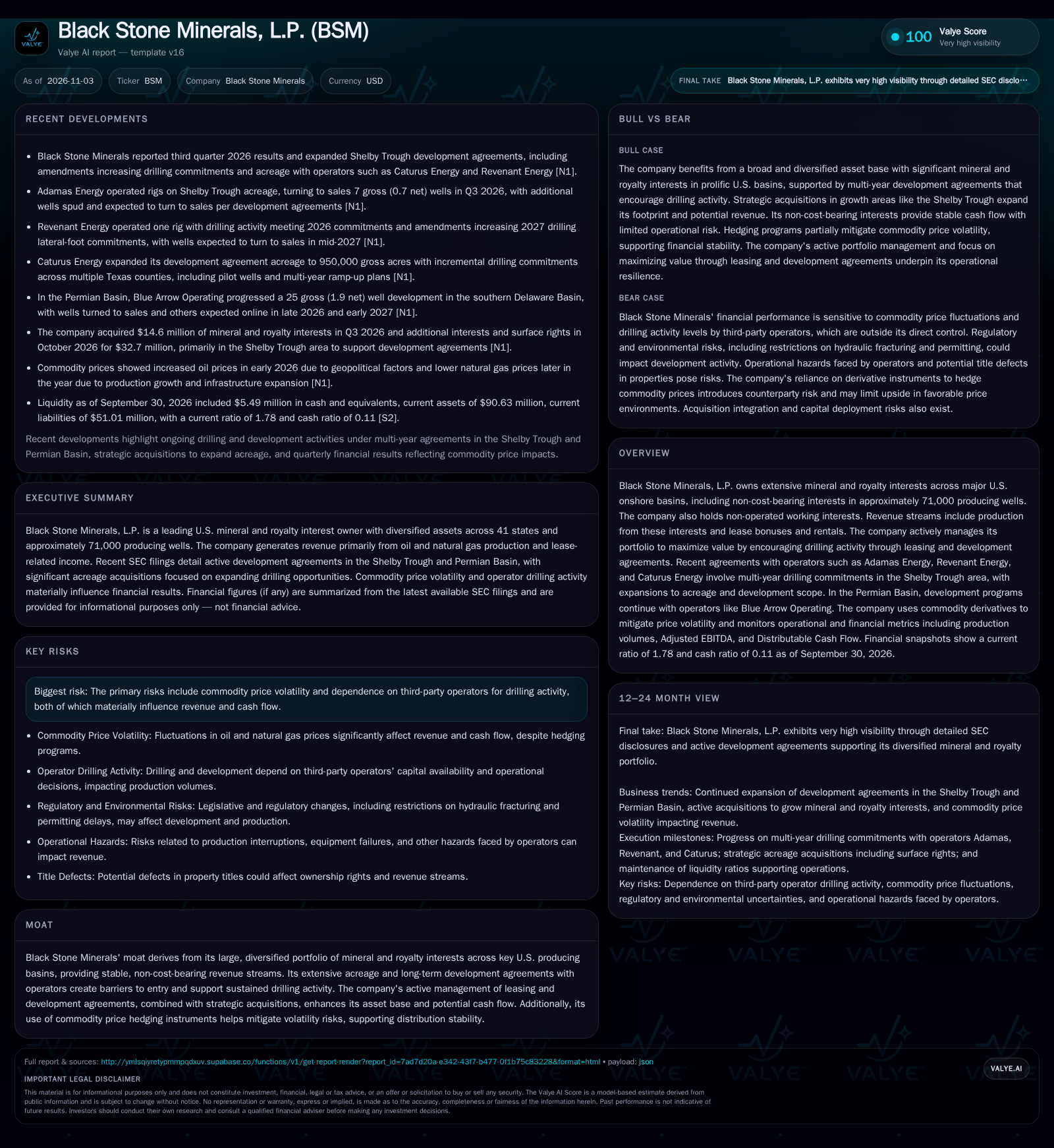
Black Stone Minerals' vast mineral and royalty portfolio provides non-cost-bearing cash flow potential, underpinned by multi-year drilling agreements and recent acquisitions in the Shelby Trough and Permian Basin. While this scale supports revenue diversity, actual cash generation is highly sensitive to operator execution and commodity price volatility, with hedging programs offering only partial insulation. The company's ability to sustain and grow distributions will depend on drilling follow-through, effective portfolio management, and the external macro environment. [S1] [S2] [N1]
Black Stone Minerals, L.P. stands as a bellwether among U.S. mineral and royalty owners, combining scale—over 71,000 producing wells—with a strategy of active portfolio management and multi-year operator partnerships. Recent expansions in the Shelby Trough and Permian Basin reflect the company's drive to secure future drilling catalysts and production growth. However, as a non-operator, Black Stone relies on the capital discipline and drilling pace of third parties, all while navigating the unpredictable tides of commodity markets. The result is a business with embedded asset value and cash flow potential, but one whose realized performance is ultimately governed by external forces that it can only partially influence.
Recent Development Agreements and Acquisitions Reshape the Asset Base
Black Stone Minerals has executed multiple development agreements in the Shelby Trough with operators such as Adamas Energy, Revenant Energy, and Caturus Energy, expanding both the acreage under commitment and the required drilling activity. These amendments include multi-year drilling obligations, with Caturus Energy's agreement now covering 950,000 gross acres and setting out pilot wells and a ramp-up in drilling across several Texas counties. In the Permian Basin, Blue Arrow Operating is progressing a 25 gross (1.9 net) well program, with several wells already online and additional wells expected to turn to sales in late 2026 and early 2027. [N1]
From September 2023 to October 2026, Black Stone completed approximately $335.5 million in acquisitions, primarily focused on mineral and royalty interests in the Shelby Trough, including surface rights to secure future drilling locations. [S2]
For the quarter ended September 30, 2026, the company reported revenue of $99.7 million, cash and equivalents of $5.49 million, current assets of $90.63 million, and current liabilities of $51.01 million, resulting in a current ratio of 1.78 and cash ratio of 0.11. [S2]
Commodity price trends in 2026 were mixed: oil prices rose due to geopolitical events, while natural gas prices declined as U.S. production and infrastructure expanded. [S2] [N1]
How Black Stone Converts Mineral Ownership into Cash Flow
Black Stone Minerals' core economic engine is ownership of mineral and royalty interests, which entitle it to a share of production revenue from oil and natural gas wells operated by third parties, without incurring the direct costs of drilling or operating the wells. This non-cost-bearing structure offers an inherently high-margin revenue stream, but the volume and timing of cash flows depend on operators' drilling decisions and the realized commodity price at the time of production.
The company supplements this with non-operated working interests in some wells, which carry a proportionate share of development costs, potentially boosting returns but also introducing greater volatility and capital requirements. Additional revenue comes from lease bonuses and delay rentals, recognized as operators acquire or maintain drilling rights.
Operating leverage is present but indirect: once a well is drilled, incremental production revenue flows largely to the bottom line, but Black Stone's ability to influence when and where new drilling occurs is limited to the terms it can negotiate in leasing agreements. Recent development deals in the Shelby Trough exemplify efforts to secure drilling commitments and align operator incentives.
Capital needs are concentrated in acquisitions—such as the recent $335.5 million outlay for new mineral interests—and, to a lesser degree, in funding working interest participation. Cash flow variability is high, given exposure to commodity prices and operator behavior, but the company attempts to smooth this through derivative contracts that hedge a portion of expected production. However, hedging is limited by policy and credit facility terms, so not all exposure is covered. [S1] [S2]
Scale, Diversification, and Operator Partnerships as Barriers and Risks
Black Stone Minerals' competitive position rests on three pillars: asset scale, geographic diversification, and the ability to structure development partnerships with operators. With interests in approximately 71,000 producing wells across 41 states, the company is less exposed to single-basin or single-operator risk than smaller peers. This breadth provides resilience against localized downturns or operator-specific setbacks.
However, the broader mineral and royalty landscape is competitive, with institutional capital, family offices, and specialist funds all vying for mineral rights in prolific basins. The durability of Black Stone's advantage depends on its ability to maintain and expand acreage in high-return areas and to structure agreements that effectively encourage operator drilling activity.
A key vulnerability is the company's reliance on third-party operators for capital allocation and technical execution. If operators cut back drilling due to commodity price weakness, capital constraints, or regulatory headwinds, Black Stone's cash flow will decline regardless of its asset footprint. Substitution risk—such as from renewables or regulatory shifts away from hydrocarbons—remains a long-term consideration, though near-term impacts are likely limited in core basins.
When Drilling Momentum and Commodity Prices Align
The most favorable scenario for Black Stone Minerals is one in which operator drilling activity meets or exceeds the multi-year commitments secured in recent development agreements, particularly in the Shelby Trough and Permian Basin. If oil prices remain robust and natural gas prices recover, operators will have both the incentive and the means to ramp up drilling, leading to increased production volumes that flow directly to Black Stone's top line.
Successful integration of newly acquired mineral interests—especially those with surface rights that facilitate drilling—could further boost production and future cash flows. In this environment, hedging programs serve to lock in attractive margins rather than merely defend against downside.
Confirmation of this scenario would come from sequential growth in production volumes, rising Adjusted EBITDA and Distributable Cash Flow, and evidence that operators are consistently meeting or exceeding drilling targets set out in development agreements. Additional signs would include new lease bonuses and further acreage acquisitions in high-potential areas. [S2] [N1]
Production Growth Paces Operator Execution and Commodity Swings
The most plausible trajectory is a mixed environment where some operators meet drilling commitments while others adjust activity in response to shifting commodity prices. Oil price strength may support healthy activity in liquids-rich areas, but natural gas-weighted regions could see drilling slow if prices remain depressed.
Black Stone's cash flow and distribution capacity would show moderate growth as new wells come online per development agreements, offset by legacy well declines and pricing headwinds. The company continues to pursue targeted acquisitions and actively manages its hedge book to mitigate near-term volatility, but is unable to fully escape the broader commodity cycle.
Evidence for this scenario includes steady but not accelerating production volumes, relatively stable Adjusted EBITDA and Distributable Cash Flow metrics, and a balance of new and legacy development activity in core basins. Operator communications and rig activity reports would show some variability, but no widespread shortfall relative to agreed drilling schedules. [S2] [N1]
Commodity Weakness or Operator Retrenchment Erodes Cash Generation
A negative outcome would arise if commodity prices—especially natural gas—remain weak or decline further, prompting operators to scale back drilling despite contractual commitments. Delays or underperformance in the Shelby Trough and Permian Basin would lead to lower-than-expected production additions, while legacy wells continue to decline.
In this scenario, Black Stone's revenue and distributable cash flow would fall short of expectations, potentially pressuring its ability to sustain distributions or fund new acquisitions. Hedging would offer some protection, but only for the portion of volumes covered and only within the limits set by the company's credit facility and risk policy.
Confirmation would come from declining production volumes, missed or deferred drilling milestones in development agreements, and a pronounced drop in Adjusted EBITDA and Distributable Cash Flow. External factors—such as regulatory hurdles, new environmental restrictions, or capital market constraints affecting operators—could exacerbate these pressures. [S2] [N1]
Testing the Resilience of Black Stone’s Cash Flow Model
Quarterly and annual production volumes by basin and commodity, as these directly drive royalty revenue and test whether development agreements are translating into realized output. [S2]
Operator drilling activity relative to stated commitments, particularly in the Shelby Trough and Permian programs, to assess the follow-through on multi-year agreements. A useful metric would be the number of wells spud and turned to sales versus contractual targets. [N1]
Trends in Adjusted EBITDA and Distributable Cash Flow, which reflect the sustainability of distributions and the effectiveness of portfolio management. [S2]
Acquisition pace, size, and location, to see whether Black Stone continues to secure high-potential mineral rights and surface access that facilitate future drilling.
Hedge coverage ratios and realized versus benchmark commodity prices, to understand how much of the company’s cash flow is insulated from market swings and at what opportunity cost. [S2]
Changes in operator capital budgets and rig counts in Black Stone’s core acreage, as these are leading indicators for future production and revenue.
Any regulatory or environmental developments that could affect permitting, hydraulic fracturing, or access to infrastructure in key basins.
Disclaimer: This is research-only, informational analysis and not investment advice. It may include AI-generated interpretation and general industry context. Always verify important details using primary sources.

Comments