
AbbVie’s Post-Humira Evolution: Pipeline Progress, Portfolio Risks, and the Next Growth Engine Test
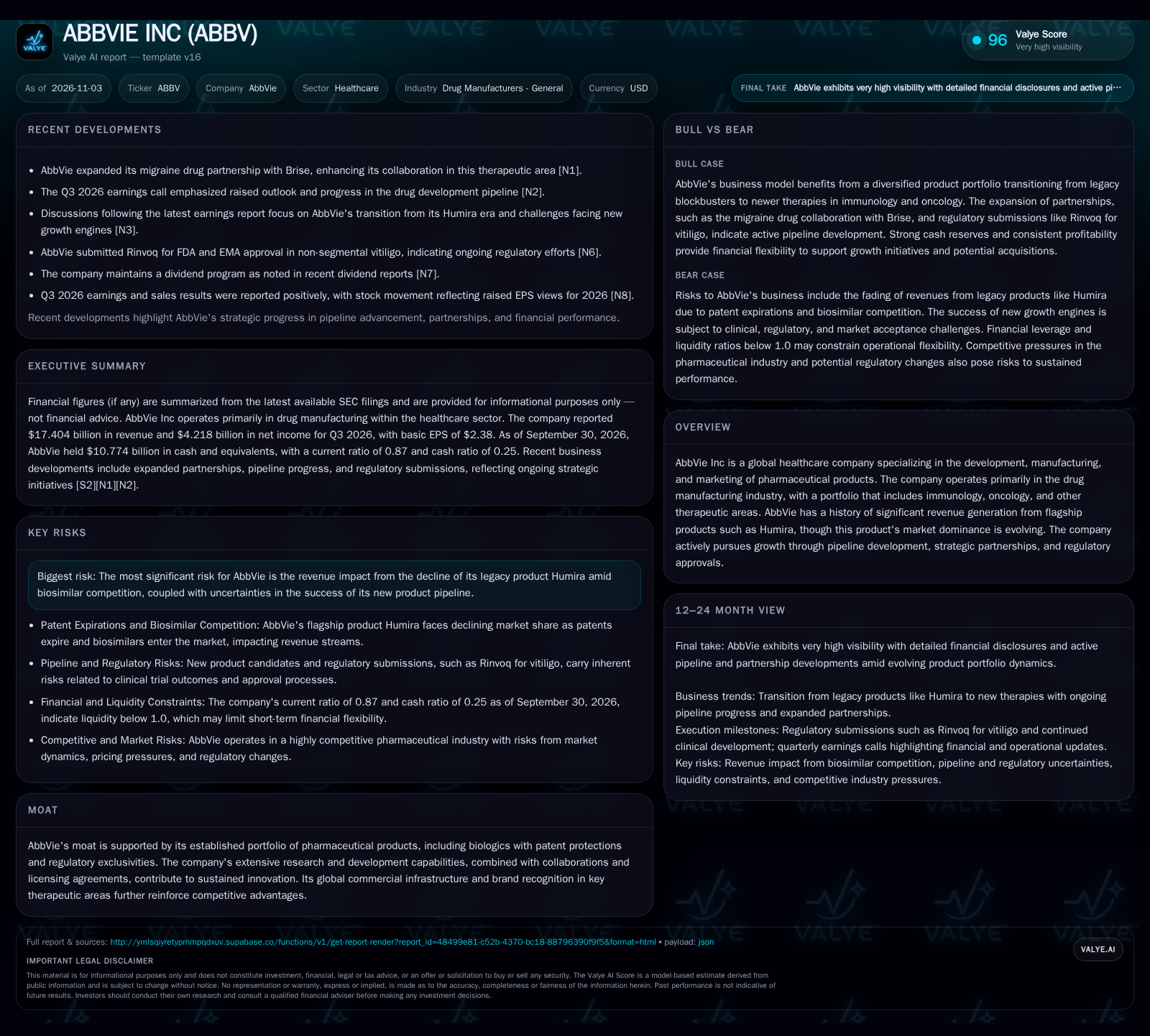
AbbVie delivered $17.4 billion in Q3 2026 revenue and $4.2 billion in net income, but faces a shifting landscape as Humira declines and new therapies and partnerships must prove their commercial and clinical value.
AbbVie delivered $17.4 billion in Q3 2026 revenue and $4.2 billion in net income, but faces a shifting landscape as Humira declines and new therapies and partnerships must prove their commercial and clinical value. The next 12-24 months will test AbbVie’s ability to replace legacy cash flows and maintain its dividend while navigating regulatory and market headwinds.
The company’s recent financial performance remains robust, but mounting biosimilar competition and liquidity ratios below 1.0 sharpen the focus on pipeline execution and portfolio renewal. With an expanded migraine partnership, regulatory advances for Rinvoq, and a raised outlook, AbbVie’s near-term future hinges on the transition from historic cash cows to its next generation of revenue drivers—and its ability to weather heightened industry and financial pressures.
Recent Financial Results and Strategic Developments Shape AbbVie’s Transition
AbbVie reported $17.404 billion in revenue and $4.218 billion in net income for Q3 2026, with basic EPS of $2.38 [S2]. The company had $10.774 billion in cash and equivalents as of September 30, 2026, but current and cash ratios of 0.87 and 0.25, respectively, signal below-par short-term liquidity [S2]. Recent moves include expanding its migraine drug partnership with Brise and submitting Rinvoq for FDA and EMA approval in non-segmental vitiligo [N1] [N6]. While the Q3 earnings call highlighted a raised outlook and pipeline progress, industry commentary centers on the challenge of replacing the declining Humira franchise with new growth engines [N2] [N3].
Revenue Mix Shifts, Margin Pressures, and the Economics of Portfolio Renewal
AbbVie’s historic business model relied on outsized contributions from Humira, a high-margin biologic, driving both top-line growth and cash flow. With Humira’s patents expiring and biosimilars eroding its market share, AbbVie’s revenue mix is shifting toward a broader set of immunology and oncology assets, as well as new specialty drugs. This shift typically brings margin compression, as newer products may launch at lower prices due to payer demands and competitive intensity, and commercial ramp-up costs tend to be higher.
The cited source reports dividend-related activity; that disclosure alone does not establish dividend-policy continuity, management confidence, or a material constraint on capital flexibility. Operating leverage may be challenged during the transition: fixed R&D and SG&A costs are significant in pharma, and declining legacy cash flows can strain coverage until new products mature. [S2]
Pipeline partnerships, such as the Brise migraine collaboration, may spread risk and expand addressable markets, but typically involve profit-sharing or milestone payments, moderating incremental margin versus wholly owned assets. The economics of these collaborations will depend on clinical success, regulatory outcomes, and commercial uptake.
The transition from a legacy blockbuster like Humira to a diversified portfolio introduces complexity in forecasting revenue stability and margin trajectories. Newer therapies often face initial market entry barriers such as slower physician adoption, payer reimbursement hurdles, and the need for extensive real-world evidence generation to justify premium pricing. These factors can delay peak sales and compress margins relative to established products. Additionally, the timing and scale of biosimilar penetration in Humira’s markets will critically influence the pace of revenue decline, thereby affecting the runway available for new assets to mature. Effective portfolio renewal thus depends on synchronized clinical success, regulatory approvals, and market access strategies to mitigate margin erosion during this transition period.
Defending Share in a Crowded Therapeutic Landscape
AbbVie’s competitive position is anchored by its established commercial infrastructure, R&D scale, and a diversified portfolio spanning immunology, oncology, and neuroscience. However, the loss of Humira’s exclusivity exposes the company to intense biosimilar competition—a dynamic that can rapidly erode market share and pricing power. In immunology, AbbVie faces branded rivals with deep pipelines, as well as generic and biosimilar entrants. Oncology, migraine therapeutics, and dermatology represent growth areas but are also crowded with innovation from both large pharma peers and nimble biotech challengers.
Switching frictions in chronic disease categories are moderate: while patients and providers may be loyal to proven therapies, payers are increasingly aggressive in promoting lower-cost alternatives when possible. AbbVie’s success in defending share will depend on demonstrating superior clinical outcomes, real-world evidence, and the ability to negotiate favorable formulary access.
Strategic partnerships (e.g., Brise) and regulatory exclusivities for newer agents provide some insulation, but these moats are narrower and shorter in duration than those enjoyed by Humira at its peak. The company’s global reach and brand equity remain strengths, but the competitive bar for pipeline success is high.
Pipeline Acceleration and Portfolio Diversification Drive a Resilient Growth Trajectory
A favorable outcome for AbbVie would see its next-generation assets—particularly Rinvoq, Skyrizi, and migraine drugs from the Brise partnership—achieve rapid market adoption, offsetting Humira’s decline and stabilizing or even expanding margins. Regulatory approvals for Rinvoq in new indications (such as non-segmental vitiligo) could open additional high-value markets and reinforce the company’s leadership in immunology [N6]. Successful clinical trials and positive reimbursement decisions would bolster revenue visibility.
If these launches are commercially effective, AbbVie could restore operating leverage, maintain or grow its dividend, and deploy capital for further innovation or targeted M&A. Upside confirmation would come from accelerating sales of new products, margin stabilization, successful regulatory outcomes, and sustained positive cash flow—even as legacy revenues fall.
Portfolio Transition Brings Mixed Results as New Engines Partially Offset Legacy Declines
The most plausible path is that AbbVie’s new assets deliver meaningful but uneven growth, with some launches exceeding expectations and others encountering clinical, regulatory, or commercial barriers. Humira’s revenue erosion continues, but is partially compensated by expanding indications and uptake of therapies like Rinvoq, Skyrizi, and migraine drugs. The net effect is a period of slower top-line growth and margin pressure, but not a collapse.
Dividend continuity persists, but payout ratios may rise, and management could prioritize cash discipline over aggressive capital deployment. This scenario would be confirmed by steady, if unspectacular, new product sales growth, moderate margin compression, and ongoing—but not accelerating—progress in the pipeline and regulatory submissions.
Pipeline Disappointments and Margin Compression Undermine Financial Stability
In a more adverse outcome, one or more of AbbVie’s lead pipeline assets fail to achieve regulatory approval, encounter safety or efficacy issues, or struggle to gain reimbursement and market traction. The result is a sharper-than-expected drop in overall revenue and profitability, with fixed costs weighing on margins and limited ability to cut expenses quickly.
Competitive intensity in immunology and neurology could drive further price concessions and share loss. Downside confirmation would include stalled or shrinking sales in new launches, unfavorable regulatory or clinical events, and negative free cash flow trends.
Signals That Will Clarify AbbVie’s Post-Humira Trajectory
Quarterly revenue and market share trends for Rinvoq, Skyrizi, and the Brise migraine portfolio—if disclosed—will be critical to gauge the pace of portfolio renewal.
Regulatory milestones for key pipeline assets, including FDA and EMA approval decisions for new indications (such as Rinvoq in vitiligo), will help test the breadth of the company’s future growth engine.
Gross and operating margin trends, particularly as new products scale, will reveal whether the business can sustain profitability during the transition.
Partnership economics and milestone payment disclosures from collaborations like Brise would clarify incremental profit contribution and risk-sharing.
Progression of biosimilar competition and formulary access changes in core markets will illuminate the persistence of legacy revenue headwinds.
If disclosed, net debt-to-EBITDA or similar leverage metrics would help assess overall balance sheet resilience as operating conditions evolve.
Disclaimer: This is research-only, informational analysis and not investment advice. It may include AI-generated interpretation and general industry context. Always verify important details using primary sources.

Comments