
Encompass Health: Network Growth and Clinical Excellence Fuel Post-Acute Care Leadership
Encompass Health deepens its leadership in inpatient rehabilitation by scaling its hospital network and emphasizing operational excellence. The company’s latest results and expansion moves highlight both demographic tailwinds and the operational, regulatory, and competitive pressures that will shape its economic trajectory.
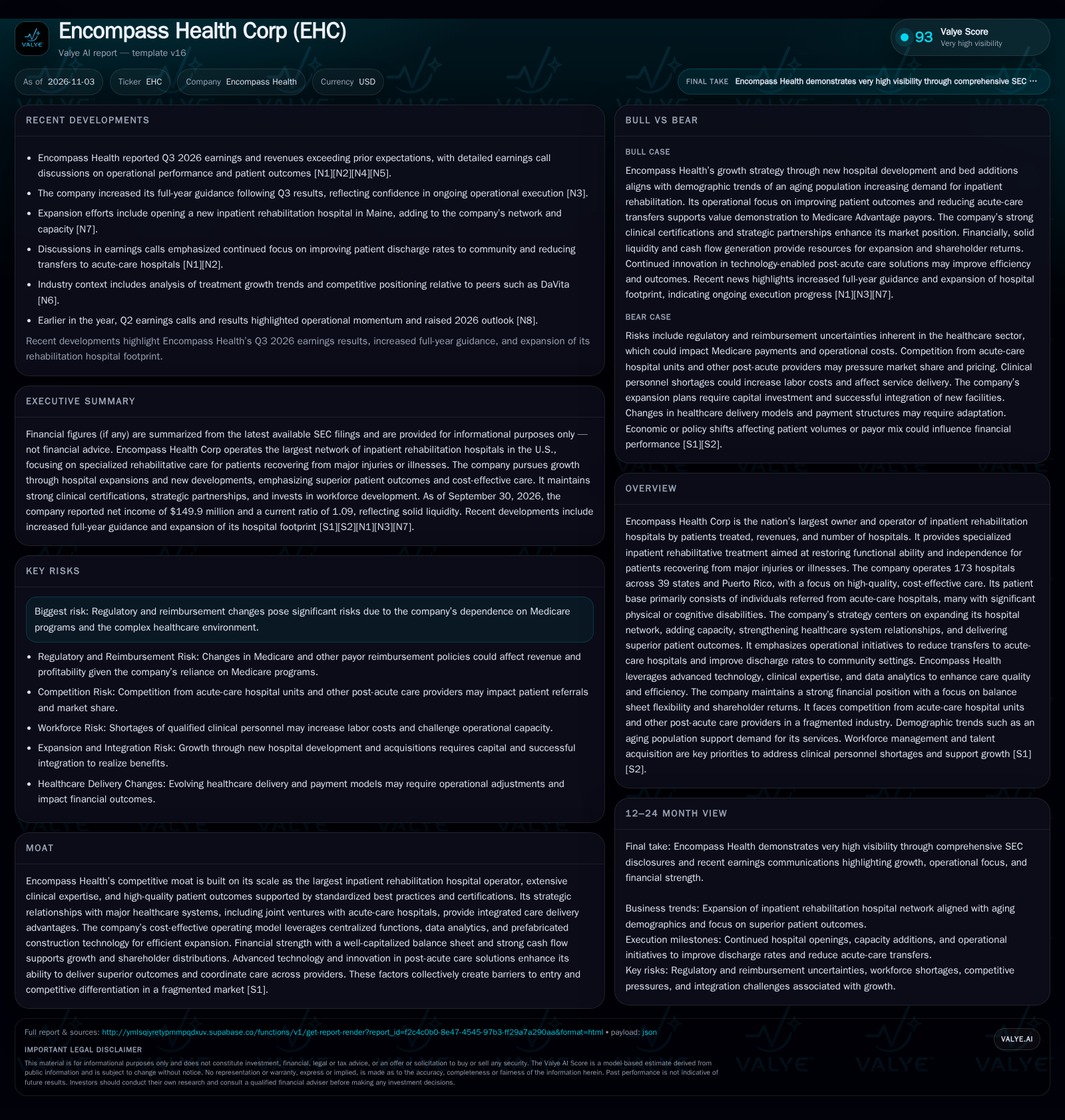
Encompass Health remains the largest U.S. owner and operator of inpatient rehabilitation hospitals, reporting solid Q3 2026 profitability and raising full-year guidance on the back of network expansion and operational gains. With 173 hospitals across 39 states and Puerto Rico, the company’s patient base and revenues are underpinned by acute-care referrals and an aging population. Strategic investments in workforce, technology, and clinical certifications support both growth and quality—but reimbursement risk, labor shortages, and integration challenges persist as structural watchpoints. [S1] [S2] [N3] [N7]
Encompass Health’s Q3 2026 results and recent expansion into Maine reinforce its position as the preeminent U.S. provider of inpatient rehabilitation, serving patients recovering from acute injuries and illnesses. The company’s strategy is anchored in network growth, operational efficiency, and clinical excellence, buttressed by demographic tailwinds from an aging population. However, as it adds capacity and raises guidance, Encompass Health continues to navigate a fragmented market, reimbursement sensitivity, and the persistent challenge of securing clinical talent—factors that will determine whether scale and quality can translate into durable economic advantage.
Recent Performance and Strategic Growth Initiatives
Encompass Health reported Q3 2026 net income of $149.9 million and basic EPS of $1.52, with results exceeding prior expectations and prompting an increase in full-year guidance [S2] [N3] [N5]. The company operates 173 inpatient rehabilitation hospitals across 39 states and Puerto Rico, having opened a new facility in Maine during Q4, further extending its national footprint [S1] [N7]. With 92% of patients admitted by referral from acute-care hospitals and a focus on complex rehabilitation needs, Encompass Health’s patient mix remains concentrated in higher-acuity, post-acute care. The company reported cash and liquidity metrics for the period; these figures do not by themselves establish operating runway, investment capacity, financial flexibility, or financing capacity. [S2]
The Role of Scale and Clinical Results in Profitability
Encompass Health’s core economic engine is its ability to admit and treat high-acuity rehabilitation patients, typically referred from acute-care hospitals, and deliver measurable functional improvement within a defined length of stay. Revenue is driven by a combination of Medicare (including Medicare Advantage), commercial, and managed care payors, with reimbursement rates and payor mix directly impacting profitability. Fixed costs are substantial, given the capital intensity of hospital construction, licensing, and staffing—particularly for specialized clinical personnel. However, once hospitals reach high occupancy, operating leverage can be significant: incremental admissions flow through at higher margins due to fixed-cost absorption.
The company’s focus on reducing readmissions to acute-care hospitals and increasing discharges to the community is not only a clinical imperative but also a lever for improving reimbursement and negotiating leverage with payors. Superior outcomes may support preferred provider status with payors and help defend against rate compression. Investments in technology—such as electronic medical records and data analytics—could further optimize care pathways, resource utilization, and regulatory compliance, potentially reducing variable costs per patient.
Expansion through new hospital development and bed additions requires substantial upfront capital but can yield attractive returns if local demand materializes and new facilities ramp efficiently. The economics of growth hinge on maintaining occupancy, controlling labor costs amid national clinical shortages, and managing the regulatory burden associated with Medicare compliance.
Market Fragmentation and Referral Relationships Limit Scale Benefits
Encompass Health operates in a highly fragmented post-acute care market, competing with acute-care hospital rehabilitation units, regional hospital systems, private equity-backed chains, and skilled nursing facilities. Its scale as the largest operator provides branding, data, and purchasing advantages, but patient flow is fundamentally dependent on referral relationships with acute-care hospitals and physicians. Joint ventures with health systems and stroke-specific clinical certifications for 148 of its hospitals as of end 2025 help differentiate its offering and support quality benchmarks [S1].
The company’s moat is strengthened by standardized best practices, clinical expertise, and a track record of superior patient outcomes. Nevertheless, switching costs for referring physicians are not absolute—competition for referrals is ongoing, and changes in hospital or payor strategies could redirect patient flows. The rise of alternative post-acute care models, such as home-based rehab and telehealth, could also begin to erode the inpatient share of the recovery pathway, particularly for lower-acuity patients. The company’s ability to demonstrate cost-effectiveness to Medicare Advantage and commercial payors will be tested as reimbursement models evolve and as payors seek to steer patients to lower-cost settings.
Enhanced Outcomes and Network Expansion Could Boost Margins and Reimbursements
A favorable trajectory for Encompass Health would see demographic tailwinds—primarily the aging U.S. population—driving sustained growth in demand for inpatient rehabilitation. If the company continues to open new hospitals in underserved markets, while ramping occupancy and maintaining its clinical workforce, it could capture incremental market share from less specialized providers. Demonstrated gains in discharge-to-community rates and reductions in acute-care readmissions could position Encompass Health as a preferred partner for Medicare Advantage and commercial payors, allowing it to negotiate more favorable reimbursement terms and defend margins as payment models shift toward value-based care.
Evidence confirming this scenario would include continued above-market volume growth, new and expanded payor contracts explicitly tied to outcome metrics, and stable or improving margins despite national labor cost pressures. Announcements of additional hospital openings, bed additions, and positive patient outcome data—particularly in new geographies—would further support the case for durable growth and profitability.
Ongoing Growth Faces Margin Challenges and Regulatory Changes
The most plausible near-term outcome is that Encompass Health continues its measured network expansion, with incremental gains in admissions and modest improvements in operational efficiency. Demographic trends support steady volume growth, but reimbursement rates may remain pressured by Medicare policy changes and commercial payor negotiations. Labor costs are likely to rise further given ongoing shortages of clinical staff, partially offset by productivity initiatives and technology adoption.
Margins could remain flat or compress slightly if wage inflation and regulatory costs outpace operational gains. The company’s ability to maintain high clinical standards and patient outcomes will be critical for defending its market position and negotiating leverage. Evidence supporting the base case would include hospital opening announcements at a pace similar to recent years, stable occupancy rates, ongoing investments in workforce development, and no material deterioration in payor mix or length of stay. Conversely, a notable drop in occupancy, a spike in labor costs without productivity offsets, or adverse regulatory changes would challenge this scenario.
Economic Vulnerability from Payment Reductions and Workforce Constraints
The principal risks to Encompass Health’s model stem from potential Medicare reimbursement reductions, adverse changes in value-based payment structures, and an acute escalation in clinical labor costs. Should regulatory changes reduce allowable reimbursement rates or restrict qualifying admissions, the company could see both revenue and margin contraction—particularly if it is unable to flex variable costs quickly. Intensified competition from acute-care hospital units or alternative post-acute settings (such as home-based rehab) could further pressure admissions and pricing.
A tightening labor market, with persistent shortages of qualified nurses and therapists, could force wage increases or result in understaffing, impairing both patient outcomes and compliance with certification requirements. Evidence for downside realization would include guidance revisions tied to regulatory headwinds, pronounced increases in wage and benefit expenses, a rising rate of acute-care transfers or adverse patient outcomes, or delays/cancellations of planned hospital openings due to capital or staffing constraints.
Factors Influencing Encompass Health’s Competitive Position in Coming Years
Occupancy rates and average length of stay by facility—if disclosed—would clarify the ramp and utilization efficiency of new and existing hospitals.
Payor mix evolution, particularly the share of Medicare Advantage versus traditional Medicare and commercial payors, will influence revenue visibility and pricing dynamics.
Reported discharge-to-community rates and acute-care readmission rates, as key outcome metrics, would help test whether operational initiatives are translating into measurable clinical and economic value.
Net new hospital openings, licensed bed additions, and facility ramp speed are critical for confirming the pace and efficiency of network expansion.
Labor expense trends, clinical staff turnover rates, and recruitment/retention metrics—if disclosed—would reveal whether workforce constraints are tightening or easing.
Updates on new or renewed payor contracts, especially those with value-based features or outcome-linked reimbursement, would indicate negotiating leverage and margin resilience.
Any regulatory or policy developments affecting Medicare reimbursement or certification requirements should be monitored closely for early warning of adverse changes.
Investments in technology adoption, EMR interoperability, and data-driven care management should be tracked as potential sources of operational leverage or cost containment.
Disclaimer: This is research-only, informational analysis and not investment advice. It may include AI-generated interpretation and general industry context. Always verify important details using primary sources.

Comments