
Mirum Pharmaceuticals: Portfolio Expansion and Clinical Milestones in the Rare Disease Arena
Mirum Pharmaceuticals is leveraging positive Phase 3 data and a broadened rare disease portfolio to pursue growth through new approvals and global commercialization. The company’s financial resources and pipeline advances set the stage for potential inflection, but success will hinge on execution in scaling sales, securing reimbursement, and navigating competitive and regulatory headwinds.
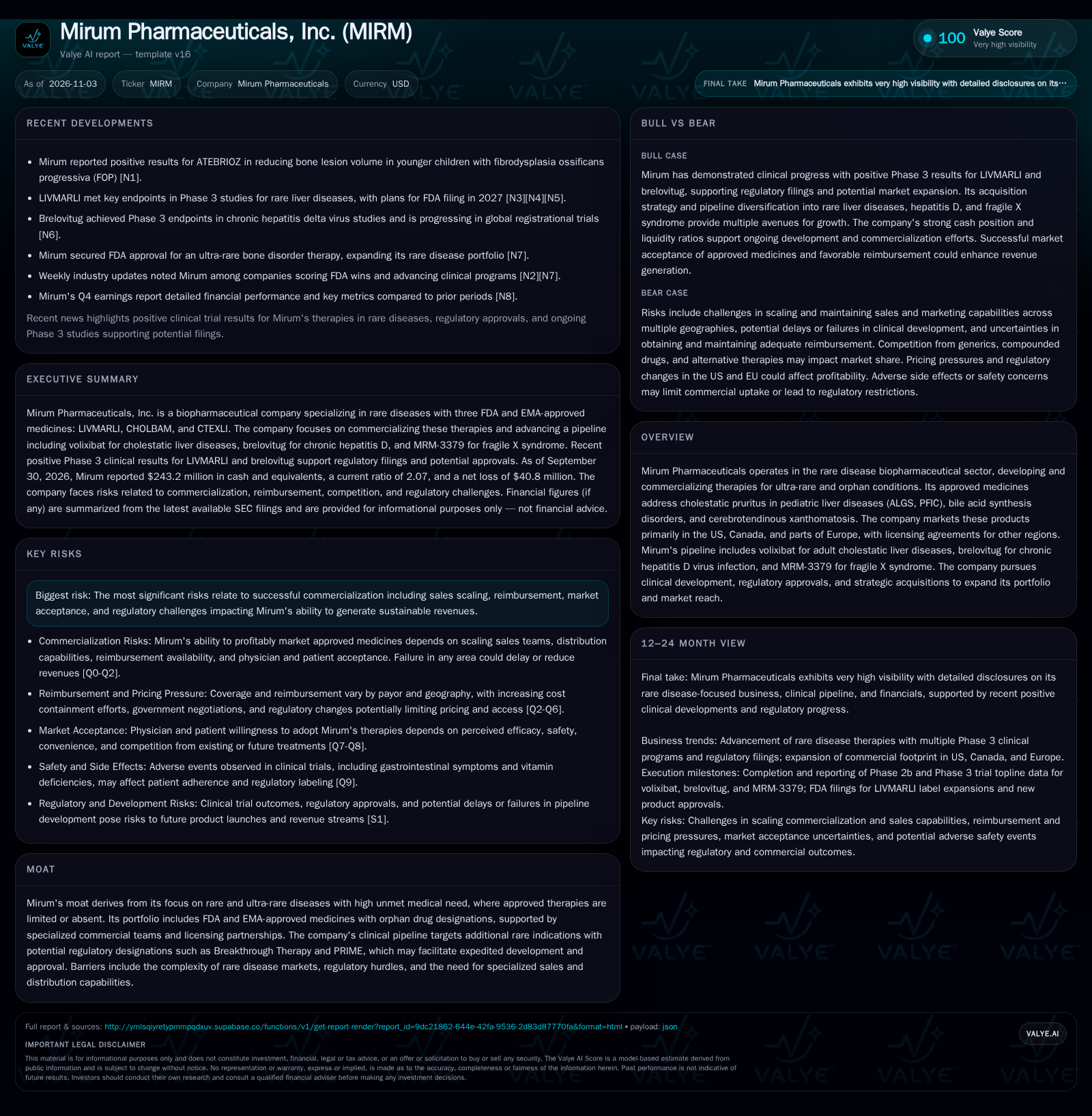
Mirum Pharmaceuticals, focused on rare diseases, has reported positive late-stage clinical results for LIVMARLI and brelovitug, supporting planned regulatory filings and potential new approvals. Recent acquisitions and pipeline progress have diversified its portfolio, while a cash-rich balance sheet underpins ongoing R&D and commercialization. The company’s next phase depends on converting clinical wins into sustainable commercial growth amid challenges in market access, reimbursement, and competition from alternative therapies and generics. [S1] [S2] [N3] [N4] [N5] [N6]
Mirum Pharmaceuticals, a specialist in rare and ultra-rare diseases, is at a strategic crossroads as it seeks to translate a string of positive clinical results and recent portfolio-expanding acquisitions into commercial momentum. With three approved therapies and several late-stage candidates—including LIVMARLI and brelovitug—Mirum is positioned to address multiple high-unmet-need indications. The company’s reported cash position provides near-term operational latitude, but the true test ahead will be converting clinical and regulatory progress into sustained revenue growth, especially as it faces reimbursement pressures, narrow patient populations, and the ongoing threat of generic and alternative therapies.
Recent Data Readouts and Portfolio Additions Reshape Mirum’s Outlook
The past year has marked several pivotal developments for Mirum Pharmaceuticals. The company reported positive Phase 3 results for LIVMARLI in rare pediatric liver diseases, supporting plans for an FDA filing in 2027. Similarly, brelovitug (BJT-778), acquired via Bluejay Therapeutics in January 2026, met endpoints in Phase 3 studies for chronic hepatitis D virus infection and is progressing through registrational trials. Mirum also expanded its portfolio with the acquisition of chenodiol and Cholbam from Travere Therapeutics, targeting further ultra-rare indications. [S1] [S2] [N3] [N4] [N5] [N6] [N1]
How Mirum’s Rare Disease Model Could Unlock Durable Revenue Streams
Mirum’s business model relies on developing and commercializing therapies for ultra-rare diseases, a segment characterized by high unmet medical need, limited competition, and the potential for premium pricing. Approved products such as LIVMARLI, CHOLBAM, and CTEXLI are commercialized directly in the US, Canada, and parts of Europe, with licensing agreements for other territories. In rare disease markets, pricing is typically negotiated on a case-by-case basis with payors, often resulting in high per-patient revenue but requiring intensive reimbursement efforts and patient identification. The economics are heavily volume-constrained—addressable populations can be in the hundreds to low thousands per indication—so success hinges on maximizing eligible patient capture and maintaining payer coverage.
Operating leverage can be significant once fixed costs for sales, distribution, and medical affairs are absorbed, but variable costs remain low relative to revenue. However, ongoing R&D and post-marketing requirements, as well as the need for specialized commercial teams, keep baseline expenses elevated. If new launches or label expansions are successful, incremental revenue could outpace cost growth, but the risk of reimbursement denials or slow uptake is substantial in these tightly regulated, evidence-driven markets.
Competitive Barriers and Counterforces in the Orphan Drug Landscape
Mirum’s focus on rare and ultra-rare diseases provides inherent competitive insulation: orphan and pediatric indications often see limited direct competition due to small patient populations and high development complexity. Orphan drug designation and regulatory exclusivities (such as those held for LIVMARLI and CHOLBAM) can confer several years of market protection. However, the company still faces counterforces—including potential competition from generics, compounded drugs, and, in some cases, off-label use of existing therapies.
Peer competitors range from other rare disease specialists to large pharmaceutical firms selectively targeting orphan indications. The competitive threat is most acute once initial exclusivity periods expire or if new entrants secure differentiated efficacy or safety data. Additionally, pricing pressure is intensifying, particularly in the US and EU, as payors and governments seek to constrain costs for high-priced therapies. Mirum’s ability to maintain share and pricing power will depend on demonstrating superior clinical benefit, managing safety profiles, and sustaining physician and patient confidence in the face of alternatives.
If Clinical and Regulatory Momentum Converts to Commercial Uptake
In the most favorable scenario, Mirum’s positive Phase 3 results for LIVMARLI and brelovitug translate into timely regulatory approvals and rapid uptake in their respective indications. Achieving FDA and EMA approvals for new or expanded indications would expand the addressable patient base and support international launches. If the company’s specialized sales teams can efficiently identify and convert eligible patients—and if reimbursement is secured at premium levels—revenue from new launches could accelerate, driving operating leverage and margin expansion.
A confirming signal would be strong initial prescription trends for new indications, positive reimbursement decisions from major payors, and evidence of rapid sales force productivity gains in new geographies. Additional upside could emerge if pipeline assets such as volixibat and MRM-3379 deliver positive data and proceed smoothly through regulatory processes, supporting a multi-product rare disease platform.
Portfolio Breadth Meets Commercial Complexity: What Steady Progress Looks Like
The most plausible near-term outcome is a period of steady but uneven progress. Mirum continues to commercialize its approved therapies while advancing late-stage pipeline candidates toward regulatory milestones. Incremental revenue growth is achieved through modest patient capture in newly approved indications and ongoing uptake in established markets, but overall growth remains limited by the size of target populations and the pace of payer adoption.
Execution risks—such as delays in regulatory review, slower-than-expected reimbursement approvals, or challenges in scaling field operations—temper the rate of commercial expansion. Pipeline readouts for volixibat, brelovitug, and MRM-3379 in 2026–2027 provide ongoing catalysts, but each carries uncertainty regarding clinical outcomes and ultimate market acceptance. Evidence confirming this scenario would include consistent, if moderate, quarter-over-quarter revenue growth, gradual expansion of the commercial footprint, and continued investment in pipeline diversification.
When Commercial Hurdles and Market Realities Stall Growth
A less favorable scenario unfolds if Mirum encounters significant commercial resistance: regulatory approvals may be delayed or restricted, payer reimbursement could be slow or insufficient, and side effect profiles may limit physician or patient adoption. Given the small size of rare disease markets, even modest shortfalls in patient identification or payer coverage can materially impact revenue. Competition from generics or alternative therapies could erode market share, especially if pricing concessions are forced or if new safety concerns emerge.
Confirming evidence for this scenario would include regulatory setbacks, disappointing initial sales for new launches, downward revisions to guidance, or increased cash burn without corresponding revenue uplift. Adverse developments in key pipeline programs—such as negative or equivocal trial results—would further dampen growth prospects and could force Mirum to reprioritize or scale back development efforts.
Milestones and Metrics That Will Shape Mirum’s Rare Disease Trajectory
Actual prescription volumes and reimbursement rates for LIVMARLI and brelovitug in newly approved indications, if disclosed, will be crucial in gauging commercial execution.
Regulatory progress and timelines for FDA/EMA approvals of pipeline assets—particularly for volixibat, brelovitug, and MRM-3379—should be monitored for inflection risk.
Reported patient identification and conversion rates in the US, EU, and Japan will clarify the effectiveness of Mirum’s specialized sales and outreach efforts.
Gross-to-net pricing trends and payer coverage decisions, if disclosed, will show whether Mirum can sustain premium pricing amid global cost containment.
Updates on side effect profiles, post-marketing safety data, and any changes to product labeling will help assess potential barriers to adoption.
Cash burn rates and R&D spend relative to revenue, especially as multiple late-stage programs progress, will indicate funding sufficiency and capital allocation discipline.
Commercial partnership activity or new licensing deals in ex-US territories could expand the addressable market and diversify revenue streams.
Evidence of generic or compounded drug competition—such as market entry or legal/regulatory developments—would test the durability of Mirum’s exclusivity and pricing power.
Disclaimer: This is research-only, informational analysis and not investment advice. It may include AI-generated interpretation and general industry context. Always verify important details using primary sources.

Comments