
ONE Gas, Inc.: Regulated Utility Economics, Liquidity Constraints, and the Dynamics of Rate-Driven Growth
ONE Gas, Inc. continues to deliver steady profitability and revenue growth through its regulated natural gas distribution business, supported by recent rate implementations.
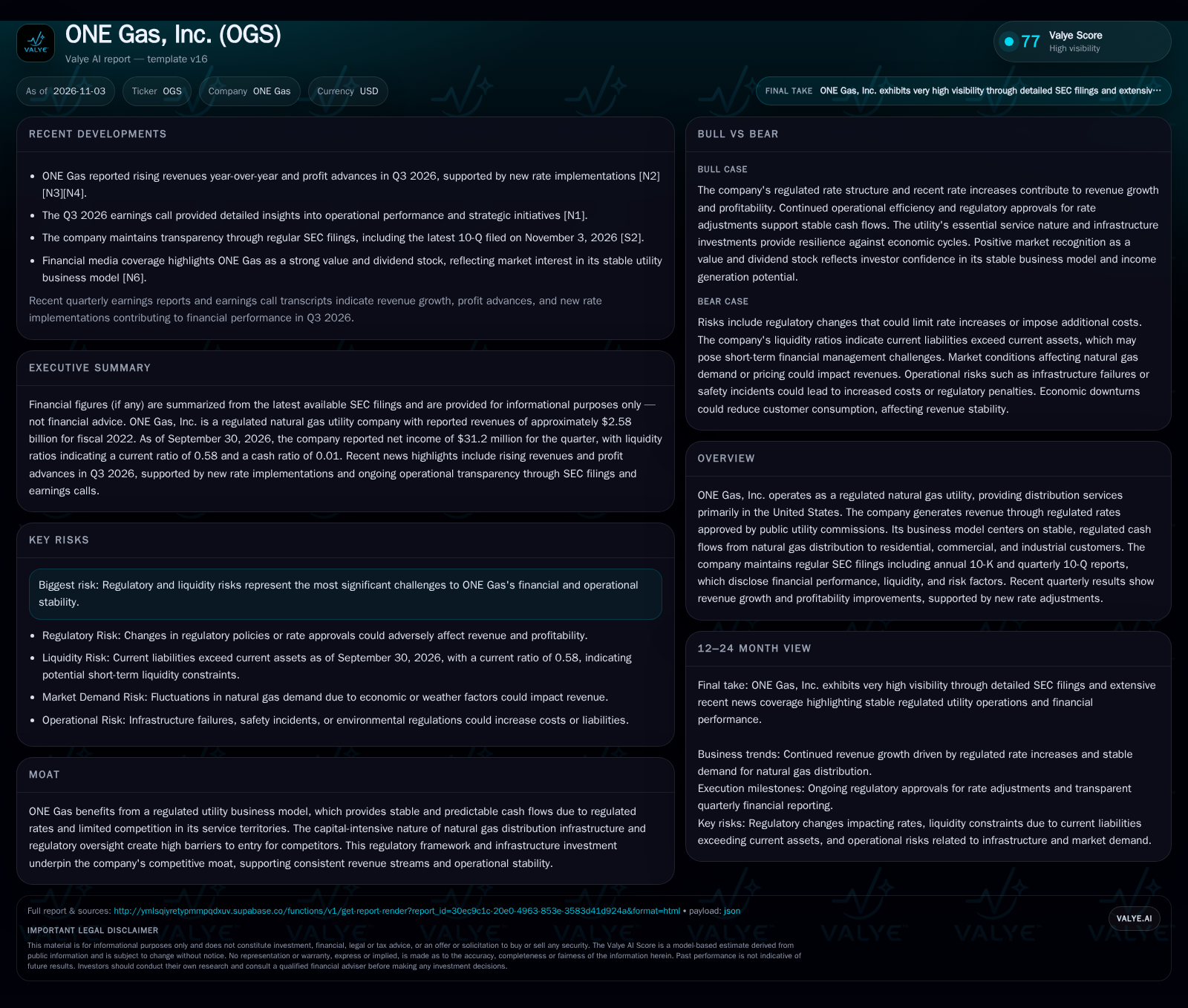
ONE Gas reported rising Q3 2026 revenues and profit, benefiting from new rate implementations and regulated utility economics. The company’s ability to secure future rate approvals and manage capital requirements will be central to maintaining its stable, regulated cash flows and competitive moat in a capital-intensive sector. [S2] [N4]
ONE Gas, Inc. exemplifies the classic regulated utility business: predictable cash flows, high barriers to entry, and a dependence on regulatory approval for revenue growth. The company’s Q3 2026 results show clear benefits from recent rate implementations, with profits and revenues advancing in line with regulatory allowances. Yet, the latest balance sheet snapshot reveals a current ratio of just 0.58 and scant cash reserves, raising questions about short-term liquidity management. For investors, the interplay between regulatory outcomes, capital needs, and the ability to sustain infrastructure investments will shape the company’s trajectory—even as its core business offers insulation from broader economic volatility. [S2] [N4]
Recent Rate Approvals Drive Profit, but Liquidity Remains Tight
ONE Gas reported net income of $31.2 million for the quarter ended September 30, 2026, with basic and diluted EPS of $0.50 and $0.49, respectively. This performance was driven by rising revenues, attributed in part to new rate implementations during the period. At the same time, the company’s liquidity position is notably constrained: as of September 30, 2026, cash and equivalents stood at just $7.27 million, with a current ratio of 0.58 and a cash ratio of 0.01. The company reported cash and liquidity metrics for the period; these figures do not by themselves establish operating runway, investment capacity, financial flexibility, or financing capacity. The company continues to provide detailed operational and financial transparency through quarterly and annual SEC filings and earnings calls. [S2] [N1] [N4]
Stable Revenue Streams Meet Capital Intensity: The Economics of a Regulated Utility
ONE Gas generates the bulk of its revenue from providing regulated natural gas distribution services to residential, commercial, and industrial customers. The company’s pricing is determined by state regulatory commissions, which periodically approve rate adjustments to allow recovery of operating costs, capital expenditures, and a regulated return on equity. This model produces stable and predictable cash flows, largely insulated from commodity price swings and broader economic cycles.
However, the business is fundamentally capital-intensive. Infrastructure investments in distribution networks, safety upgrades, and regulatory compliance require ongoing funding. While fixed costs are high, incremental volume growth typically provides operating leverage once baseline infrastructure is in place. The company must regularly seek regulatory approval for rate increases to match inflation, capital investment, and changing cost structures. If rate relief lags cost escalation or regulatory disallowances occur, margins can compress. The fundamental trade-off is between the stability of regulated returns and the perpetual need for capital to sustain and grow the asset base.
Barriers to Entry and Regulatory Structure Limit Competition—but Not Risk
ONE Gas benefits from a classic utility moat: exclusive service territories, regulatory oversight, and significant up-front infrastructure costs create high barriers to entry for would-be competitors. Within each state or local market, the company typically operates as the sole provider of natural gas distribution, protected from direct competition by regulatory franchise agreements.
However, the regulatory framework is a double-edged sword. While it limits competition and provides revenue visibility, it also subjects the company to political and regulatory risk. Commissions may delay, deny, or reduce requested rate increases, especially in periods of economic or political sensitivity. Long-term, the threat of substitution from electrification initiatives, renewable energy adoption, or changes in energy policy could erode the natural gas utility’s relevance, even if such transitions tend to be gradual. The company’s ability to maintain constructive regulatory relationships and adapt to evolving policy trends will be central to sustaining its competitive position.
If Regulatory Approvals Align with Capital Needs, Cash Flow Stability Could Improve
A favorable scenario for ONE Gas would see regulatory bodies granting timely and sufficient rate increases, allowing the company to recover rising operating and capital costs while maintaining or improving profit margins. This alignment could enable ONE Gas to manage its capital expenditures, fund infrastructure upgrades, and potentially improve its liquidity metrics over time. The regulated model could deliver consistent earnings growth if customer base expansion or weather-driven volume increases coincide with approved rate hikes.
Evidence confirming this scenario would include a track record of approved rate cases matching or exceeding cost inflation, visible improvements in current ratio and cash reserves, and continued revenue and profit growth in subsequent quarters. Additional signs would be successful completion of major infrastructure projects without cost overruns or regulatory disallowances, and management commentary signaling constructive regulatory engagement.
Steady Operations Amid Ongoing Liquidity Management and Regulatory Negotiation
The most plausible outcome is that ONE Gas continues to operate as a stable, regulated utility, with modest revenue and earnings growth tied to periodic rate approvals and steady demand for natural gas distribution. Liquidity remains tight, requiring active management of working capital, short-term borrowing, or refinancing to bridge gaps between cash inflows and outflows. Regulatory relationships are maintained, but rate relief may not always keep pace with cost inflation, requiring efficiency gains or cost controls to preserve margins.
This scenario would be confirmed by continued quarterly profits, stable or gradually improving liquidity ratios, and regular updates on successful rate case outcomes. If disclosed, trends in capital expenditure approval, debt issuance, and credit ratings would also help test the company’s ability to sustain its capital-intensive operations without significant financial stress.
Delayed Rate Relief or Adverse Regulatory Shifts Could Exacerbate Funding Pressure
A negative sequence would involve regulatory delays or denials of requested rate increases, leaving ONE Gas unable to fully recover rising costs or required capital investment. This could compress margins, weaken cash flow, and force the company to rely more heavily on short-term borrowing or asset sales. Persistent liquidity pressure could, in turn, raise borrowing costs or trigger credit downgrades, further constraining capital access.
Evidence of this downside would include a pattern of denied or significantly reduced rate cases, deteriorating liquidity ratios, missed or postponed infrastructure projects, or negative developments in credit outlooks. Additional warning signs would be management commentary highlighting regulatory friction, cost overruns, or increased reliance on interim financing arrangements.
Assessing ONE Gas’s Stability: What Will Reveal the Durability of Its Regulated Model?
Approval outcomes and timing for major pending or upcoming rate cases across the company’s key jurisdictions.
Quarterly trends in current ratio, cash ratio, and short-term debt levels, if disclosed, to assess near-term funding pressure.
Year-over-year growth in regulated asset base and capital expenditures, and the degree to which these are matched by approved rates.
Earnings call commentary on regulatory engagement, cost recovery mechanisms, and anticipated changes in rate structures.
Any disclosed changes in credit ratings or debt covenants that could impact capital access.
Updates on customer growth, weather-driven demand variability, or broader shifts in natural gas consumption.
Operational metrics related to infrastructure reliability, safety incidents, or compliance costs, if disclosed.
Management guidance or commentary on the pace and impact of electrification or alternative energy policy developments.
Disclaimer: This is research-only, informational analysis and not investment advice. It may include AI-generated interpretation and general industry context. Always verify important details using primary sources.

Comments