
Louisiana-Pacific’s Q3 Outperformance: Navigating Cyclicality with Margin Discipline and OSB Leverage
Louisiana-Pacific’s third-quarter results surpassed expectations, with profit growth and a reported liquidity position. The company’s exposure to OSB and building materials places it at the center of housing and construction cycles, but disciplined cost management and capital structure provide levers as the market evolves.
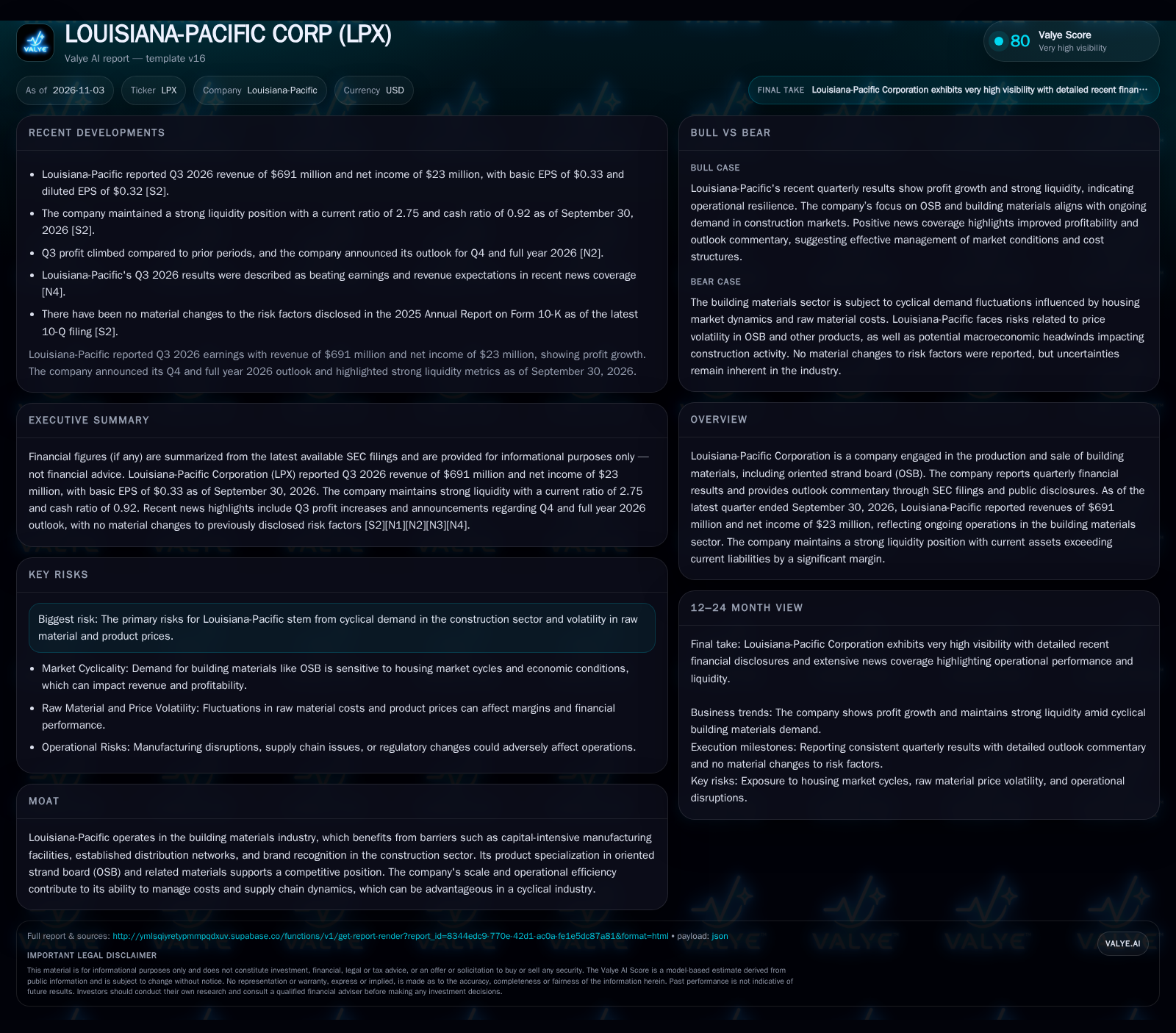
Louisiana-Pacific reported Q3 2026 revenue of $691 million and net income of $23 million, beating expectations and maintaining a reported current ratio. The company’s focus on OSB and building materials ties its fortunes to construction cycles, but recent results reflect operational discipline and liquidity that could help manage market volatility. Key watchpoints include OSB pricing, construction activity, and cost controls.
Louisiana-Pacific’s latest quarterly results offer a snapshot of disciplined execution in a sector notorious for its cyclicality. Yet, the building materials business remains fundamentally tied to the unpredictable rhythms of construction demand and input cost swings—a dynamic that will shape the company’s prospects as it enters the next phase of the housing cycle.
Profit Growth and Balance Sheet Strength Define Q3 Snapshot
Louisiana-Pacific reported Q3 2026 revenue of $691 million and net income of $23 million, translating to basic EPS of $0.33 and diluted EPS of $0.32 [S2]. The company reported cash and liquidity metrics for the period; these figures do not by themselves establish operating runway, investment capacity, financial flexibility, or financing capacity. [S2] News coverage highlighted that these results exceeded earnings and revenue expectations, and management provided guidance for Q4 and full-year 2026 [N2] [N4].
No material changes to previously disclosed risk factors were reported, suggesting operational stability and continuity in risk posture [S2]. These facts matter because they confirm Louisiana-Pacific’s ability to generate profits and maintain liquidity during a period when many building products peers face headwinds from housing market volatility.
How OSB Exposure and Fixed Costs Drive Operating Leverage
Louisiana-Pacific’s core business generates revenue primarily from the sale of oriented strand board (OSB) and other engineered wood products, which are used extensively in residential and commercial construction. OSB pricing and sales volumes are highly sensitive to new housing starts, repair and remodel activity, and broader economic conditions—variables that can swing sharply across the cycle.
The economics of OSB manufacturing are capital-intensive: large-scale mills require significant upfront investment, but once operational, they exhibit high fixed costs and substantial operating leverage. This means that incremental volume gains or price increases can rapidly translate into higher margins and profits. Conversely, downturns in construction demand can lead to underutilized capacity, pressuring margins and requiring strict cost controls.
Variable costs are dominated by wood fiber, resin, energy, and logistics. While the company’s scale helps with procurement and distribution efficiency, raw material price volatility can quickly erode margins if not offset by pricing power or operational discipline. Capital needs in this industry are typically concentrated in periodic plant upgrades and maintenance, but expansion or modernization programs can require substantial funding.
The interplay between fixed and variable costs in OSB production also means that Louisiana-Pacific's margin sensitivity to volume changes is asymmetric. During periods of rising demand, the fixed-cost base dilutes over greater output, improving margin percentages more rapidly than in a linear fashion. However, in downturns, the inability to reduce fixed costs promptly can exacerbate margin declines, leading to disproportionate profit erosion. This dynamic underscores the importance of flexible operating practices and the potential value of strategic capacity adjustments or temporary curtailments to mitigate downside risk.
Barriers to Entry and the Realities of Commodity Competition
Louisiana-Pacific competes in a concentrated segment of the building materials industry, where scale, manufacturing expertise, and distribution reach are critical. The capital-intensive nature of modern OSB mills and the need for a reliable supply chain create meaningful barriers to entry for new players. Established relationships with builders, distributors, and retail channels further entrench incumbents.
However, OSB and commodity building materials are largely undifferentiated, and price competition is fierce, especially in periods of oversupply or weak demand. Substitutes such as plywood or engineered lumber products can capture share if OSB pricing becomes unfavorable, and customers are often price-sensitive, limiting the ability to pass on cost increases. While branding and technical support can aid retention, true pricing power is typically cyclical and fleeting.
Peers include other large North American OSB producers and diversified building products firms. The competitive dynamic is shaped by mill utilization rates, capacity additions or curtailments, and the pace of housing construction—factors that can quickly shift the supply-demand balance.
If Housing Demand Recovers, Margin Expansion Could Accelerate
A plausible upside scenario is driven by a rebound in new home construction and renovation activity, leading to higher OSB volumes and firmer pricing. Given Louisiana-Pacific’s operating leverage, even modest improvements in utilization or price realization could disproportionately boost margins and net income.
Additional upside could materialize if the company manages to control input costs amid rising demand, or if it successfully shifts its product mix toward higher-margin engineered wood offerings. Evidence that would confirm this scenario includes sustained increases in OSB benchmark prices, reported gains in mill utilization rates, and sequential margin expansion in quarterly results.
A further accelerant would be industry capacity discipline—if competitors refrain from aggressive expansion, supply-demand could remain balanced longer, supporting elevated profitability.
Managing Through Cyclicality: Stable Results but Limited Visibility
The most likely scenario is that Louisiana-Pacific continues to manage through a choppy construction environment, with moderate fluctuations in OSB pricing and demand. Revenue and profit may oscillate quarter to quarter, but the company’s liquidity and cost controls help it maintain positive earnings and operational continuity.
In this scenario, input cost volatility and potential dips in housing starts are offset by disciplined expense management and incremental efficiency gains. The absence of material changes to risk factors or operational disclosures suggests continuity in management approach and risk appetite [S2].
What would confirm this base path is a pattern of quarterly results with mid-single-digit revenue swings, stable gross margins, and continued reported current ratio metrics. Falsification would come from a sharp deterioration in earnings, margin compression, or a rapid drawdown in liquidity unrelated to strategic investment.
A Demand Shock or Cost Spike Could Trigger Margin Compression
A negative scenario would unfold if there is a pronounced downturn in housing starts or a broader construction slowdown, leading to sharply lower OSB demand and price declines. Given the fixed-cost structure, underutilized mills could quickly erode profitability.
Simultaneously, if raw material or energy costs spike—due to supply disruptions, weather events, or regulatory changes—margins could be squeezed even if revenue holds steady.
Evidence of this scenario would include a rapid drop in OSB benchmark prices, significant declines in reported volumes, negative operating margins, or a marked reduction in cash and current assets relative to liabilities.
Signals That Will Clarify Louisiana-Pacific’s Resilience and Upside
OSB pricing trends and published benchmark indices: Sustained increases or decreases would directly impact revenue and margin trajectory.
Mill utilization rates and production volumes, if disclosed: Higher rates would indicate operating leverage and demand recovery.
Sequential gross margin and operating margin movements: Expansion would signal successful cost management or mix shift.
Trends in U.S. housing starts and construction permits: As leading indicators, these contextualize end-market demand.
Quarterly changes in cash and current asset balances: Downward trends could reveal margin stress or working capital pressure.
Disclosures or commentary on raw material cost inflation: Escalating input costs may precede margin contraction.
Capex commitments or new plant announcements: Could signal confidence in long-term demand or, conversely, risk of future oversupply.
Disclaimer: This is research-only, informational analysis and not investment advice. It may include AI-generated interpretation and general industry context. Always verify important details using primary sources.

Comments