
Bel Fuse: New Leadership, Global Expansion, and the Next Phase of Electronic Component Scale
Bel Fuse’s recent sales surge, leadership overhaul, and expanded manufacturing footprint in India set the stage for a new growth cycle—but also raise questions about execution, demand resilience, and competitive differentiation in a crowded sector.
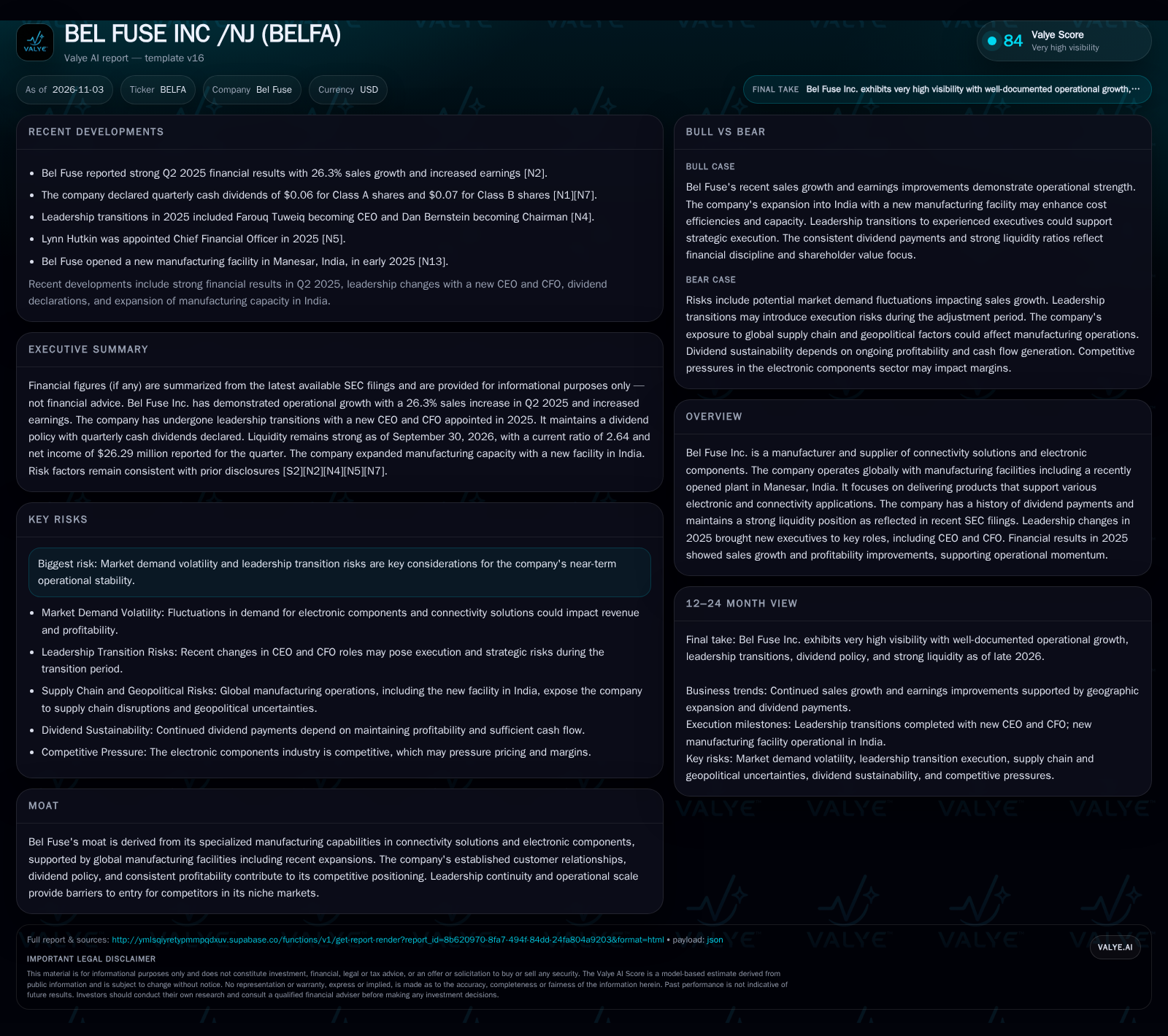
Bel Fuse reported a 26.3% sales increase and higher earnings in Q2 2025, expanded manufacturing with a new India facility, and transitioned to new executive leadership in 2025. The critical test will be whether operational scale and fresh strategic direction can deliver durable margin gains and defend against sector headwinds. [S2] [N2] [N4] [N5]
Bel Fuse Inc. sits at a turning point shaped by both internal transformation and external expansion. The company’s 26.3% Q2 2025 sales surge, new manufacturing capacity in India, and a wholesale shift in executive leadership suggest an ambition to scale and adapt in the evolving electronics components marketplace. Yet, the real test lies ahead: Can Bel Fuse turn recent operational gains and its expanded footprint into lasting competitive advantage, or will execution risks and sector headwinds erode momentum? Investors will need to watch not just the headline numbers, but the interplay of cost structure, market demand, and strategic follow-through in the coming quarters.
Recent Surge in Sales, Strategic Expansion, and Executive Realignment
Bel Fuse reported 26.3% year-over-year sales growth and increased earnings in Q2 2025, marking a period of strong operational performance [N2]. This sales momentum coincided with the grand opening of a new manufacturing facility in Manesar, India, in early 2025, signaling a push to expand production capacity and geographic reach. The company also underwent significant leadership changes, with Farouq Tuweiq becoming CEO and Lynn Hutkin taking over as CFO in 2025, while Dan Bernstein moved to Chairman [N4] [N5]. As of September 30, 2026, Bel Fuse reported $333.1 million in cash, a current ratio of 2.64, and net income of $26.29 million for the quarter, reflecting both liquidity and profitability [S2]. These developments set the backdrop for a company seeking to leverage new operational muscle and leadership to navigate the next phase of industry evolution.
How Scale, Mix, and Global Operations Could Reshape Earnings Power
Bel Fuse generates revenue by manufacturing and supplying connectivity solutions and electronic components, serving a global customer base across industrial, communications, and transportation sectors. Revenue growth can be driven by both volume (increased units shipped) and mix (higher-value or specialized components), with pricing power often constrained by the commoditized nature of much of the sector. The launch of the Manesar, India facility may lower per-unit production costs through labor arbitrage and improved logistics, potentially enhancing gross margin if volume follows. Operating leverage is a plausible opportunity: as fixed costs are spread over a higher sales base, incremental margin gains could materialize, especially if the company can maintain or improve pricing and product mix.
[S2] However, the ultimate profit potential will depend on the company’s ability to balance cost control, product innovation, and customer retention—particularly as new leadership shapes strategy.
A notable economic question is whether the India facility’s output will be absorbed by new or existing customers, and whether it enables Bel Fuse to win share from competitors or simply serve as a cost hedge in a slow-growth environment. The answer will shape both near-term earnings quality and long-term return on invested capital.
Specialization, Scale, and the Challenge of Differentiation in a Crowded Market
Bel Fuse operates in a highly competitive sector populated by global component manufacturers, regional specialists, and low-cost Asian producers. Its competitive position has historically rested on a combination of specialized manufacturing capabilities, global supply chain reach, and a broad product portfolio. The addition of the India facility could help close cost gaps with lower-cost competitors and support local-for-local supply strategies for multinational customers.
However, the competitive landscape is shaped by price-based competition, rapid product cycles, and switching frictions that are often modest for standardized parts but higher for custom or high-reliability solutions. Customer retention may depend on Bel Fuse’s ability to deliver consistent quality, supply chain reliability, and integration support. The company’s global footprint and operational scale could provide some barrier to entry, but true differentiation may require ongoing investment in engineering and customer service, especially as rivals pursue similar expansion and automation strategies.
Leadership transition introduces both risk and opportunity: new executives may pursue fresh partnerships, vertical integration, or digitalization initiatives, but could also disrupt established relationships or processes if not managed carefully.
When Expansion and Execution Align: Margin Expansion and Share Gains
In a favorable scenario, the India facility ramps efficiently, enabling Bel Fuse to capture new business from cost-sensitive OEMs and to serve existing customers more profitably. If new leadership successfully executes on operational integration and leverages the expanded capacity for both volume growth and improved product mix, the company could see sustained margin gains and above-sector growth.
Evidence supporting this scenario would include continued double-digit sales growth, rising gross and operating margins, new customer wins or share gains in target geographies, and positive commentary from management on capacity utilization and order backlog. A reduction in production lead times or improved working capital efficiency could also confirm successful execution.
The scenario would be further validated if Bel Fuse demonstrates the ability to invest in R&D or value-added services without eroding profitability—suggesting that scale and operational leverage are translating into durable economic advantage.
Operational Stability with Incremental Gains, but Competitive Pressures Persist
The most plausible near-term outcome is that Bel Fuse maintains operational stability with modest sales growth and steady profitability, while absorbing the impact of leadership changes and industry competition. The India facility may provide incremental margin benefit and supply chain resilience, but industry pricing pressure and the risk of demand volatility could limit outsized gains.
Confirmation of this scenario would come from sustained mid-single-digit sales growth, stable or slightly improving margins, and lack of major disruptions during the leadership transition. Customer retention, order flow consistency, and the absence of significant supply chain or geopolitical shocks would also support this narrative.
Falsification would occur if integration costs or execution missteps lead to margin erosion, or if competitive dynamics force price concessions that offset operational gains from the new facility.
If Execution Stumbles and Demand Softens: Margin Compression and Strategic Drift
In an adverse scenario, the combination of leadership transition and external headwinds—such as global demand slowdown, supply chain disruptions, or intensified price competition—results in margin compression and stalled growth. If the India facility fails to ramp efficiently, or if customer demand shifts to lower-priced competitors, Bel Fuse could face underutilized assets and rising costs.
Early warning signs would include a reversal in sales growth, declining gross or operating margins, inventory build-ups, or management guidance cuts. Prolonged execution missteps or loss of key customers would amplify downside risk, particularly if competitors capitalize on any perceived instability.
A severe outcome could see the company forced into defensive cost-cutting or restructuring, eroding its ability to invest for future growth.
Milestones That Will Reveal Whether Bel Fuse Can Sustain Its Growth Ambitions
Quarterly revenue growth rates, especially in the wake of the India facility’s ramp, will indicate whether capacity expansion is translating into real demand.
Gross and operating margin trends by segment, if disclosed, will help test whether cost savings and operating leverage are materializing or being offset by pricing pressure.
Utilization rates and output from the Manesar, India facility, if disclosed, would clarify the success of the geographic expansion and potential for further scale benefits.
Customer concentration and order backlog disclosures would help assess revenue visibility and the risk of demand shocks.
Retention rates for major customers, or evidence of new customer wins in target geographies, would confirm Bel Fuse’s ability to defend and grow share.
Updates on supply chain reliability and inventory levels would reveal resilience to external shocks and management’s operational grip.
Management guidance on capital allocation—such as R&D investment, further capacity expansion, or shareholder returns—will indicate strategic priorities and confidence.
Disclosures of integration costs or restructuring charges, if any, would provide insight into the true cost of expansion and transition.
Disclaimer: This is research-only, informational analysis and not investment advice. It may include AI-generated interpretation and general industry context. Always verify important details using primary sources.

Comments