
Resilient Earnings and Engine Leasing Cycles: Willis Lease Finance at an Inflection Point
Willis Lease Finance Corp sets a new revenue record but contends with earnings volatility tied to maintenance demand and sector cyclicality. The cited source reports dividend-related activity; that disclosure alone does not establish dividend-policy continuity, management confidence, or a material constraint on capital flexibility.
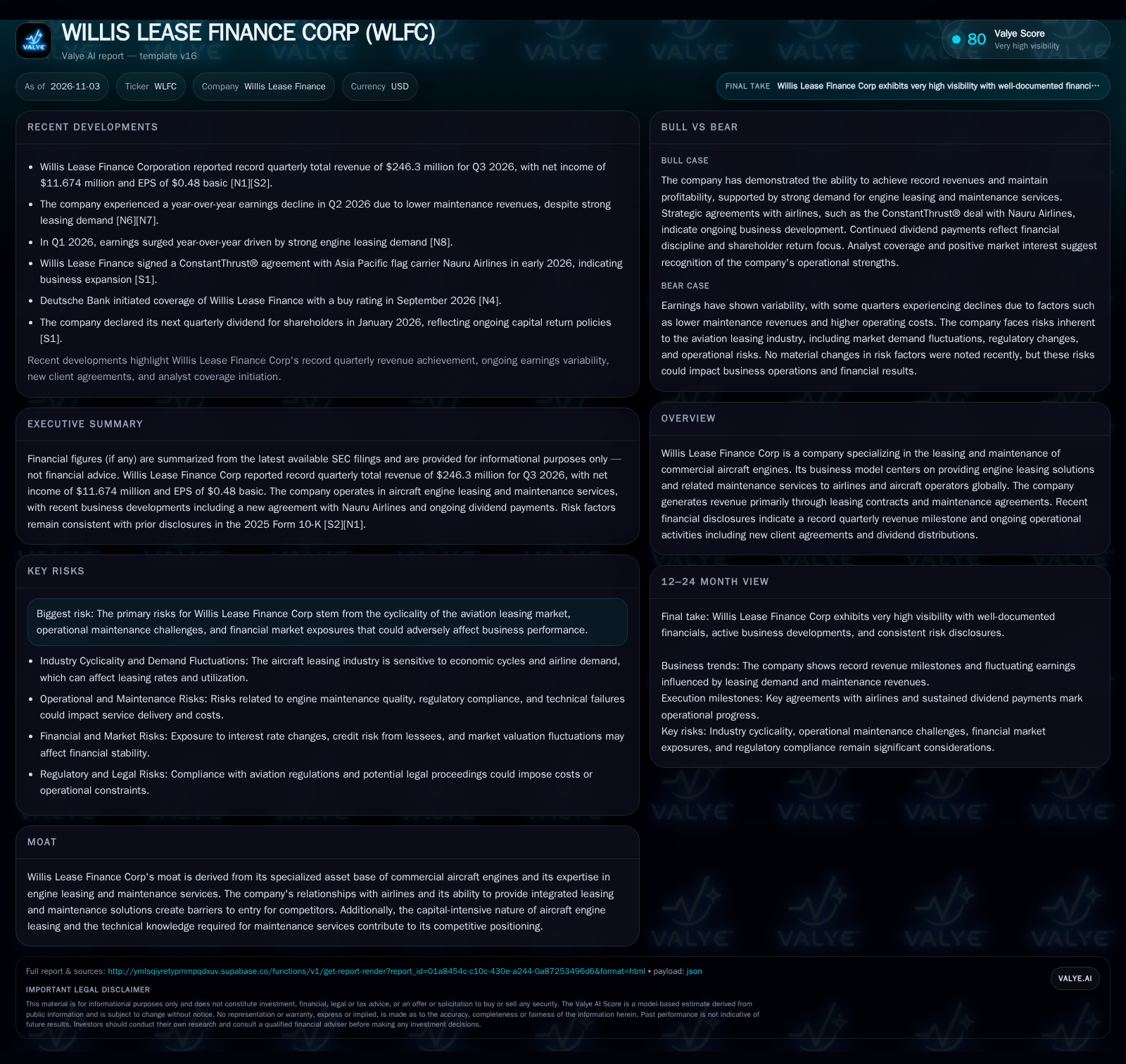
Willis Lease Finance Corp reported record Q3 2026 revenue of $246.3M, driven by robust engine leasing demand, but earnings remain variable due to shifting maintenance revenues and the cyclical nature of the aviation sector. Recent airline agreements and consistent dividends underline business development and capital return priorities, while analyst coverage points to growing market recognition. The company’s moat relies on asset specialization and technical service integration, but exposure to industry cycles and operational risks remains material. Future performance hinges on sustaining leasing utilization, managing maintenance cycles, and navigating industry headwinds.
Willis Lease Finance Corp is navigating a pivotal phase marked by record-high quarterly revenue and visible business development, but also by pronounced earnings swings that echo the underlying volatility of the aviation leasing industry. The company’s value proposition—specialized engine leasing and integrated maintenance—has delivered both expansion opportunities and exposure to cyclical, operational, and financial risks. With new airline agreements, ongoing dividends, and fresh analyst coverage, Willis Lease Finance stands at a crossroads where asset utilization, maintenance cycles, and industry demand will shape its next chapter.
Recent Revenue Records and Earnings Volatility: The Current Picture
Willis Lease Finance Corp reported a record quarterly total revenue of $246.3 million for Q3 2026, with net income of $11.674 million and basic EPS of $0.48 [N1] [S2]. This milestone underscores robust demand for engine leasing, a core driver of the company’s business. However, quarterly earnings have been variable throughout 2026: Q1 saw a significant year-over-year surge attributed to strong engine leasing demand, while Q2 earnings declined due to lower maintenance revenues despite continued leasing activity [N6] [N7] [N8].
The company’s ongoing business development is reflected in a new ConstantThrust® agreement with Nauru Airlines, signaling continued customer acquisition and service innovation [S1]. Meanwhile, Willis Lease Finance has maintained its policy of quarterly dividends, supporting a narrative of shareholder returns alongside growth [S1]. On the market side, Deutsche Bank’s recent initiation with a buy rating (September 2026) adds a layer of institutional validation [N4]. These developments collectively highlight both the company’s top-line momentum and its exposure to the inherent cyclicality and operational risks of the aviation leasing sector.
Engine Leasing Economics: Volume, Mix, and the Maintenance Margin Dilemma
Willis Lease Finance’s core revenue streams come from leasing commercial aircraft engines to airlines and providing associated maintenance services. Lease contracts typically generate predictable recurring payments over the lease term, while maintenance revenues are more variable, tied to engine utilization, timing of overhauls, and the scope of required work. The company’s record revenue in Q3 2026 suggests high fleet utilization and/or favorable lease rates, but the earnings volatility seen in 2026 points to the sensitivity of the business model to fluctuations in maintenance demand [N6] [N7] [N8].
The economic structure of engine leasing is capital-intensive: acquiring, maintaining, and remarketing engines requires substantial upfront investment, but also offers the potential for high operating leverage if lease yields and utilization remain strong. Maintenance, while necessary for asset value preservation and compliance, introduces variability—periods of heavy shop visits can depress margins if not offset by pass-through charges or efficient scheduling. A key analytical question is whether Willis can optimize its lease/maintenance mix and asset rotation to smooth earnings across cycles. The cited source reports dividend-related activity; that disclosure alone does not establish dividend-policy continuity, management confidence, or a material constraint on capital flexibility.
Asset Specialization and Service Integration: How Willis Lease Finance Stands Out—And Where It’s Exposed
Willis Lease Finance’s moat rests on its specialized portfolio of commercial aircraft engines and its technical expertise in maintenance and leasing solutions. This creates barriers to entry for lessors lacking aviation asset knowledge or the capital to acquire and maintain engines. Integrated service offerings, such as the ConstantThrust® program, can deepen customer relationships by bundling lease and maintenance, potentially reducing downtime and switching incentives for airlines [S1].
However, the competitive landscape includes global lessors, OEM-affiliated leasing arms, and specialist maintenance providers. Larger competitors may enjoy scale economies or broader customer networks, while OEMs can leverage proprietary knowledge and direct customer ties. Technological change (e.g., new engine platforms) and regulatory shifts could also pressure legacy asset values or require new investment. Willis’s exposure to customer credit quality—especially among smaller or emerging-market airlines—remains a structural vulnerability, as does the risk of underutilization during industry downturns.
When Cycles Turn Favorably: Sustained Leasing Demand and Maintenance Optimization
In a constructive scenario, industry demand for leased engines remains strong, driven by airline fleet expansion, deferred aircraft purchases, or continued constraints in new engine supply. Willis Lease Finance could benefit from high asset utilization, stable or rising lease rates, and a balanced cadence of maintenance events, all supporting both revenue and margin expansion. New agreements like the ConstantThrust® deal with Nauru Airlines could be replicated with larger or additional carriers, diversifying the customer base and increasing visibility [S1].
Confirmation of this scenario would come from several quarters of elevated utilization rates (if disclosed), steady or growing leasing revenue, and stable maintenance margins as reflected in earnings quality. Additional airline partnerships, successful renewals, or expansion of integrated service offerings would further support the upside case. Conversely, a sudden spike in unscheduled maintenance or customer defaults would challenge the scenario.
Navigating Normal Cycles: Steady Demand Amid Maintenance and Margin Swings
The most plausible trajectory is one where Willis Lease Finance continues to experience generally healthy engine leasing demand, punctuated by periodic earnings volatility linked to maintenance cycles and customer events. Lease revenues provide a recurring backbone, but the timing and scale of maintenance work inject quarter-to-quarter variability, as seen in the 2026 results [N6] [N7] [N8].
In this environment, the company’s performance will likely track broader airline industry health, with incremental growth from new customer agreements and modest margin improvement if maintenance costs can be better forecasted or passed through. A base case is falsified if utilization drops sharply, maintenance overruns erode margins for several quarters, or customer payment issues become more frequent.
Industry Downturn or Maintenance Shock: How Results Could Unravel
A negative outcome could materialize if global airline demand weakens—due to macroeconomic shocks, regulatory constraints, or airline failures—reducing engine utilization and lease rates. This would directly pressure revenue and could lead to asset idling or impairment. An adverse maintenance cycle, such as widespread technical issues or unexpected shop visits, could simultaneously drive up costs and depress profitability, as indicated by the earnings dip in Q2 2026 [N6] [N7].
Further, credit events among lessees—especially smaller or financially stretched airlines—could translate into payment defaults, asset repossessions, and remarketing challenges. The risk is compounded by Willis’s capital intensity and the potential for financing constraints if asset values or cash flows deteriorate.
Testing the Thesis: What Will Confirm or Refute Willis Lease Finance’s Resilience
Lease fleet utilization rates—if disclosed—would directly indicate whether engine demand and asset deployment remain robust.
The mix and magnitude of maintenance revenues versus leasing revenues, as well as the margin contribution of each, would help clarify the drivers of earnings variability.
The pace and scope of new customer agreements, especially with larger or more creditworthy airlines, would signal business development effectiveness.
Any disclosures of lessee payment delays, credit losses, or asset impairments would highlight emerging credit risk.
Quarterly net income and margin trends, particularly in relation to maintenance cycles, would test the company’s ability to manage operational swings.
Updates on analyst coverage or ratings changes could reflect shifts in market perception and institutional interest.
Fleet composition and investment in next-generation engine platforms, if disclosed, would indicate how Willis is positioning for technological and regulatory change.
Disclaimer: This is research-only, informational analysis and not investment advice. It may include AI-generated interpretation and general industry context. Always verify important details using primary sources.

Comments