
Global Water Resources: Integrated Utility Model in Arizona’s Growth Corridors Faces Capital and Regulatory Crosswinds
Global Water Resources operates 39 regulated water, wastewater, and recycled water utilities in Arizona, serving over 121,000 people and approximately 40,000 homes as of late 2025.
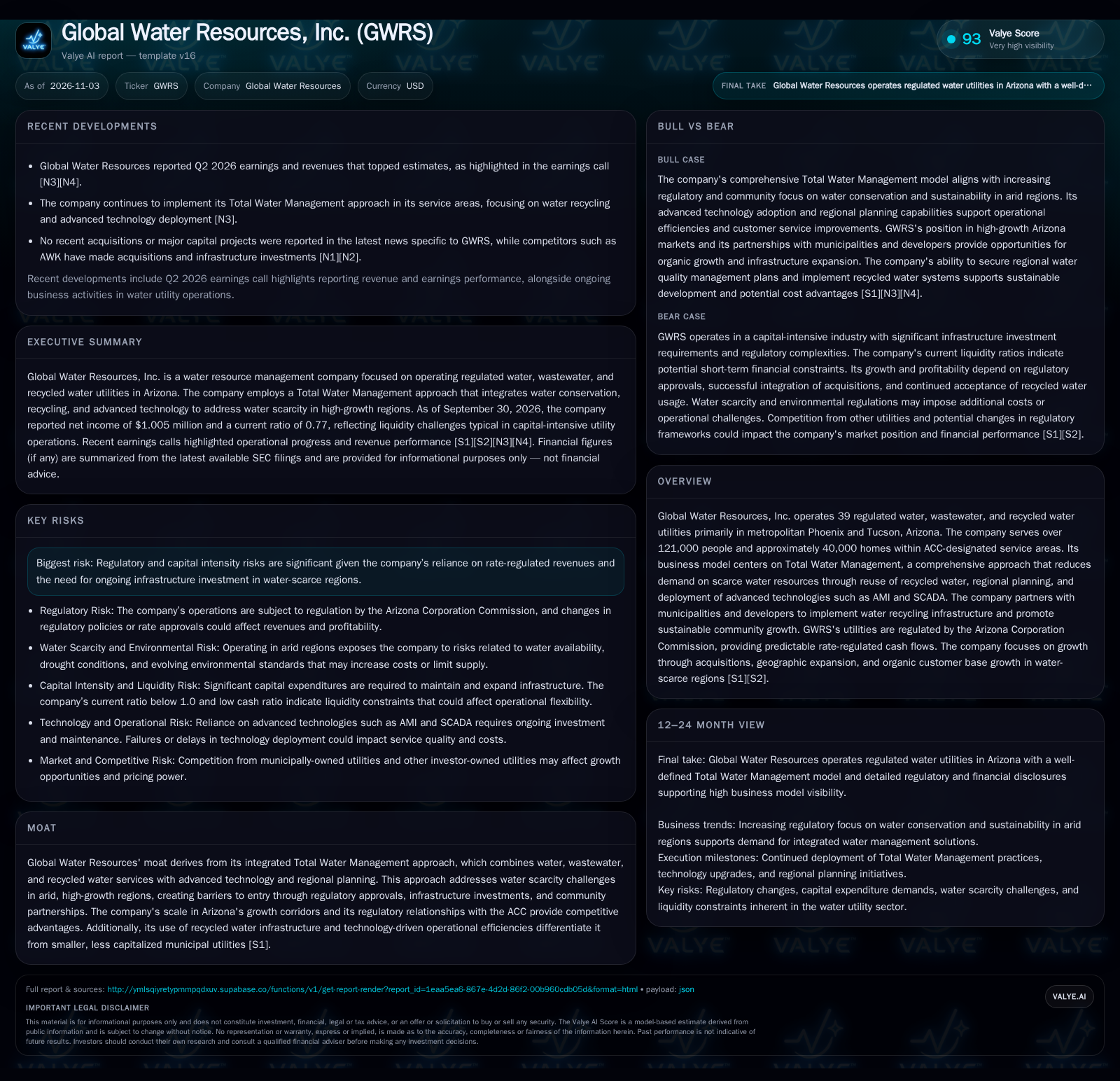
Global Water Resources operates 39 regulated water, wastewater, and recycled water utilities in Arizona, serving over 121,000 people and approximately 40,000 homes as of late 2025. Its Total Water Management model, which incorporates advanced technology and sustainability practices, aligns with growing regulatory and community focus on conservation. Success hinges on its ability to navigate regulatory approvals, expand infrastructure, and maintain operational efficiency in the face of environmental and financial pressures. [S1] [S2] [N3] [N4]
Global Water Resources, Inc. exemplifies a modern, integrated approach to utility management in some of the nation’s most water-stressed growth corridors. By combining water, wastewater, and recycled water services, and deploying advanced technology across its 39 Arizona utilities, GWRS seeks to address both the operational challenges of scarcity and the regulatory demands for sustainable development. Yet, as a capital-intensive, regulated business, the company’s ability to scale and weather shocks increasingly depends on its financial agility, regulatory strategy, and the ongoing evolution of Arizona’s water infrastructure landscape.
Recent Performance and Financial Position: Liquidity Pinch Amid Operational Momentum
As of September 30, 2026, Global Water Resources operated 39 regulated utilities in the Phoenix and Tucson metropolitan areas, serving over 121,000 people across approximately 40,000 homes [S1]. The company’s Total Water Management model—emphasizing integrated water, wastewater, and recycled water services with advanced technology deployment—remains central to its strategy. Financially, GWRS reported net income of $1.005 million for the September 2026 quarter, but its balance sheet showed cash and equivalents of $3.457 million against current liabilities of $19.977 million, resulting in a current ratio of 0.77 and a cash ratio of 0.17 [S2]. On the operational front, Q2 2026 earnings and revenues topped estimates, suggesting efficiency gains or favorable rate/revenue mix in the near term [N3] [N4].
How Total Water Management Shapes Revenue and Cost Structure
GWRS’s economics are fundamentally shaped by its position as a regulated utility: revenues are largely determined by rate cases approved by the Arizona Corporation Commission (ACC), with cost recovery for capital investments and operating expenses. The Total Water Management approach—integrating water, wastewater, and recycled water infrastructure—may enable GWRS to capture incremental value by maximizing water reuse, reducing per-customer marginal supply costs, and offering sustainability benefits that can support favorable regulatory treatment or community acceptance.
Advanced technology deployment, such as Supervisory Control and Data Acquisition (SCADA) and Automated Meter Infrastructure (AMI), is intended to increase operational efficiency, reduce non-revenue water loss, and enable more granular consumption data, which could support more precise rate design or demand management. However, these investments are capital-intensive, requiring ongoing funding and successful regulatory recovery. The capital intensity of water utilities means operating leverage is typically limited: most costs are fixed (infrastructure, maintenance, regulatory compliance), while variable costs (such as chemicals or energy) are a smaller share. [S2]
Barriers to Entry and the Role of Partnerships in Arizona’s Utility Landscape
GWRS operates in a sector with high barriers to entry due to regulatory requirements, infrastructure costs, and the need for regional planning. Its moat centers on the Total Water Management model, which leverages integrated infrastructure, advanced technology, and long-term relationships with municipalities and developers. These elements can create switching frictions for communities, as transitioning to a new operator would require significant capital and regulatory effort.
Competitive pressure comes primarily from municipally-owned utilities and other investor-owned utilities, some of which have greater scale or access to capital. For example, competitors such as American Water Works (AWK) are actively acquiring and investing in water assets in adjacent markets [N1]. However, GWRS’s local knowledge, regulatory relationships, and embedded infrastructure (especially recycled water systems required in new developments) may provide a degree of protection. Technology adoption also differentiates GWRS from smaller operators, but does not eliminate competition for new service areas or acquisitions.
Unlocking Value Through Regulatory Support, Technology, and Regional Growth
The most attractive scenario for GWRS involves a confluence of supportive regulatory outcomes, continued population and housing growth in its Arizona service areas, and successful demonstration of cost and sustainability benefits from its Total Water Management model. If the ACC continues to approve timely and favorable rate cases—recognizing the value of integrated water management and recycled water infrastructure—GWRS could recover capital investments efficiently and expand margins. Further, if partnerships with developers and municipalities yield more contracts for recycled water systems in new communities, the company could see organic customer growth and greater asset utilization.
Operationally, continued efficiency gains from SCADA and AMI could lower operating expenses per customer, improve service reliability, and support regulatory arguments for cost recovery. Confirmation of this scenario would include: sustained above-average customer growth in service areas, successful rate case outcomes, rising return on invested capital, and evidence that new developments are adopting GWRS’s recycled water infrastructure. Falsification would be signaled by regulatory pushback, stalled customer additions, or failure to demonstrate cost or service advantages from technology investments.
Arizona Utility Steady-State: Regulated Growth, Persistent Capital Demands
The most plausible trajectory for GWRS is continued incremental growth in line with Arizona’s population and housing expansion, offset by the ongoing capital intensity and regulatory complexity inherent to the sector. Rate cases are likely to be approved, but perhaps not always at levels that fully offset inflation or rising infrastructure costs. The company will likely continue deploying advanced technologies and recycled water systems, but the pace may be constrained by liquidity and the need for external funding.
Under this scenario, GWRS maintains or slightly expands its customer base, sees gradual revenue growth, and posts modest earnings with periodic fluctuations tied to rate outcomes, weather, and capital spending cycles. Confirmation would come from stable service area expansion, successful technology rollouts, and consistent—but not dramatic—improvements in operating metrics. Disconfirmation would involve a sudden regulatory or environmental shock, a sharp decline in customer growth, or evidence that capital constraints are forcing deferrals of necessary investment.
Regulatory Delays or Capital Shortfalls Could Amplify Financial Strain
The primary adverse scenario for GWRS involves a combination of regulatory headwinds, capital market tightening, or environmental disruptions. If the ACC were to delay or deny rate increases needed to recover past or planned investments, the company could face margin compression and be forced to defer infrastructure upgrades or maintenance. This could, in turn, increase operational risk, reduce service reliability, or jeopardize compliance with environmental standards.
Environmental shocks, such as severe drought or new regulatory requirements for water reuse or quality, could trigger sudden, unplanned capital needs. Confirmation of this downside would include negative regulatory news, a spike in deferred maintenance or capital projects, covenant breaches or emergency financings, or public service failures.
Testing the Resilience of GWRS’s Growth and Sustainability Strategy
Rate case outcomes and regulatory filings with the Arizona Corporation Commission: Material changes in allowed returns or recovery of capital investments would directly impact earnings and investment capacity.
Customer base and connection growth in core service areas: Sustained expansion would validate the organic growth thesis; a slowdown could signal market saturation or competitive encroachment.
Adoption rates for recycled water systems in new developments: If disclosed, this would provide insight into the success of GWRS’s Total Water Management model and its competitive differentiation.
Capital expenditure levels and funding mix: Trends in capex, and whether they are funded through operations, debt, or equity, would reveal management’s ability to balance growth and financial discipline.
Operational efficiency metrics—such as non-revenue water, service reliability, and cost per customer—would help test whether technology investments are translating into economic advantage.
Environmental and drought-related regulatory developments in Arizona: New rules or restrictions could materially alter cost structure or capital requirements.
Progress on technology deployment (AMI and SCADA penetration): If disclosed, further increases in coverage would support the thesis of operational leverage and service quality gains.
Disclaimer: This is research-only, informational analysis and not investment advice. It may include AI-generated interpretation and general industry context. Always verify important details using primary sources.

Comments