
JBT MAREL: Scaling Global Food Processing with Integration, Efficiency, and Aftermarket Leverage
JBT MAREL’s integration of Marel and its ongoing IT overhaul aim to strengthen operating leverage and deepen aftermarket ties, but supply chain, contract, and labor pressures could constrain margin expansion and growth consistency.
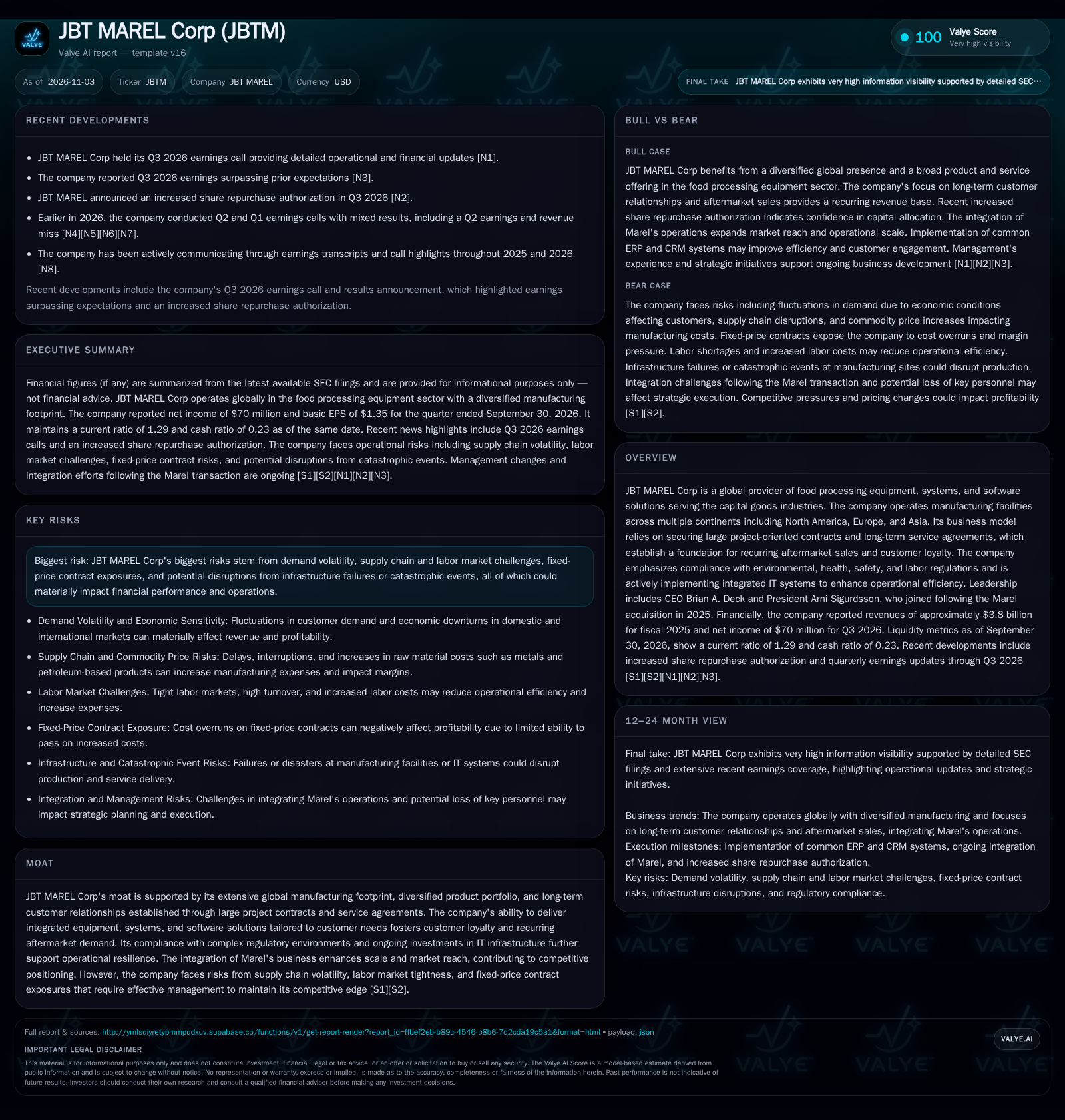
JBT MAREL reported $3.8B in 2025 revenue and $70M in Q3 2026 net income, reflecting its global presence in food processing equipment and systems. The company is pursuing operational improvements through ERP/CRM integration and expanded its share repurchase authorization in Q3 2026. While long-term customer relationships and aftermarket sales support recurring revenue, risks remain from fixed-price contract exposures, supply chain volatility, and labor market tightness. The effectiveness of the Marel integration and execution of IT upgrades will be pivotal for margin and growth resilience over the next 12–24 months. [S1] [S2] [N1] [N2] [N3]
JBT MAREL Corp sits at a critical inflection point, leveraging its global manufacturing footprint and the recent Marel acquisition to build scale in the food processing equipment sector. With $3.8 billion in 2025 revenue and $70 million net income in Q3 2026, the company’s model is grounded in project-based contracts, long-term service agreements, and a growing installed base that feeds aftermarket demand. However, the push for efficiency through unified IT systems and the expanded share buyback program come amid persistent risks: cost overrun exposure on fixed-price contracts, supply chain and labor headwinds, and the operational complexity of integrating Marel. The next phase depends on whether JBT MAREL can translate its integration and efficiency initiatives into sustainable margin improvement and recurring revenue growth. [S1] [S2] [N1] [N2] [N3]
Integration Progress and Margin Pressures Define the Current Landscape
JBT MAREL reported $3.798 billion in 2025 revenue and $70 million in net income for Q3 2026, underscoring its scale in the food processing equipment sector. The company’s current ratio stands at 1.29 and its cash ratio at 0.23 as of September 2026, reflecting a typical capital goods liquidity profile. A notable recent development is the increased share repurchase authorization in Q3 2026, which signals management’s confidence in capital allocation but does not directly address operational execution or margin sustainability. The ongoing integration of Marel, following the 2025 transaction, is a central focus, as is the rollout of unified ERP and CRM systems designed to improve efficiency. These moves come against a backdrop of earnings volatility: Q3 2026 results topped expectations, but earlier quarters in 2026 saw mixed performance, including a Q2 miss. The company continues to face risks from fixed-price contract exposures, supply chain volatility, and labor market tightness, all of which could materially affect profitability and operational stability. [S1] [S2] [N1] [N2] [N3]
How JBT MAREL’s Revenue Mix and Cost Structure Shape its Economic Engine
JBT MAREL’s core economics center on the sale of large-scale food processing equipment and systems, supported by long-term service contracts and equipment leases. This model typically delivers lumpy upfront project revenue, followed by higher-margin recurring aftermarket sales—such as maintenance, parts, software upgrades, and consulting. The installed base is critical: each new project increases the potential for long-term aftermarket revenue, which tends to be more stable and profitable than initial equipment sales.
Pricing power is constrained by competitive pressures and customer capital budgets, especially during economic downturns. Fixed-price contracts, a standard in the industry, expose JBT MAREL to cost overrun risk—if input costs spike or execution is delayed, margins can be compressed, as the company cannot easily pass through these increases. Labor and commodity costs are significant variables, impacting both direct manufacturing expenses and the cost to deliver on project commitments.
Operating leverage is plausible in this business, especially as the company integrates ERP and CRM systems to streamline operations and reduce redundant overhead. If integration succeeds, fixed cost absorption across a larger revenue base (post-Marel) could drive incremental margin gains. However, the need for ongoing capital investment in manufacturing, R&D, and regulatory compliance means free cash flow conversion is sensitive to project execution and working capital swings.
Assessing Moat Strength: Scale, Customer Relationships, and Global Footprint
JBT MAREL’s competitive position is anchored in its global manufacturing scale, diversified product offering, and entrenched customer relationships. By operating in North America, Europe, and Asia, the company can serve multinational food processors and adapt to regional regulatory requirements—a non-trivial barrier for smaller players. Its broad portfolio enables cross-selling of equipment, systems, and software, while long-term service agreements and leases foster customer lock-in and recurring aftermarket demand.
However, the capital goods sector is structurally competitive, with global and regional rivals vying on price, technology, and service quality. Substitutes include alternative automation vendors, local equipment producers, and, in some cases, in-house solutions developed by large food processors. The integration of Marel expands JBT MAREL’s market reach and product depth, but also introduces the risk of execution missteps, customer attrition, or cultural clashes.
Switching costs for customers are moderate to high, especially once a plant is configured around JBT MAREL’s systems and ongoing service contracts. Still, competitive pricing pressure—especially in project bidding—and the threat of new automation technologies or disruptive business models could erode this advantage over time if innovation or service levels lag.
If Integration and IT Overhaul Deliver: Unlocking Margin Expansion and Recurring Revenue Growth
The most favorable scenario for JBT MAREL is one where the Marel integration proceeds smoothly, unlocking synergies in procurement, manufacturing, and sales. Successful deployment of unified ERP and CRM systems would enhance visibility into operations, reduce redundant costs, and improve customer engagement, supporting both margin expansion and higher cross-sell rates. As the installed base grows, aftermarket revenue could become a larger share of the mix, stabilizing cash flows and dampening the cyclicality of project sales.
This scenario would be confirmed by sustained improvement in EBIT margins, rising aftermarket revenue as a percentage of total sales (if disclosed), and evidence of reduced SG&A as a proportion of revenue. Key falsification signals would be persistent integration costs, margin stagnation, or customer churn following the merger.
Operational Complexity Balances Gains from Scale and Aftermarket Expansion
The most plausible outcome is a mixed performance: JBT MAREL leverages its expanded scale and product breadth to win new business and grow its installed base, but integration and IT upgrades progress more slowly than hoped. Margins remain under pressure from labor and input costs, and fixed-price contract exposures continue to create earnings volatility. Aftermarket and service revenue provide some cushion against project cyclicality, but competitive pricing and supply chain issues limit meaningful margin expansion.
This scenario would be confirmed by modest revenue growth, stable but unremarkable margin trends, and continued (but not accelerating) aftermarket revenue contribution. Integration milestones may be achieved on a delayed timeline, with periodic charges or disruptions. Evidence against this scenario would include either a rapid post-integration margin inflection or, conversely, a sharp deterioration in profitability or share loss.
Cost Overruns, Integration Risks, and External Shocks Threaten Stability
A negative scenario could unfold if JBT MAREL encounters material cost overruns on fixed-price contracts, exacerbated by supply chain disruptions or labor shortages. Failure to integrate Marel effectively—manifesting as operational disruptions, inconsistent service delivery, or loss of key personnel—could undermine customer confidence and lead to lost business or margin erosion. Persistent inflation in raw materials or wages would further squeeze profitability, especially if competitive pressures prevent price increases.
Confirmation would come from margin compression, project delays or cancellations, increased integration expenses, and signs of customer attrition or reduced aftermarket sales. A deterioration in cash flow, increased leverage, or the need to curtail share repurchases or dividends would be additional red flags. A reversal in the trend of operational efficiency improvements, or regulatory non-compliance events, would also support the downside case.
What Will Determine Whether JBT MAREL’s Integration Pays Off
Progress on ERP and CRM system implementation across the combined business—milestone achievement, cost savings, and any reported operational disruptions.
Aftermarket and service revenue as a percentage of total revenue (if disclosed), to assess the stability and profitability of the installed base.
Gross and operating margin trends, particularly after accounting for integration costs and fixed-price contract overruns.
New contract wins or backlog growth, especially those that leverage both legacy JBT and Marel capabilities.
Labor cost trends and reported turnover rates, as indicators of operational risk and efficiency.
Supply chain lead times, input cost inflation, and any reported production disruptions.
Integration-related charges, customer churn, or loss of key personnel following the Marel transaction.
Actual pace and scale of share repurchases relative to authorization, as a proxy for management’s confidence and available free cash flow.
Disclaimer: This is research-only, informational analysis and not investment advice. It may include AI-generated interpretation and general industry context. Always verify important details using primary sources.

Comments