
Global Industrial: Multi-Channel Distribution, Private Brands, and the Challenge of Customer-Centric Scale
Recent acquisitions and digital investments sharpen Global Industrial’s competitive posture in North America’s fragmented MRO distribution landscape, but persistent margin and share pressures test its ability to translate breadth and service into durable economics.
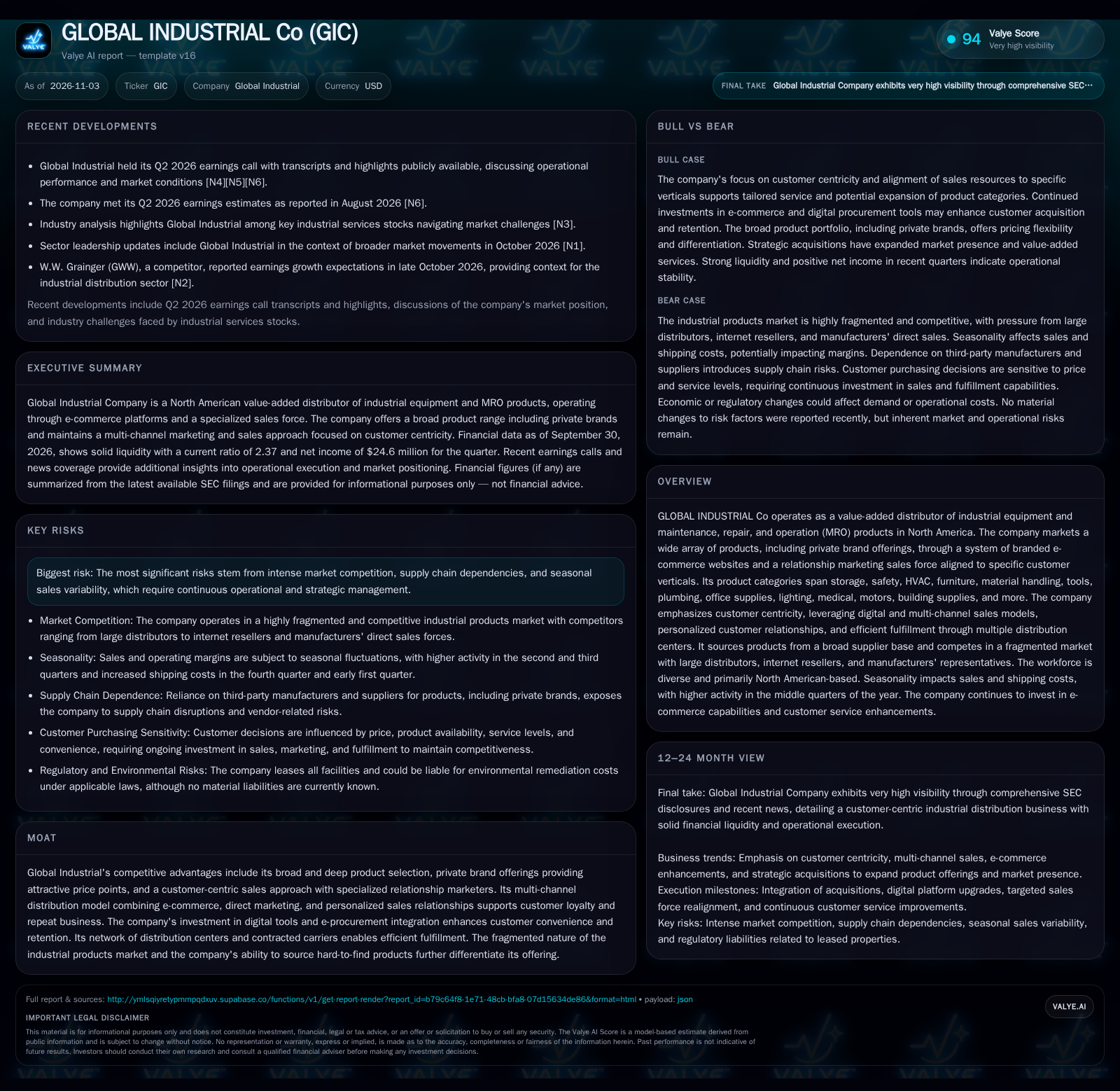
Global Industrial continues to leverage its broad product catalog, private label offerings, and multi-channel sales model to deepen customer relationships and expand market share. Recent acquisitions and ongoing digital investments aim to enhance the customer experience and operational efficiency. However, competition remains intense, seasonality impacts margins, and supply chain dependencies pose ongoing risks. The next phase depends on the company’s ability to scale value-added services, integrate acquisitions, and defend margins as industry consolidation and digital disruption accelerate. [S2] [N3] [N4] [N5] [N6]
Global Industrial Company sits at the intersection of digital transformation and traditional distribution in North America’s sprawling market for industrial and MRO supplies. With a product portfolio spanning everything from private-label storage solutions to janitorial equipment, the company has recently amplified its market reach through targeted acquisitions and investments in digital sales and customer service tools. The central question: Can Global Industrial convert its scale and customer-centric model into a sustainable edge as the industry consolidates and digitizes?
Recent Financials and Strategic Moves Shape the Near-Term Outlook
Global Industrial reported $24.6 million in net income for the quarter ending September 30, 2026, with basic and diluted EPS of $0.64. Over 60% of orders are now placed electronically, signaling the growing impact of the company’s digital investments on customer behavior and operational efficiency. Notably, the company completed two significant acquisitions—Indoff LLC in 2023 and an equipment service provider in 2025—aimed at expanding both its product portfolio and value-added service capabilities. These developments are material because they demonstrate the company’s ability to execute on its multi-channel strategy, deepen customer engagement, and potentially capture higher-margin business in a market where both scale and differentiation are critical. [S2] [N4] [N5] [N6]
How Global Industrial Earns: The Mechanics of Margin in a Fragmented Arena
Global Industrial’s business model is built on value-added distribution: the company sources a wide assortment of industrial and MRO products, including a growing share of private brands, and delivers them to business customers through e-commerce platforms, direct marketing, and a specialized sales force. Gross margins in this sector are typically thin—often in the mid-to-high teens or low twenties—due to intense price competition and the relative commodity nature of many SKUs. However, private-label products and value-added services (such as kitting, technical support, and e-procurement integration) can lift margins above those for pure reselling.
Variable costs are dominated by product sourcing, shipping, and fulfillment, with fixed costs tied to distribution centers, technology infrastructure, and sales/marketing personnel. Operating leverage can be achieved through increased order volume and digital automation, but seasonality (with stronger Q2 and Q3, and higher Q4 shipping costs) can exacerbate margin swings. Capital needs are moderate; most inventory is fast-moving, and the company leases its facilities, reducing asset intensity compared to vertically integrated peers. The ability to scale digital procurement and automate order handling is crucial for margin expansion, especially as customers demand both low prices and high service levels.
The economics of the model hinge on driving repeat business, upselling private brands, and efficiently managing the long tail of product assortment. As more transactions migrate online and through e-procurement channels, the company’s digital investments could yield incremental efficiency gains and improved customer stickiness, but only if price and service remain competitive.
Multi-Channel Reach Versus Scale Players: Where Does Global Industrial Stand?
Global Industrial operates in one of the most fragmented and contested segments of the North American distribution landscape. Its competitors span large-scale national distributors (often with deeper purchasing power and technology budgets), online-first resellers, manufacturers selling direct, and a host of regional/local specialists. The company’s core differentiators are its breadth of product selection (including private brands), multi-channel sales strategy (combining e-commerce, relationship marketers, and field sales), and ongoing investment in digital and service capabilities.
However, these advantages are increasingly being matched or exceeded by the largest distributors, who can leverage scale for better pricing, broader inventory, and faster fulfillment. At the other end, digital-native competitors and niche specialists often undercut on price or outflank with tailored service. The company’s recent acquisitions may bolster its value-added service offering and extend its reach into new customer segments, but the risk is that integration complexity and rising customer expectations could erode any near-term differentiation.
Switching frictions in the industrial supplies market are modest: customers typically value price, availability, and ease of ordering above all. The company’s push into e-procurement and personalized account management could increase retention among larger customers, but price transparency and commoditization remain persistent counterforces.
Unlocking Margin Expansion Through Digital Scale and Service Differentiation
In the favorable scenario, Global Industrial successfully leverages its digital investments and recent acquisitions to drive a higher share of orders through automated, lower-cost channels while simultaneously upselling private-label and value-added service offerings. As more customers adopt the company’s e-procurement tools and personalized account management, repeat business grows and customer churn declines, allowing for greater pricing discipline and mix improvement.
The company’s field sales and relationship marketers deepen penetration into higher-margin verticals (such as healthcare, public sector, and manufacturing), while the integration of acquired service capabilities enables new bundled offerings. Operating leverage materializes as order processing and fulfillment become more efficient, and seasonality impacts are muted by a more diversified customer base.
Evidence supporting this scenario would include sustained growth in electronic order share (well above 60%), rising gross margins (particularly on private brands), increased customer retention rates (if disclosed), and positive commentary on acquisition synergies and cross-selling success in future earnings calls. A notable reduction in SG&A as a percentage of revenue—signaling digital efficiency—would further validate this trajectory.
Steady Execution Amid Ongoing Margin and Share Pressures
The most plausible outcome is that Global Industrial continues to grow in line with the broader industrial distribution market, maintaining its multi-channel approach while facing persistent pressures on margin and share. Electronic ordering and e-procurement adoption rise incrementally, but price competition from both national distributors and digital-first resellers keeps gross margins from expanding meaningfully.
Customer retention remains stable, aided by the company’s investment in service and digital tools, but switching frictions are not high enough to materially reduce churn or increase pricing power. The benefits from recent acquisitions are positive but gradual, with integration costs and complexity offsetting some initial gains. Seasonality continues to shape quarterly performance, with Q2 and Q3 outperforming and Q4 shipping costs compressing margins.
This scenario would be confirmed by continued solid net income and liquidity metrics, steady (but not accelerating) growth in digital order share, stable gross margin trends, and management commentary that emphasizes operational discipline and incremental improvements rather than transformative change.
Margin Compression and Share Loss in a Race to the Bottom
In a more adverse chain of events, intensifying price competition from larger scale players and digital disruptors erodes both gross margins and customer loyalty. The company’s digital investments fail to keep pace with customer expectations or competitor offerings, leading to stagnation in online order growth and loss of key accounts to lower-cost or more technologically advanced rivals.
Acquisition integration stumbles, resulting in operational inefficiencies, cultural misalignment, or distraction from core execution. Supply chain disruptions—whether from vendor concentration, logistics cost spikes, or macroeconomic shocks—further compress margins and test working capital management. Seasonality amplifies downside volatility, with weak Q4 and Q1 results highlighting structural vulnerabilities.
This scenario would be evidenced by declining or stagnant net income, falling gross margins, a flattening or decline in electronic order share, negative customer retention or account growth trends (if disclosed), and management commentary focused on cost cutting, restructuring, or competitive response rather than growth initiatives.
What Will Validate—or Challenge—the Customer-Centric Thesis at Global Industrial
Sustained growth in electronic and e-procurement order share above 60%, with clear digital adoption trends over multiple quarters.
Gross margin performance, particularly in private-label products and value-added services, as a measure of pricing power and mix improvement.
Customer retention and repeat purchase rates—if disclosed—or management commentary on churn and account growth.
Integration milestones and synergy capture from recent acquisitions, including revenue contribution and cross-selling evidence.
SG&A as a percentage of revenue, indicating whether digital and operational investments are driving efficiency gains.
Quarterly net income and EPS trends, particularly through seasonal troughs (Q4 and Q1), as a proxy for resilience.
Competitive pricing dynamics and any signals of intensified discounting or share loss to digital-native or large-scale peers.
Supply chain stability—vendor dependency, fulfillment bottlenecks, or logistics cost spikes—that could impact margins or service levels.
Disclaimer: This is research-only, informational analysis and not investment advice. It may include AI-generated interpretation and general industry context. Always verify important details using primary sources.

Comments