
Rocky Brands: Margin Expansion, Channel Mix, and the Sustainability of a Tariff-Driven Rebound
Rocky Brands delivered double-digit sales and margin growth in Q3 2026, aided by tariff refunds and digital channel momentum. The challenge now is to convert these one-time benefits into sustainable operating leverage amid rising expenses and evolving competitive dynamics.
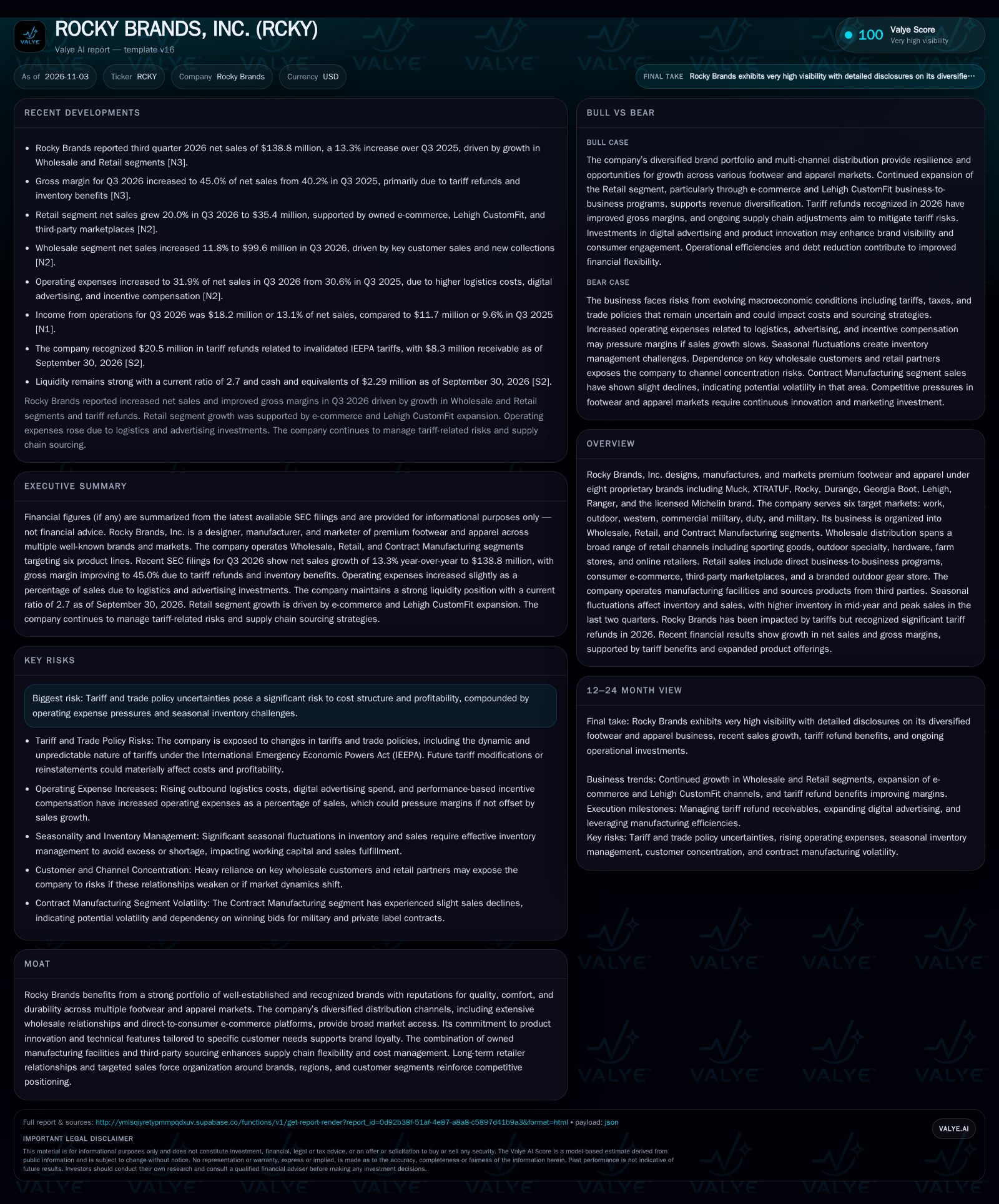
Rocky Brands posted a 13.3% year-over-year sales increase and a 480-basis-point gross margin expansion in Q3 2026, helped by tariff refunds and e-commerce gains. Retail and Wholesale segments both grew, but operating costs also rose. The question is whether Rocky can drive ongoing margin improvement once tariff benefits fade, as expense pressures, customer concentration, and contract manufacturing volatility persist. Channel mix, digital execution, and supply chain flexibility are likely to determine the next phase of value creation. [N2] [N3] [S2]
Rocky Brands’ latest quarterly results reflect a business firing on several cylinders: double-digit sales growth, visible margin expansion, and strong performance from both Wholesale and Retail channels. Yet beneath the headline numbers, much of the margin surge traces to a $20.5 million tariff refund—a benefit unlikely to recur at the same scale. As operating expenses creep higher and contract manufacturing softens, Rocky’s ability to sustain its improved profitability will hinge on continued channel mix evolution, digital execution, and nimble supply chain management. The durability of this margin inflection—and the company’s ability to convert one-time windfalls into structural advantages—will shape the next phase of Rocky’s value trajectory. [N2] [N3] [S2]
Tariff Refunds and Digital Momentum Fuel a Margin Inflection
Rocky Brands reported Q3 2026 net sales of $138.8 million, a 13.3% increase over the prior-year period, with both Wholesale and Retail segments contributing to the growth. Gross margin surged to 45.0% from 40.2%, primarily reflecting a $20.5 million benefit from tariff refunds and improved inventory management. Retail segment sales grew 20.0%, driven by e-commerce and Lehigh CustomFit, while Wholesale sales rose 11.8% on key customer wins and new collections. Operating expenses increased to 31.9% of sales, up from 30.6%, due to higher logistics, advertising, and incentive compensation. The quarter’s income from operations was $18.2 million, or 13.1% of sales, compared to $11.7 million, or 9.6%, a year earlier. These results highlight a sharp, but partially one-off, improvement in profitability that will be difficult to repeat without underlying operational or strategic shifts. [N2] [N3] [S2]
How Channel Mix, Scale, and Sourcing Shape Rocky’s Margin Structure
Rocky Brands’ economics are driven by a diversified channel portfolio—Wholesale, Retail, and Contract Manufacturing—with variable margin and working capital profiles. The Retail segment, particularly e-commerce and Lehigh CustomFit, delivers higher gross margins (50.0% in Q3 2026) than Wholesale (44.6%) or Contract Manufacturing (9.9%), reflecting direct-to-consumer pricing and lower channel dilution. However, Retail also incurs higher digital advertising and fulfillment costs, which can erode operating leverage if not offset by scale or pricing.
Wholesale remains the largest segment by revenue, benefiting from broad distribution but facing margin pressure from channel partners and customer concentration. Contract Manufacturing offers capacity utilization for Rocky’s facilities but generates lower margins and is sensitive to bid-based military and private label contracts. The company’s ability to flex between owned manufacturing and third-party sourcing supports cost control but exposes it to tariff and supply chain volatility.
Operating leverage is visible: as sales rise, fixed costs—such as manufacturing overhead and core SG&A—are diluted, but recent increases in logistics, digital spend, and incentives mean that margin expansion is not automatic. Tariff refunds provided a temporary boost; going forward, sustainable margin growth will require either further channel mix shift toward Retail, additional product innovation allowing pricing power, or greater scale efficiency.
Brand Portfolio Strength and Multi-Channel Access—But No Permanent Moat
Rocky Brands leverages a portfolio of recognized brands (e.g., Muck, XTRATUF, Rocky, Durango, Georgia Boot) that command loyalty in niche segments—work, outdoor, western, and duty footwear. This brand equity underpins pricing power and repeat business, especially in specialized use-cases where performance and durability matter. Multi-channel access, including mass merchants, specialty retailers, and direct e-commerce, broadens reach and provides diversification against channel-specific shocks.
However, the footwear and apparel sector remains intensely competitive, with large, global peers (such as Wolverine, Deckers, and Red Wing in work/outdoor, as well as general athletic brands) offering comparable products, often with deeper marketing budgets and digital capabilities. Private-label expansion by mass merchants and the rise of niche DTC brands also threaten channel control and margin structure. While Rocky’s ability to manufacture and source flexibly is a plus, it is not unique. The company’s competitive position, therefore, is defensible but not unassailable—it relies on continuous product refresh, customer engagement, and supply chain agility to maintain relevance and margin.
If Digital and B2B CustomFit Outpace Wholesale, Margin Gains Could Persist
The most favorable trajectory for Rocky Brands is one where the Retail segment—driven by direct e-commerce and the Lehigh CustomFit B2B platform—continues to outpace Wholesale growth, raising consolidated gross margins and reducing channel dependency. If digital marketing investments translate into sustained customer acquisition and retention, and if the company can maintain higher e-commerce mix even as brick-and-mortar rebounds, then operating leverage could improve as fixed costs are spread over a larger, higher-margin revenue base.
Additional upside may come from successful innovation in product lines that command premium pricing, further supply chain optimization to offset logistics and tariff headwinds, and possible new contracts in Contract Manufacturing that provide incremental scale without incremental fixed cost.
Evidence that would confirm this scenario includes: further sequential increases in Retail segment gross margin and revenue mix, above-industry e-commerce growth rates, sustained SG&A as a percentage of sales despite digital investment, and visible new product launches or customer wins in higher-margin categories.
Normalization After Tariff Benefits: Margin Compression and Mixed Segment Performance
A more plausible midline outcome is that Rocky Brands’ recent margin gains partially reverse as the one-time effect of tariff refunds fades and operating expenses remain elevated. Wholesale and Retail segments both grow at moderate rates, but the channel mix stabilizes, limiting further gross margin expansion. Retail continues to benefit from e-commerce and CustomFit, but digital advertising and logistics costs keep operating margins in check. Contract Manufacturing remains volatile or flat, providing little incremental profit.
In this scenario, Rocky’s overall margin profile settles above pre-2026 levels but below the Q3 2026 peak, with moderate sales growth and stable, but not expanding, operating leverage. The company remains exposed to macro and policy risks (tariffs, trade, consumer demand) and must actively manage inventory and working capital through seasonal swings.
Confirmation would come from sequential stabilization in gross and operating margins, modest growth in both Wholesale and Retail, and the absence of further large one-off benefits. Falsification would be sharp declines in either segment or a persistent rise in operating expenses outpacing sales.
Expense Creep, Tariff Headwinds, and Channel Volatility Erode Profitability
The adverse scenario features the fading of tariff-related benefits just as operating expenses—logistics, digital ad spend, and labor—increase faster than revenue. If Wholesale growth slows due to channel consolidation or customer loss, and Retail’s e-commerce gains plateau or face increased competition from larger DTC players, consolidated margins could compress sharply.
Contract Manufacturing could continue its decline, reducing fixed-cost absorption in Rocky’s facilities. Meanwhile, the company’s exposure to renewed or increased tariffs on imported products could squeeze gross margins further, especially if Rocky cannot offset these costs through price increases or sourcing changes. Inventory mismanagement, prompted by unpredictable seasonal demand, could force markdowns or stockouts, compounding margin pressure.
This scenario would be confirmed by a sequential decline in gross and operating margins, rising SG&A as a percentage of sales, negative growth in Retail or Wholesale, and a resurgence of tariff-related cost pressures not mitigated by refunds or sourcing shifts.
What Will Determine If Rocky’s Margin Gains Are Structural or Transient?
Track the Retail segment’s gross margin and revenue mix each quarter—sustained increases would suggest ongoing channel shift benefits.
Monitor the sequential trend in operating expenses (particularly logistics and digital advertising) as a percentage of sales. Persistent increases without sales acceleration could indicate margin risk.
Watch for updates on the remaining $8.3 million tariff refund receivable and any new tariff or trade policy changes affecting cost of goods sold.
Assess e-commerce growth rates relative to industry benchmarks. Outperformance would support the upside scenario.
Follow Contract Manufacturing segment trends—further declines or volatility could pressure overall fixed-cost absorption.
If disclosed, analyze customer concentration data in Wholesale; increased reliance on a few accounts could amplify channel risk.
Inventory turnover and working capital metrics would help test Rocky’s ability to manage seasonal swings without margin dilution.
Announcements of new product launches, major customer wins, or expanded digital partnerships would provide evidence of sustainable competitive differentiation.
Disclaimer: This is research-only, informational analysis and not investment advice. It may include AI-generated interpretation and general industry context. Always verify important details using primary sources.

Comments