
Chemours at a Regulatory Crossroads: Environmental Headwinds, Margin Pressures, and the Bet on Low-GWP Innovation
Chemours faces mounting regulatory and environmental liabilities amid volatile earnings, but its pivot toward low-GWP refrigerants for data centers signals a bid to reposition its portfolio for stricter global standards and new demand verticals. The company’s ability to offset remediation costs and margin pressures with product innovation and operational discipline will define its next phase.
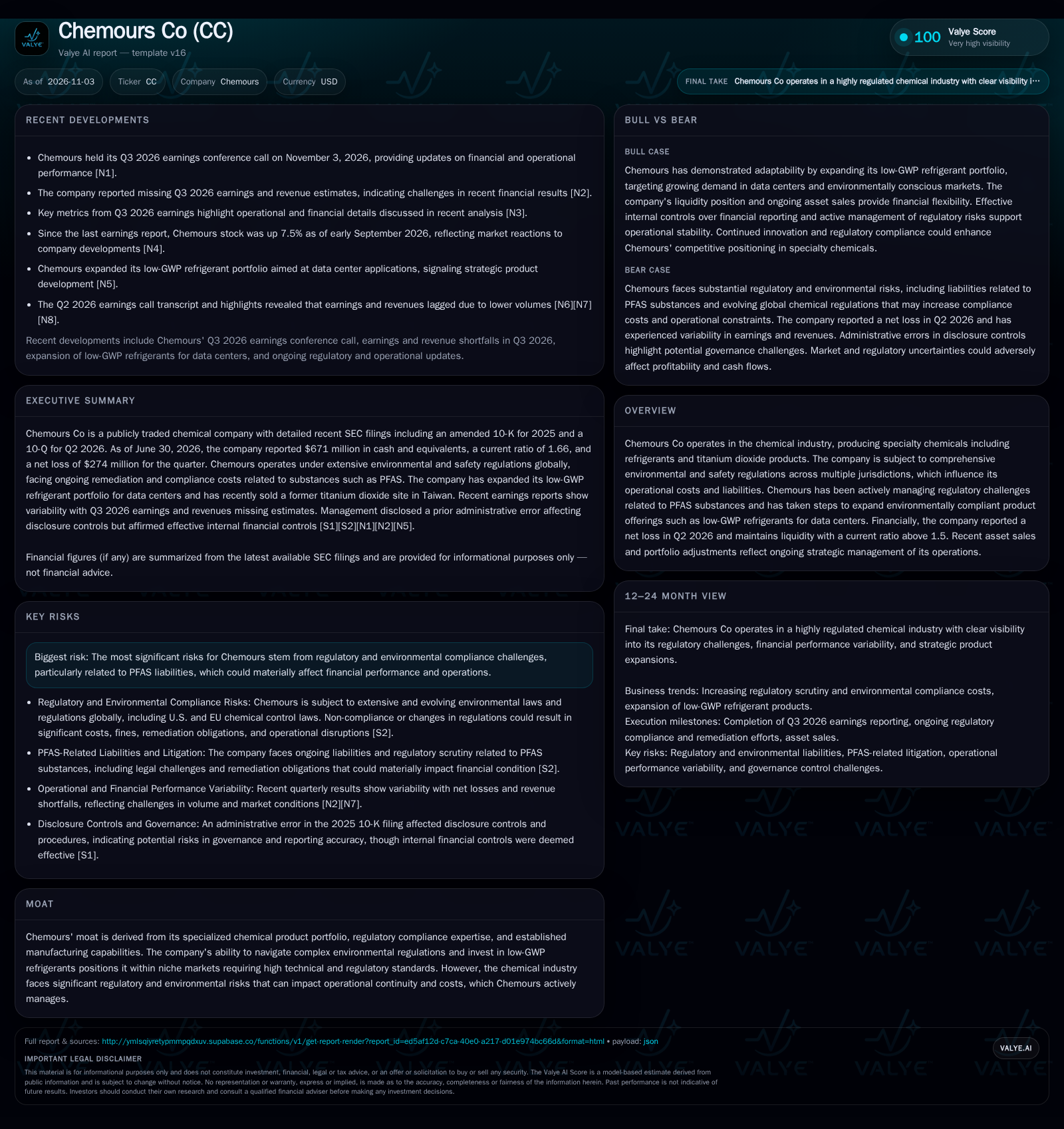
Chemours reported a net loss of $274 million for Q2 2026 and missed Q3 earnings estimates as volumes declined. The company operates under intense global environmental regulation, faces substantial PFAS-related liabilities, and recently expanded its low-GWP refrigerant portfolio for data centers. The future direction hinges on Chemours’ ability to translate innovation in environmentally compliant products into stable, profitable growth while managing regulatory headwinds. [S2] [N2] [N5]
Chemours sits at the intersection of legacy environmental liabilities and the evolving demand for sustainable chemical solutions. Recent quarterly losses and missed earnings point to persistent pressures from both market conditions and the cost of regulatory compliance, especially related to PFAS. Yet, the company’s push into low-GWP refrigerants for data centers represents a strategic attempt to reposition its portfolio for a future where environmental standards are only tightening. The question is whether innovation and asset discipline can keep Chemours ahead of rising compliance costs and margin erosion, or if regulatory burdens will outpace the company’s ability to adapt.
Regulatory Burden and Earnings Shortfall Define the Present
Chemours reported a net loss of $274 million for Q2 2026, with diluted EPS at -$1.81, and subsequently missed Q3 2026 earnings and revenue estimates as volumes remained soft. These financial setbacks come alongside a liquidity position of $671 million in cash and a current ratio of 1.66 as of June 30, 2026. At the same time, Chemours continues to navigate substantial regulatory and environmental liabilities, especially around PFAS remediation and compliance with evolving global standards. The company’s recent product expansion into low-GWP refrigerants for data centers signals a strategic pivot toward environmentally compliant, higher-growth markets, but it remains to be seen whether this can offset the drag from legacy operations and mounting compliance costs. [S2] [N2] [N5]
How Environmental Costs and Innovation Shape Chemours’ Profit Model
Chemours’ core revenue streams derive from specialty chemicals, notably refrigerants and titanium dioxide products, which have historically depended on both industrial demand and regulatory frameworks. Pricing power in these markets can be constrained by commodity-like competition and customer sensitivity to input cost inflation. However, the company’s expansion into low-GWP refrigerants—especially those targeting data centers—opens the door to higher-margin, differentiated offerings if Chemours can establish technical or regulatory barriers to entry.
The economics of the business are increasingly shaped by fixed regulatory and compliance costs, including ongoing environmental remediation obligations, legal proceedings, and the need to continuously adapt manufacturing processes to meet tightening standards. These fixed costs reduce operating leverage, meaning incremental revenue from new products must be substantial to move the needle on margins. At the same time, asset divestitures (such as the Taiwan titanium dioxide site) suggest a move to streamline the portfolio and free up capital, but may also reduce scale advantages.
The company reported cash and liquidity metrics for the period; these figures do not by themselves establish operating runway, investment capacity, financial flexibility, or financing capacity. The critical question is whether new environmentally compliant products can generate enough volume and price premium to outpace rising fixed costs—a dynamic that will be tested as regulatory scrutiny intensifies globally.
Where Chemours Stands in the Specialty Chemical Arena
Chemours operates in a global chemical industry characterized by high regulatory barriers, significant capital intensity, and a mix of commodity and specialty product segments. Its competitive position has traditionally relied on manufacturing scale, established customer relationships, and technical expertise in complex chemistries. However, legacy liabilities—especially those linked to PFAS—present a structural disadvantage relative to peers with cleaner environmental records or less exposure to hazardous substances.
The shift toward low-GWP refrigerants could provide Chemours with a window of differentiation, particularly as data centers and other high-growth verticals seek to comply with stricter emissions and climate mandates. Success here hinges on the company’s ability to innovate ahead of both regulatory requirements and competitors, which may include diversified chemical giants as well as niche specialty players. However, any advantage may prove fleeting if competitors rapidly develop or license similar technologies, or if regulatory frameworks change faster than Chemours can adapt its portfolio.
Switching costs for customers in specialty chemicals can be high due to qualification processes and regulatory approvals, but price and supply reliability remain critical. Chemours’ ability to retain and grow share will depend on balancing these factors while navigating ongoing legal and compliance headwinds.
Innovation in Low-GWP Refrigerants Offsets Legacy Drag
In a favorable scenario, Chemours’ early investment in low-GWP refrigerants for data centers and other high-growth sectors pays off. Regulatory mandates accelerate adoption of these products, allowing Chemours to command premium pricing and capture market share from slower-moving incumbents. The portfolio shift reduces the company’s exposure to legacy products most affected by environmental litigation and remediation costs.
Earnings variability stabilizes as new product lines gain traction, and asset sales free up capital for further R&D or selective bolt-on acquisitions. If Chemours can demonstrate sustained volume growth and margin improvement in its environmentally compliant offerings, it could gradually rebuild investor confidence and potential financial flexibility.
Confirmation of this scenario would come from sequential revenue and margin growth in the low-GWP refrigerant segment, expanded supply agreements with data center or technology customers, and declining remediation or legal expense as a percentage of sales. Accelerated regulatory adoption of Chemours’ technologies would also support the case.
Balancing Compliance Costs with Incremental Growth in Specialty Segments
The most plausible trajectory is that Chemours continues to face a drag from regulatory and remediation costs, which offset much of the incremental progress in new product areas. Earnings remain volatile, with occasional quarters of net loss as legacy business declines or compliance costs spike. The low-GWP refrigerant portfolio grows, but not fast enough to fully counterbalance headwinds from PFAS liabilities and operational disruptions tied to regulatory changes.
Asset sales and portfolio streamlining provide intermittent balance-sheet support but do not fundamentally alter the company’s risk profile. Chemours maintains a reported liquidity position buffer and remains a going concern, but investor sentiment is likely to remain cautious until there is clearer evidence that new product lines can consistently drive profitable growth.
Evidence for this scenario would be continued earnings and revenue variability, persistent high compliance and legal costs, and only modest improvement in the contribution from new, environmentally compliant products.
Regulatory Escalation and Legacy Liabilities Overwhelm Progress
In a negative scenario, regulatory and legal risks escalate more quickly than Chemours can adapt. At the same time, new product launches in low-GWP refrigerants fail to achieve meaningful scale or pricing power due to competitive responses or slower customer adoption.
Earnings remain negative, and asset sales become increasingly necessary just to maintain liquidity, undermining operational scale and long-term competitiveness. Investor confidence erodes, raising the cost of capital and further constraining the company’s ability to invest in innovation or defend market share.
This scenario would be confirmed by a sharp increase in environmental or legal reserves, accelerated cash outflows, further missed earnings estimates, and limited revenue traction from new product lines. Regulatory actions that expand the scope of Chemours’ liabilities or restrict product sales would be particularly damaging.
Milestones That Will Shape Chemours’ Regulatory and Innovation Thesis
Quarterly revenue and margin trends specifically attributable to the low-GWP refrigerant portfolio, if disclosed, will be critical to assess whether new product bets are paying off.
Updates on environmental remediation and legal expenses as a percentage of total sales will signal whether the regulatory drag is stabilizing or worsening.
Any announced long-term supply agreements with data center operators or technology companies would help validate new demand verticals.
Changes in regulatory status, especially regarding PFAS-related substances and EU/US environmental standards, could materially shift cost structures and market access.
Management commentary and SEC disclosures on internal control remediation and improvements in disclosure practices would help gauge governance risks.
Evidence of competitor product launches or regulatory approvals in low-GWP refrigerants may signal the durability of Chemours’ current innovation lead—or lack thereof.
A useful metric would be customer retention rates and new customer wins in key specialty segments, indicating how well Chemours is defending and expanding its market position.
Disclaimer: This is research-only, informational analysis and not investment advice. It may include AI-generated interpretation and general industry context. Always verify important details using primary sources.

Comments