
Ovintiv’s Montney Expansion: Integration, Scale, and Sustaining Shareholder Value
Ovintiv’s aggressive acquisition-driven expansion in the Alberta Montney basin has reshaped its asset base and potential production profile.
Ovintiv has recently completed and announced significant acquisitions to expand its Montney footprint, adding substantial well inventory and acreage. The company’s commitment to high shareholder returns and disciplined capital allocation depends on successful execution and commodity price support. Watch for integration progress, margin stability, and production efficiency as key signals.
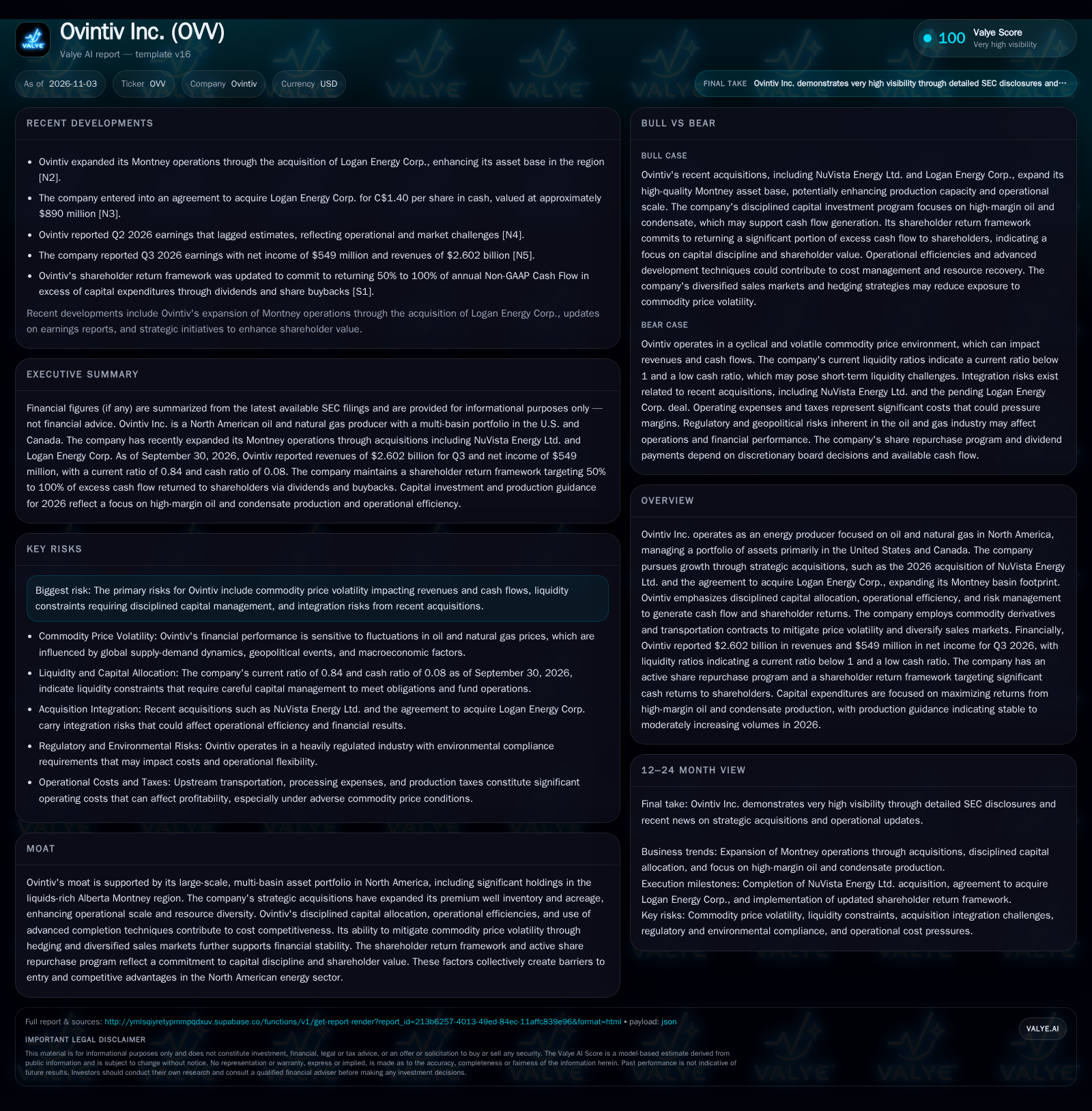
Ovintiv Inc. has rapidly expanded its Montney basin presence through the acquisitions of NuVista Energy and the pending Logan Energy deal, adding substantial well inventory and premium acreage in a core North American liquids play. This positions the company for increased production and potential scale-driven efficiencies, but brings with it integration demands, significant capital requirements, and heightened exposure to commodity cycles. Key signals will be operating margins, production efficiency, and real progress on integration and synergy capture.
Acquisition-Driven Expansion Reshapes Ovintiv’s Asset Base and Near-Term Focus
Ovintiv completed its $2.8 billion acquisition of NuVista Energy Ltd. in February 2026, adding approximately 930 net well locations and 140,000 net acres in the high-margin, liquids-rich Alberta Montney region. The company also entered an agreement in October 2026 to acquire Logan Energy Corp. for approximately $890 million, further expanding its Montney asset base by 109,000 net acres [S2] [N2] [N3].
For the nine months ended September 30, 2026, Ovintiv reported revenues of $8.147 billion and net income of $375 million, while guiding capital investment between $2.25 billion and $2.35 billion, focused on high-margin oil and condensate production [S2].
The company’s shareholder return framework targets returning 50% to 100% of annual Non-GAAP cash flow in excess of capital expenditures through dividends and share buybacks [S1].
How Ovintiv’s Capital Cycle and Asset Mix Shape Cash Flow Potential
Ovintiv’s business model centers on converting a deep inventory of unconventional oil and gas wells into cash flow through disciplined capital allocation and operational efficiency. The company’s capital investment program is directed predominantly at high-margin oil and condensate assets in the Montney, Permian, and other North American basins. This focus is designed to maximize return on capital employed and sustain high cash conversion ratios, especially when commodity prices are supportive.
The economics of shale and unconventional resource development are characterized by high upfront capital intensity and steep early well declines, requiring continuous reinvestment to maintain and grow production. Fixed costs (infrastructure, land, and certain personnel) are significant, but variable costs—primarily drilling, completion, and operating expenses—scale with activity. Ovintiv’s guidance for 2026 calls for upstream transportation and processing costs of $8.75–$9.25 per BOE and operating expenses of $3.00–$3.50 per BOE, with production taxes at 3.25–3.75% of upstream revenues [S2].
The company’s ability to generate attractive free cash flow is highly sensitive to realized commodity prices, well productivity, and the efficiency of capital deployment. Commodity derivatives and transportation contracts are used to reduce cash flow volatility, but structural exposure to oil and gas cycles remains. Integration of newly acquired assets introduces additional operating and capital allocation complexity, with the potential for synergy capture but also for cost overruns or underperformance if integration falters.
Montney Scale, Asset Quality, and Peer Dynamics in North American Unconventionals
Ovintiv’s main competitive advantages stem from its multi-basin portfolio, operational scale, and recent expansion in the Alberta Montney—a top-tier North American liquids-rich play. The acquisitions of NuVista and Logan Energy have further concentrated Ovintiv’s position in this region, adding premium drilling inventory and contiguous acreage that can lower per-unit costs and enable more efficient development.
In North American unconventionals, competitive differentiation is typically driven by inventory depth and quality, cost structure, capital discipline, and the ability to sustain high drilling and completion efficiency. Ovintiv’s use of advanced completion techniques and focus on operational excellence may support cost competitiveness, but these advantages are not unique and are pursued by many large peers.
Key competitors include other large independent E&Ps with multi-basin portfolios and significant Montney or Permian exposure. Potential substitutes for Ovintiv’s output include other sources of energy supply (including renewables) in the longer term, but near-term substitution is limited by the scale and infrastructure needs of industrial and utility customers.
Barriers to entry in the Montney and similar basins are substantial due to land acquisition costs, infrastructure requirements, and technical know-how. However, rivalry among large incumbents is intense, and returns are cyclical and subject to external shocks from commodity markets, regulation, and environmental policy.
If Integration Succeeds and Commodity Prices Hold, Scale Could Drive Durable Cash Flow Growth
The most favorable scenario for Ovintiv is one in which the integration of NuVista and Logan Energy assets proceeds smoothly, with operational synergies realized and the combined Montney position delivering superior well economics and development efficiency. In this case, Ovintiv could achieve both production growth and margin expansion, driving higher free cash flow.
Successful execution would likely enable the company to return the upper end of its targeted 50–100% of excess cash flow to shareholders, reinforcing its capital return narrative and potentially supporting an upward rerating relative to E&P peers.
Key confirming evidence would include a rapid decline in operating costs per BOE, consistently strong well results from newly acquired acreage, and clear disclosures around synergy capture and capital efficiency improvements. Strong realized commodity prices (especially for oil and condensate) would further amplify positive outcomes.
Operational Complexity and Cost Pressures Offset by Production Stability and Disciplined Capital Allocation
The most plausible path is that Ovintiv delivers on its production guidance (620,000–645,000 BOE/d for 2026), maintains capital discipline, and achieves incremental cost improvements while absorbing the integration of new Montney assets. Margins may be stable to slightly improved, but realization of full synergy potential could take time and involve modest setbacks.
The company’s ability to return cash to shareholders would remain intact, but likely toward the middle of its 50–100% range, as capital is also required for integration, debt service, and ongoing development. Commodity price volatility continues to drive earnings swings, but hedging and market diversification blunt the worst impacts.
Integration Risks, Liquidity Constraints, and Commodity Downturn Could Pressure Returns
Adverse outcomes could arise if Ovintiv encounters significant integration challenges with its new Montney assets—manifesting as higher-than-expected costs, operational disruptions, or underperforming wells. These setbacks, combined with a commodity price downturn, could compress margins and limit free cash flow, potentially forcing a reduction in capital returns to shareholders.
In an adverse scenario, the company might need to slow development, divest non-core assets, or seek additional financing to protect the balance sheet.
Warning signs would include missed production or cost guidance, rising per-unit expenses, delays or cost overruns in integration, and any curtailment of the share repurchase or dividend programs.
Signals That Will Test Ovintiv’s Scale-Driven Value Creation Thesis
Progress on integration of NuVista and Logan Energy assets—timing, costs, and synergy realization, if disclosed, will help validate or challenge the scale thesis.
Trends in per-BOE operating costs and upstream transportation/processing expenses, as disclosed in future filings, will indicate efficiency gains or setbacks.
Production volumes from the expanded Montney position versus company guidance; sustained outperformance would support the upside scenario.
Actual percentage of annual Non-GAAP cash flow returned to shareholders via dividends and buybacks—delivery at the upper end of the range would signal robust execution.
Commodity price realizations and hedging effectiveness—material deviations from benchmark prices, or derivative losses, could impact cash flow visibility.
Liquidity trends, including changes in the current and cash ratios, especially following further acquisitions or if commodity prices weaken.
Disclosure of any new debt or equity financing, or material asset sales, as responses to liquidity pressures or integration challenges.
Disclaimer: This is research-only, informational analysis and not investment advice. It may include AI-generated interpretation and general industry context. Always verify important details using primary sources.

Comments