
Lattice Semiconductor: Platform Leverage and Longevity in the AI and Edge FPGA Race
Lattice Semiconductor’s record Q3 2026 results highlight its unique position in low-power programmable logic, as AI, edge, and communications infrastructure demand accelerates. The company’s platform-based engineering and product longevity strategy have fueled momentum, but sustaining leadership will hinge on innovation cadence and navigating intense competition.
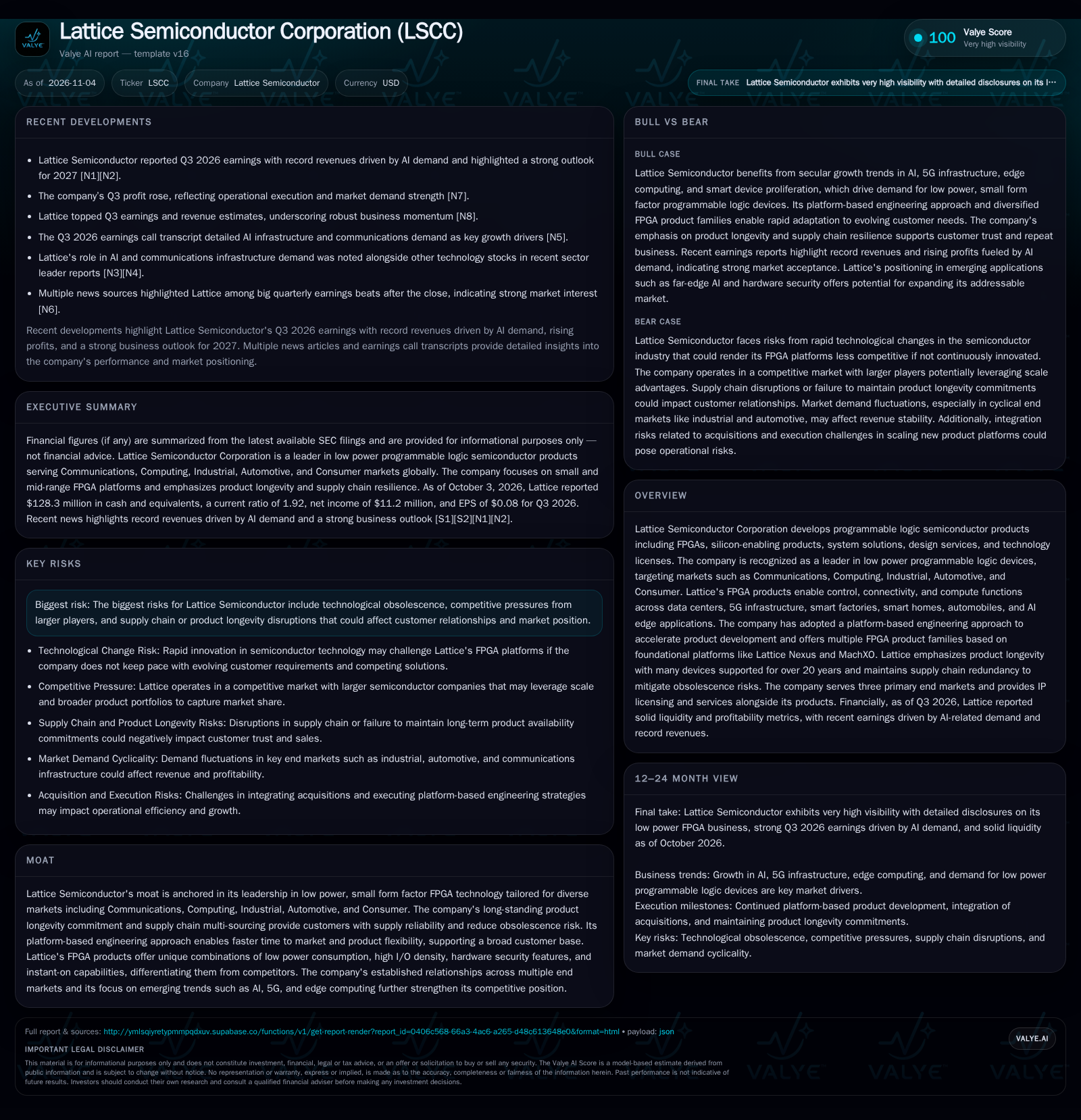
Lattice Semiconductor reported record Q3 2026 revenues and profitability, driven by AI and communications infrastructure demand. Its focus on low-power, small form factor FPGAs and a platform-based engineering model enables agility and broad market reach. The company’s emphasis on product longevity, supply chain resilience, and emerging applications like edge AI underpins its competitive position, though rapid technology shifts and larger rivals remain persistent challenges. Sustained growth will depend on Lattice’s ability to continually innovate and expand its addressable market while managing cyclical end-market risks and supply chain complexity. [S1] [S2] [N1] [N2]
Lattice Semiconductor’s Q3 2026 performance—marked by record revenues and solid profitability—reflects the company’s successful alignment with secular technology trends in AI, edge computing, and communications infrastructure. As a specialist in low-power, small form factor FPGAs, Lattice has leveraged a platform-based engineering model and product longevity commitments to build trust with customers across diverse end markets. However, as demand cycles intensify and competitive stakes rise, the company’s ability to sustain its innovation pace and manage operational complexity will be decisive in translating current momentum into durable market share and earnings growth.
Record Q3 2026 Results and AI Demand Surge: Current Momentum and What’s at Stake
For the quarter ended October 3, 2026, Lattice Semiconductor reported net income of $11.2 million and basic and diluted EPS of $0.08, alongside record revenues attributed to robust AI and communications infrastructure demand [S2] [N1] [N2]. This performance not only beat estimates but also underlined the company’s operational execution and market alignment, with management highlighting a strong outlook into 2027. The company reported cash and liquidity metrics for the period; these figures do not by themselves establish operating runway, investment capacity, financial flexibility, or financing capacity. [S2] The combination of strong top-line growth and profitability signals that Lattice’s product mix and platform strategy are resonating with customers in fast-growing verticals. The challenge is whether this momentum can be sustained as the competitive and technological landscape continues to shift rapidly.
How Lattice Converts Platform Innovation into Profitable Growth
Lattice generates revenue primarily from the sale of programmable logic devices (PLDs), silicon-enabling products, IP licensing, and design services [S1]. Its focus on small and mid-range FPGAs—characterized by low power consumption, small form factor, and high I/O density—positions the company to serve applications where thermal budgets, board space, and power efficiency are critical (e.g., edge AI, 5G radios, automotive ADAS, and industrial automation). Pricing in these segments is typically less commoditized than in high-end FPGAs, supporting gross margin stability if differentiation is maintained.
The platform-based engineering approach, instituted since 2019, enables Lattice to launch multiple product families (e.g., Nexus, MachXO) from foundational architectures, accelerating time to market and allowing for efficient R&D leverage [S1]. This model supports operating leverage as incremental products can be developed at lower marginal cost, provided the base platform remains competitive. The company’s emphasis on product longevity—supporting devices for over 20 years—reduces customer switching, stabilizes long-tail revenue, and aligns with the multi-year design cycles of industrial and automotive clients, though it also requires disciplined supply chain management and inventory planning.
IP licensing and system solutions add a recurring, higher-margin layer to the business, though the core economics remain tied to hardware volume and mix. Capital needs are moderate compared to foundry-based or vertically integrated competitors, as Lattice is fabless, relying on third-party manufacturing. However, the need to invest in next-generation architectures and ecosystem development remains persistent, with R&D and application engineering as critical spend categories.
Defending the Low-Power Niche: Moat Dynamics and Threats from Scale Players
Lattice’s core competitive edge lies in its leadership in low-power, small form factor FPGAs tailored for diverse, high-growth verticals [S1]. Its differentiation is reinforced by a combination of instant-on capability, hardware security features, high I/O density, and long product lifecycles. This makes Lattice a preferred supplier for applications where power, size, and reliability are non-negotiable—such as edge AI inference, automotive sensor fusion, and industrial robotics.
However, the programmable logic market is intensely competitive, with larger players—traditionally Xilinx (now AMD), Intel (Altera), and Microchip—offering broader portfolios and greater R&D firepower. These incumbents can leverage economies of scale, deep customer relationships in hyperscale and enterprise, and broader software ecosystems. The risk for Lattice is that if these larger rivals successfully drive down power consumption or introduce more flexible platforms at competitive price points, Lattice’s niche could erode.
Substitution risk also comes from application-specific standard products (ASSPs), custom ASICs, and emerging AI accelerators, particularly in segments where volume justifies custom silicon. Lattice’s defense is the flexibility and time-to-market advantage of FPGAs, especially when new protocols or rapid market changes occur. Its platform-based approach and track record of product longevity help embed Lattice in customer designs for years, but the question is whether this stickiness will persist as application demands evolve.
If Edge AI and 5G Proliferation Accelerate: How Lattice Could Outgrow Expectations
A favorable scenario for Lattice would see continued secular expansion in edge AI, 5G infrastructure, and smart industrial/automotive devices. As device makers increasingly require low-latency, low-power programmable logic for on-device AI inference, sensor fusion, and security, Lattice’s FPGAs could become the default choice for a broader array of applications. The company’s platform-based R&D model would enable rapid adaptation to new protocols and standards, supporting design wins across both established and emerging customers.
Evidence that would confirm this scenario includes sustained double-digit revenue growth outpacing industry averages, rising design win announcements with major OEMs in edge AI and automotive, and expanding licensing or software attach rates. Gross margin stability or improvement, despite rising R&D, would indicate durable differentiation. Additionally, new product launches (such as further Nexus platform iterations) that are rapidly adopted by key customers would signal that Lattice is winning the innovation race.
Conversely, if Lattice’s revenue growth falls in line with or below industry growth, or if customer concentration rises sharply (indicating lost share in diversified verticals), this scenario would be less likely.
Platform Execution Meets Market Cyclicality: The Most Probable Trajectory
The most plausible outcome is that Lattice continues to grow in line with secular trends in AI, communications, and embedded intelligence, but with periodic revenue and margin fluctuations tied to end-market cycles—especially in industrial and automotive. The platform-based engineering strategy should allow Lattice to maintain a steady cadence of new product introductions and incremental share gains in low-power FPGA niches.
Revenue growth would remain positive but may moderate as competition intensifies and some applications move to custom silicon or ASSPs. Gross margins could face pressure if larger rivals target Lattice’s core markets, but product longevity, customer stickiness, and supply chain resilience would provide a buffer.
Signs that would support this scenario include steady, if unspectacular, revenue and earnings growth; continued diversification of design wins; and maintenance of current gross margin levels. A shift toward higher mix of software, IP licensing, or system solutions—if disclosed—would also support resilience. Conversely, sharp declines in revenue or gross margin, or a spike in customer churn, would suggest downside risks are materializing.
Technological Disruption and Margin Squeeze: How Lattice Could Lose Its Edge
In an adverse scenario, rapid innovation by larger FPGA vendors or new entrants could diminish the differentiation of Lattice’s low-power, small form factor value proposition. If competitors introduce equally power-efficient or more flexible platforms at scale, Lattice could face price-based competition, margin compression, and loss of key design slots—especially in cost-sensitive consumer or automotive applications.
Supply chain disruptions or failure to maintain product longevity commitments could erode customer trust, prompting OEMs to shift to more stable or vertically integrated suppliers. Cyclical downturns in industrial or automotive demand would exacerbate top-line volatility, with limited offset from IP or services revenue. If Lattice fails to keep pace with rapidly evolving AI and connectivity standards, its core platforms could become obsolete in critical growth markets.
Confirmation of this scenario would come from sequential revenue declines, shrinking gross margins, or elevated R&D without corresponding new product traction. Rising inventory, missed product launch timelines, or negative customer commentary (if disclosed) would further support the bear case.
Milestones and Metrics That Will Shape Lattice’s Competitive Trajectory
Sustained revenue growth above industry averages, particularly in AI edge, 5G, and automotive verticals, would support the upside case.
Gross margin trends quarter-over-quarter: margin stability or expansion would indicate continued differentiation, while compression would signal intensifying competition.
Number and caliber of new design wins or customer engagements in high-growth verticals—especially edge AI, industrial automation, and automotive (if disclosed).
Cadence and adoption rate of new platform launches (e.g., next-generation Nexus iterations) and their uptake by major OEMs.
R&D expense as a percentage of revenue: rising investment may be necessary to sustain innovation, but efficiency of spend will be critical.
Product longevity and supply chain performance: any disruptions or inability to meet long-term commitments would be early warning signs.
Customer concentration trends: rising dependency on a few customers may signal lost share in diversified applications.
Any disclosed changes in IP licensing, system solutions, or software attach rates, which could signal a shift toward higher-margin or recurring revenue streams.
Disclaimer: This is research-only, informational analysis and not investment advice. It may include AI-generated interpretation and general industry context. Always verify important details using primary sources.

Comments