
Zevra Therapeutics: Profitability in Rare Disease, but Market Concentration and Compliance Risks Loom
Zevra Therapeutics has achieved profitability on the strength of MIPLYFFA for Niemann-Pick Disease Type C, with reported liquidity position and ongoing operational execution. However, its fortunes remain tightly linked to a single rare disease franchise and a complex regulatory landscape, raising questions about sustainability, risk, and the pathway to broader value creation.
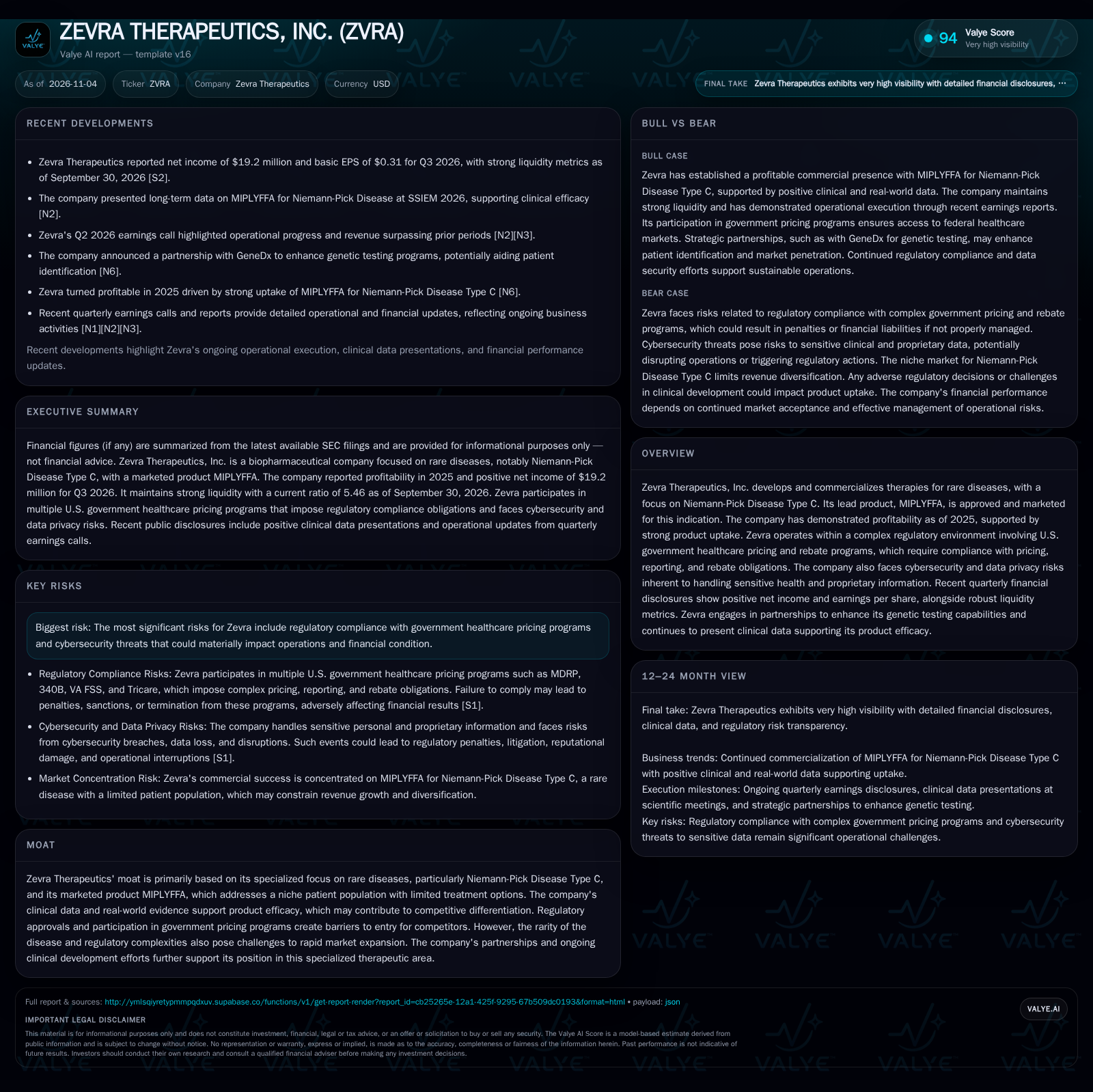
Zevra Therapeutics is now profitable, driven by strong uptake of its rare disease treatment MIPLYFFA for Niemann-Pick Disease Type C. Its ability to sustain growth and navigate regulatory complexities will be crucial to its long-term investment case. [S2] [N6]
Zevra Therapeutics has crossed a milestone inflection, moving from clinical-stage risk to commercial profitability on the back of MIPLYFFA for Niemann-Pick Disease Type C. With net income of $19.2 million in the latest quarter and a substantial liquidity buffer, Zevra stands out among rare disease biotechs for its financial turnaround. Yet, this success is highly dependent on a single asset in a niche market, and the company faces a thicket of regulatory compliance hurdles tied to government pricing programs. The critical question for investors is whether Zevra can sustain and broaden its commercial momentum—or whether its current position is as much a ceiling as a foundation. [S2] [N6]
Recent Profitability Anchored by MIPLYFFA Uptake and Reported Liquidity Position
Zevra Therapeutics reported net income of $19.2 million for the quarter ended September 30, 2026, marking sustained profitability since 2025. Basic earnings per share reached $0.31, with diluted EPS at $0.26. The company’s liquidity position is reflected in $122.1 million in cash and cash equivalents and a current ratio of 5.46. These financials demonstrate robust uptake of MIPLYFFA, its treatment for Niemann-Pick Disease Type C, and indicate resources available for ongoing operations. However, Zevra’s commercial exposure continues to be concentrated in a single rare disease product, and its participation in U.S. government healthcare pricing programs brings heightened compliance and pricing obligations. [S2]
How Zevra’s Rare Disease Model Drives Profit—and Its Limits
Zevra’s current economics are defined by a high-value, low-volume model typical of rare disease therapeutics. Pricing for orphan drugs like MIPLYFFA tends to be high due to limited patient populations and the lack of alternative therapies, enabling strong gross margins when market access is achieved. Fixed costs are front-loaded in R&D and regulatory approval, while commercial operations can remain relatively lean post-launch. This structure supports rapid operating leverage once sales scale, as evidenced by Zevra’s shift to profitability following strong product uptake.
However, participation in government pricing and rebate programs—such as Medicaid, 340B, and VA FSS—can compress realized net pricing and introduce unpredictability in revenue recognition. These programs require complex compliance and reporting infrastructure, raising the fixed cost baseline and exposing Zevra to potential penalties or retroactive adjustments. Additionally, capital needs are modest in the commercial phase for a single-product company, but any effort to diversify into new indications or products would likely require substantial incremental investment.
Barriers Protect MIPLYFFA, but Market Breadth Is Inherently Limited
The competitive moat for Zevra is rooted in first-mover advantage and regulatory exclusivity for MIPLYFFA in Niemann-Pick Disease Type C. Barriers to entry are high: rare disease drug development requires deep clinical expertise, significant capital, and navigating a complex regulatory pathway. Once approved, additional protection comes from orphan drug exclusivity and intellectual property rights. There are few, if any, direct competitors with approved therapies for this indication, and the rarity of the disease further limits commercial incentive for new entrants.
However, the same factors that create a moat also cap the addressable market. The narrow patient population means revenue growth is inherently limited unless Zevra can expand MIPLYFFA’s label, develop additional products, or leverage its commercial infrastructure into adjacent rare disease indications. Indirect competition could arise from gene therapies or new modalities targeting the same disease space, but these are likely several years away from commercial threat.
Momentum Builds if Zevra Expands Access and Diversifies Its Pipeline
A favorable scenario for Zevra would see continued robust uptake of MIPLYFFA, possibly driven by expanded reimbursement, increased diagnosis rates (potentially aided by the GeneDx partnership for genetic testing), and favorable real-world clinical outcomes. This could support both revenue growth and margin stability, especially if government pricing headwinds are managed effectively. If Zevra succeeds in expanding MIPLYFFA’s indication or brings additional rare disease assets to market, it could leverage its existing commercial platform and expertise to create a multi-product rare disease franchise.
Evidence for this scenario would include sequential revenue growth, successful label expansion filings, new product launches, and clinical or commercial partnerships that broaden the pipeline. Announcements of expanded payer coverage, increasing diagnosed patient pools, and new licensing or acquisition activity would further validate the upside case.
Sustained Niche Profitability Anchored in MIPLYFFA and Compliance Execution
The most plausible trajectory for Zevra is continued profitability anchored in MIPLYFFA’s established market for Niemann-Pick Disease Type C, with moderate growth paced by incremental diagnosis and access improvements. The business would remain operationally efficient, with high gross margins offset by ongoing compliance and reporting costs tied to government pricing programs. Revenue growth would be capped by the finite patient pool, and earnings would fluctuate with the cadence of new patient starts and payer reimbursement cycles.
Confirmation of this scenario would come from consistent quarterly profitability, stable or gradually increasing revenue, and manageable compliance costs. Any new product or pipeline asset would likely contribute only modestly in the near term, and the majority of value would remain concentrated in the current franchise.
Regulatory or Market Shocks Could Erode Zevra’s Profitability Quickly
The primary risk to Zevra’s current position is an adverse regulatory or compliance event tied to its participation in government pricing programs. Penalties, exclusion from key pricing programs, or retroactive rebate liabilities could materially impact net pricing and earnings, especially given the company’s reliance on a single product. Additionally, any unexpected drop in MIPLYFFA uptake—due to competitive entrants, negative clinical data, or changes in treatment guidelines—could rapidly compress revenues and margins.
Evidence of this scenario would include regulatory investigations, restatements of revenue or earnings due to rebate adjustments, material increases in compliance costs, or negative clinical or payer developments. A significant cybersecurity breach could exacerbate downside risk by disrupting operations or triggering additional regulatory scrutiny.
Milestones and Metrics That Will Shape Zevra’s Next Phase
Quarterly MIPLYFFA revenue growth and new patient starts—if disclosed—will be critical to gauging ongoing market penetration and the sustainability of profitability.
Updates on regulatory compliance status, including any government audits, investigations, or material changes in pricing program participation.
Progress on pipeline diversification, including advancement of new rare disease candidates or expansion of MIPLYFFA into additional indications.
Gross-to-net revenue adjustments and rebate accruals, which will indicate the real-world impact of government pricing programs on realized margins.
Announcements of payer coverage expansions, label updates, or major partnerships that could increase the addressable patient pool.
Incidence of cybersecurity or data privacy events and the company’s response, as these could trigger regulatory action or operational disruption.
Disclosure of research and development spending relative to revenue, which would signal the company’s commitment to pipeline growth versus margin defense.
Any shifts in executive leadership or commercial strategy, especially as they relate to pipeline prioritization or market expansion.
Disclaimer: This is research-only, informational analysis and not investment advice. It may include AI-generated interpretation and general industry context. Always verify important details using primary sources.

Comments