
Aptiv PLC: Strategic Separation, Non-Auto Growth, and the Test of Focus in a Fragmenting Industry
Aptiv’s planned spin-off of its Electrical Distribution Systems business, combined with Q3 2026 profitability and non-automotive expansion, marks a pivotal moment. The company’s future will hinge on execution discipline, resilience to reduced diversification, and its ability to capture value in evolving mobility and technology markets.
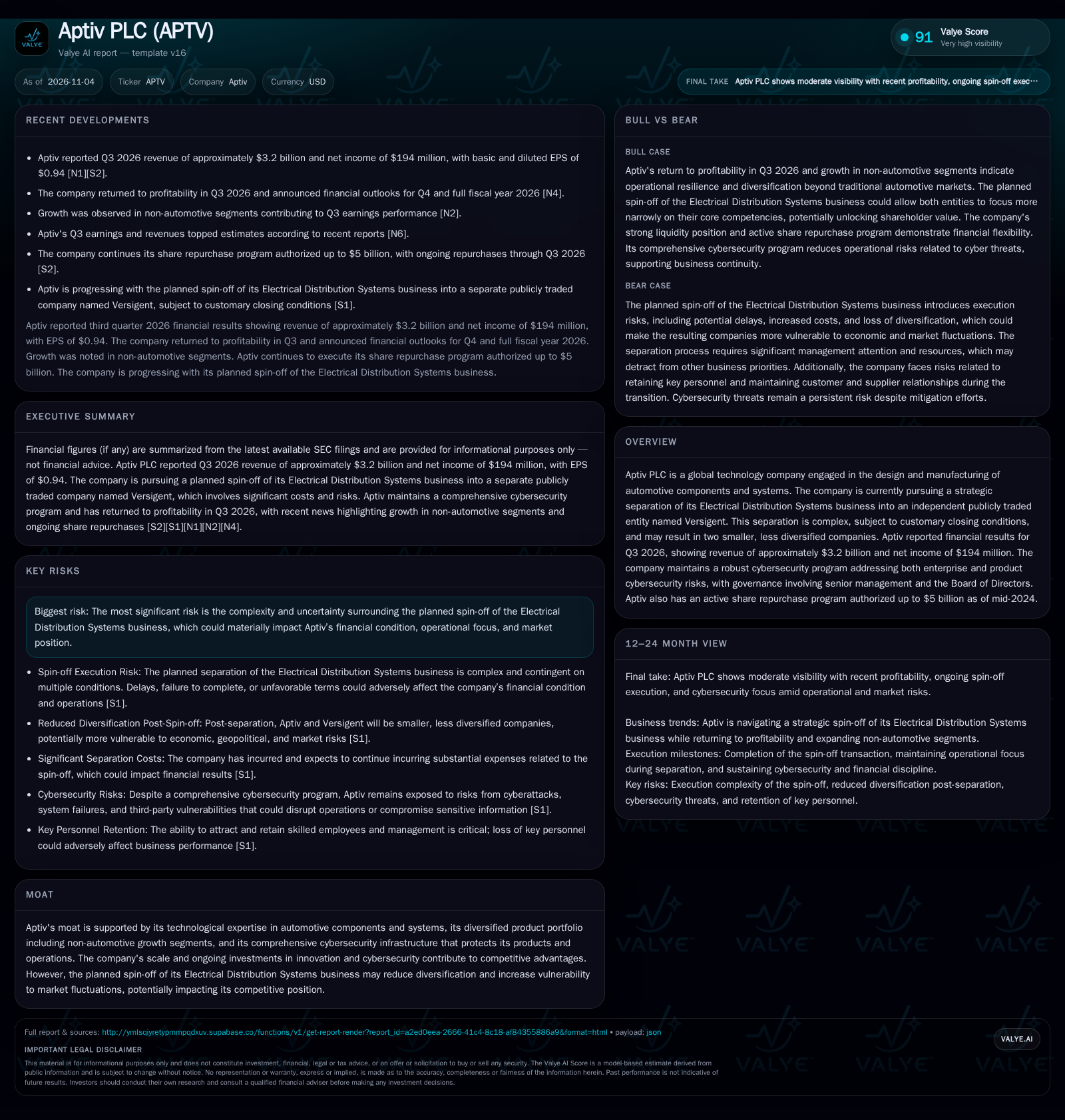
Aptiv is moving forward with a major spin-off, returning to profitability in Q3 2026 with $3.2 billion in revenue, and reporting growth in non-automotive segments. The separation will create two specialized, less diversified companies, raising both opportunity and risk. Execution, cost management, and maintaining innovation momentum will determine the value unlocked—or lost—by this transformation. [S1] [S2] [N1] [N2] [N4] [N6]
Aptiv PLC stands at a turning point, with its strategic decision to spin off the Electrical Distribution Systems business reshaping its operational and financial profile. The Q3 2026 return to profitability and momentum in non-automotive segments suggest Aptiv can adapt to shifting industry dynamics. However, the separation will test management’s ability to execute, manage costs, and sustain innovation while exposing both Aptiv and the new Versigent entity to increased market vulnerability. This analysis examines the mechanisms and scenarios that will define whether Aptiv’s focused future delivers shareholder value or heightens exposure to a volatile industry landscape.
Spin-Off Execution and Q3 Profitability Define the Current Strategic Crossroads
Aptiv is actively pursuing the separation of its Electrical Distribution Systems business into a standalone, publicly traded company, Versigent, through a tax-free spin-off. This move is subject to regulatory approvals and customary closing conditions, and has already incurred $178 million in separation-related expenses in 2025, with further costs expected regardless of completion [S1].
In Q3 2026, Aptiv reported revenue of approximately $3.2 billion and net income of $194 million, returning to profitability after recent periods of volatility [S2] [N4]. Notably, the company’s quarterly performance was buoyed by growth in non-automotive segments, signaling some diversification away from cyclical automotive markets [N2].
Aptiv’s balance sheet as of September 30, 2026, showed $670 million in cash and equivalents, with a current ratio of 1.97 and a cash ratio of 0.47 [S2]. The company reported cash and liquidity metrics for the period; these figures do not by themselves establish operating runway, investment capacity, financial flexibility, or financing capacity.
The company also maintains a $5 billion share repurchase authorization, with ongoing buybacks through Q3 2026 [S2].
How Aptiv’s Business Model and Cost Structure Are Poised to Change Post-Separation
Aptiv’s traditional economics have been shaped by high-volume, lower-margin electrical distribution systems (wiring harnesses, connectors) and higher-margin, technology-driven segments (advanced safety, user experience, and software). The separation of the Electrical Distribution Systems business will decouple these two models, leaving core Aptiv more focused on electronics, software, and advanced vehicle architectures.
This structural shift could result in a business with a higher gross margin profile but also greater exposure to R&D intensity, customer concentration, and the timing of automotive technology adoption cycles. The divested entity, Versigent, will likely be more exposed to pricing pressure, volume swings, and capital intensity typical of lower-tech auto components.
Fixed costs in advanced electronics and software—especially in areas like ADAS, connectivity, and cybersecurity—are substantial, but if Aptiv can scale volumes and maintain platform wins, operating leverage could be significant. However, the loss of internal scale and cross-segment synergies may increase per-unit costs and dilute negotiating power with OEM customers.
The separation also brings non-trivial capital and transition costs. Aptiv incurred $178 million in expenses for the separation in 2025 and expects further costs, which will be a drag on near-term profitability and cash flow [S1].
Specialization Versus Diversification: How the Spin-Off Could Reshape Aptiv’s Moat
Aptiv’s competitive position historically rested on its ability to deliver integrated solutions spanning both electrical distribution and high-value electronics/software. This integration offered cross-selling opportunities and made Aptiv a strategic partner for OEMs seeking bundled solutions.
Post-spin, Aptiv’s remaining business will be more specialized, focusing on advanced automotive electronics, software, and non-automotive applications. This focus could sharpen innovation but also increases exposure to competitors with deep software or semiconductor expertise—including both incumbent auto suppliers and tech entrants.
The reduction in diversification means that Aptiv and Versigent could each become more vulnerable to sector-specific shocks. For Aptiv, customer adoption of next-generation vehicle architectures, regulatory changes in autonomy and electrification, and the pace of software-defined vehicle rollouts will become more critical. Versigent, meanwhile, will need to defend share in a mature, cost-competitive segment with limited pricing power.
Aptiv’s cybersecurity investments and partnerships in automation and AI remain differentiators, but as the industry moves toward open platforms and modularity, sustaining a moat will depend on maintaining technical leadership and deep OEM integration rather than breadth alone.
Unlocking Value Through Focus: How the Spin-Off Could Catalyze Growth and Margin Expansion
If Aptiv executes the spin-off smoothly, containing separation costs, retaining key personnel, and maintaining customer relationships, both entities could benefit from sharper strategic focus. For core Aptiv, a streamlined portfolio may enable faster innovation cycles, higher R&D efficiency, and improved margin potential as resources are concentrated on advanced electronics and software.
Growth in non-automotive segments, already contributing to recent results, could further diversify revenue and reduce cyclicality if new end markets are penetrated successfully [N2]. Aptiv’s cybersecurity program and investments in software-defined vehicle technologies may position it to win higher-value content per vehicle as OEMs shift toward connected, automated, and electrified platforms.
Evidence that would confirm this scenario includes sustained above-market growth in electronics/software sales, margin expansion post-spin, new platform wins with global OEMs, and continued growth in non-automotive verticals. A lower run-rate for separation costs and successful retention of key engineering talent would further validate the upside.
Aptiv as a Focused Tier-1 Tech Supplier: Execution Delivers Stability but Not Breakout Growth
The most plausible outcome is that Aptiv and Versigent each operate as focused, mid-cap suppliers—Aptiv in advanced electronics/software and Versigent in wiring and distribution. The separation proceeds with manageable disruption: some customer churn or transitional inefficiencies occur, but are offset by cost controls and operational discipline.
Aptiv’s revenue growth moderates as the company adapts to a narrower portfolio and the industry’s cautious pace of adopting new vehicle architectures. Margins improve modestly, driven by mix shift toward higher-value electronics, but ongoing R&D requirements and competitive pricing in a maturing ADAS and infotainment market limit further expansion.
Evidence supporting this scenario would be consistent, mid-single-digit revenue growth, stable or slightly improved gross margins, and continued but slower growth in non-automotive segments. Partial offset of separation costs through operational savings, and no major loss of key customers or personnel, would reinforce this base case.
Separation Complexity and Market Shocks Expose the Limits of Specialization
In an adverse scenario, the spin-off process is protracted or disrupted by regulatory, operational, or market obstacles. Extended separation costs and management distraction undermine both Aptiv’s and Versigent’s ability to serve key customers, leading to lost business and/or pricing concessions.
For Aptiv, a narrower portfolio increases reliance on a handful of large OEMs and exposes the company to delays in the adoption of next-generation vehicle architectures or new regulatory hurdles for advanced driver-assistance and software-defined vehicles. Loss of diversification amplifies the impact of cyclical downturns or competitive losses, while fixed R&D costs become harder to absorb.
Confirmation of this scenario would include spiraling separation expenses, missed execution milestones, customer defections, margin compression, and/or the need for defensive restructuring. An uptick in cybersecurity incidents or loss of key technical talent would further erode Aptiv’s position.
What Will Determine Aptiv’s Success or Vulnerability After the Spin-Off?
Completion timing and terms of the Electrical Distribution Systems spin-off, including regulatory approvals and final separation costs.
Revenue and margin trends in Aptiv’s core advanced electronics and software businesses, particularly relative to peers.
Growth rate and revenue mix from non-automotive segments—if disclosed, this would help test diversification efforts.
Customer retention and new platform wins with global OEMs post-separation; loss of major contracts would signal risk.
R&D spending levels and efficiency, especially as Aptiv attempts to sustain innovation with a narrower focus.
Retention of key engineering and management talent through and after the separation process.
Incidence and impact of cybersecurity events or product vulnerabilities, given the company's emphasis on cyber risk management.
Progress on the $5 billion share repurchase program and any changes in capital allocation priorities post-spin.
Disclaimer: This is research-only, informational analysis and not investment advice. It may include AI-generated interpretation and general industry context. Always verify important details using primary sources.

Comments