
Atlas Energy Solutions: Cyclical Pressures, Segment Risks, and the Search for Durable Demand in Proppant and Power
Despite exceeding revenue estimates in Q3 2026, Atlas Energy Solutions reported a substantial net loss and continues to grapple with the volatility of oil and gas markets, customer concentration in its power segment, and operational dependencies. The company’s future will hinge on its ability to weather commodity cycles, diversify its customer base, and adapt to shifting demand for proppant and distributed power.
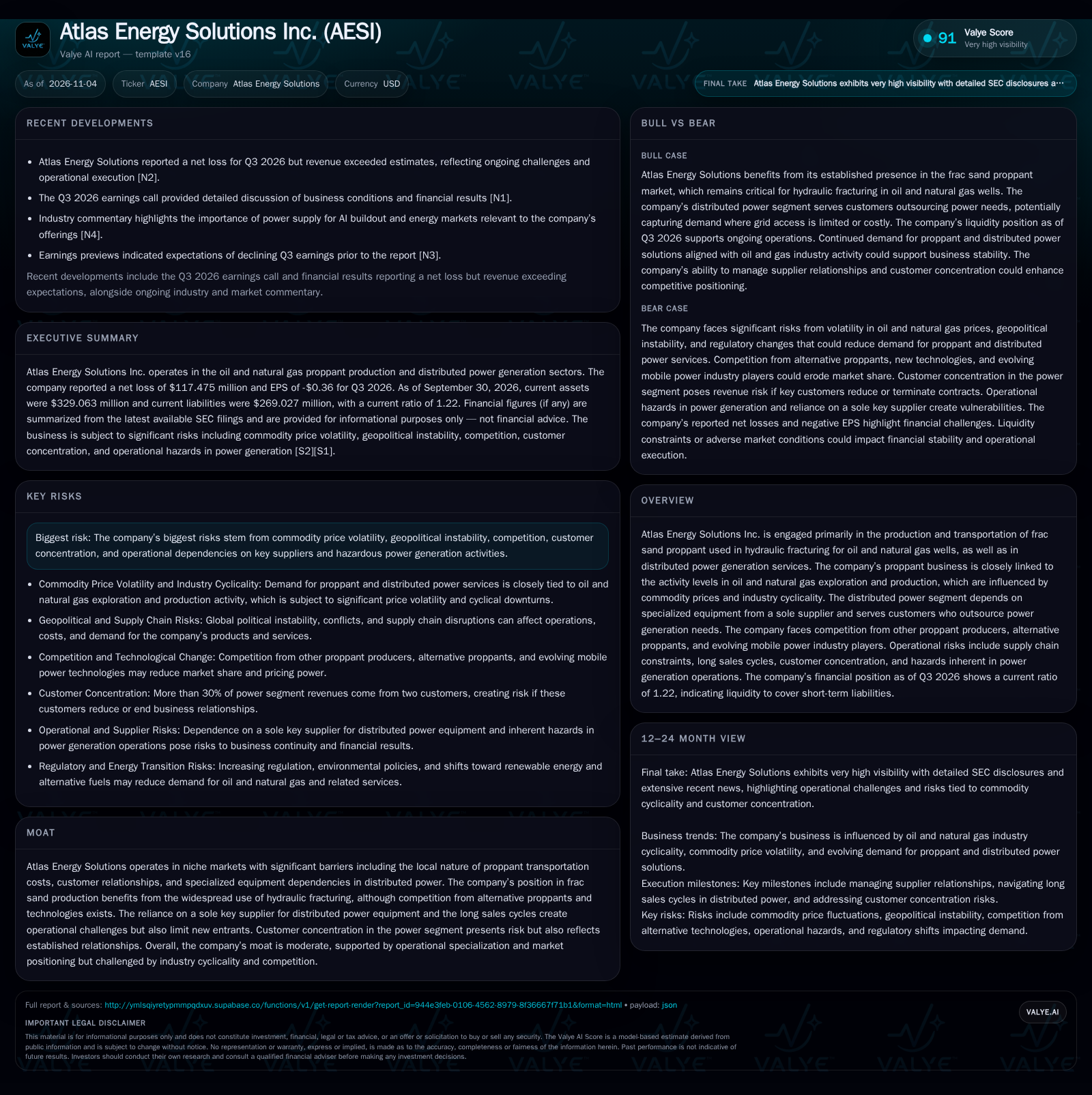
Atlas Energy Solutions posted a Q3 2026 net loss of $117.5 million, with revenue outperforming expectations but profitability challenged by industry cyclicality and segment-specific risks. The company’s reliance on oil and gas activity, customer concentration in distributed power, and dependence on a sole supplier heighten vulnerability. Strategic execution around customer diversification and operational adaptability will be crucial as energy transition and technological change reshape demand [S2] [N2].
Atlas Energy Solutions Inc. finds itself at a crossroads as it navigates the volatile intersection of oilfield services and distributed power. The company’s dual exposure to proppant production and outsourced power generation offers potential for differentiated growth but brings acute cyclicality and operational risk. Q3 2026 results underscore this tension: while revenues topped expectations, Atlas posted a significant net loss, reflecting both cost pressures and the unpredictable tides of energy markets. Its future will be shaped by how effectively it can mitigate customer concentration, manage supply dependencies, and adapt to secular shifts in energy demand.
Q3 2026 Results Highlight Ongoing Volatility and Segment Exposures
Atlas Energy Solutions reported a net loss of $117.475 million for Q3 2026, with earnings per share of -$0.36 [S2]. This loss came despite revenue exceeding analyst estimates, suggesting that while customer activity may have been resilient, cost structures or segment profitability remain under pressure [N2].
The company’s current assets totaled $329.063 million against current liabilities of $269.027 million as of September 30, 2026, producing a current ratio of 1.22 [S2]. This reflects coverage of short-term obligations but does not in itself guarantee operating flexibility or resilience if market conditions deteriorate.
In the distributed power segment, more than 30% of 2025 revenues came from just two customers, highlighting significant customer concentration risk [S1]. Additionally, the business depends on a sole supplier for specialized power equipment—a vulnerability if supply chain disruptions or supplier issues arise [S1].
Both core businesses remain tightly linked to oil and gas exploration and production cycles, leaving Atlas highly exposed to commodity price swings, regulatory changes, and broader energy market volatility [S1].
How Proppant and Power Economics Shape Atlas’s Cash Generation Potential
Atlas’s proppant business monetizes the essential role of frac sand in hydraulic fracturing. Revenue is primarily a function of volume (driven by drilling and completion activity), price per ton, and logistics costs. The capital intensity is moderate, with significant fixed costs around mining, processing, and transportation infrastructure. Margins can be attractive during drilling upcycles, but price competition and overcapacity can rapidly erode profitability when oil and gas prices fall.
On the distributed power side, business economics are shaped by the ability to sell or lease mobile power units and provide outsourced power services. This segment is capital-intensive, requiring investment in specialized equipment (sourced from a single supplier) and significant working capital to support long sales cycles. Customer outsourcing can yield recurring revenue potential, but the risk of customer concentration and long contract negotiation periods can create lumpy cash flows.
Both segments face variable costs tied to input prices (e.g., energy, labor, transportation) and must manage operational risks, including supply chain disruptions and equipment downtime. Operating leverage is high: fixed costs do not scale down easily during downturns, so profitability can swing sharply with small changes in volume or price. The company’s recent net loss despite strong revenue performance suggests that cost structures are not fully flexible, or that pricing power has been eroded in at least one segment [S2] [N2].
Assessing Atlas’s Position Amid Commodity Cycles and Technological Disruption
Atlas faces competition from both traditional and evolving sources. In proppant, regional competitors with local sand mines can undercut on transportation costs, while alternative proppants (such as ceramics or resin-coated sand) and fracturing techniques may gain share if they offer performance or cost advantages. Customer relationships, local logistics infrastructure, and consistent product quality are the main competitive levers, but switching costs for E&P companies are typically modest unless long-term supply contracts are in place.
In distributed power, Atlas competes with other mobile power providers, rental fleets, and—over time—potential improvements in grid access. The reliance on a sole supplier for specialized equipment may limit differentiation and bargaining power. Customer concentration suggests some incumbency advantage but also exposes Atlas to significant revenue volatility if a major account defects or renegotiates terms.
Secular risks loom: as the energy transition accelerates and oil/gas drilling moderates, demand for traditional proppant could decline. However, pockets of growth may persist if Atlas can position its power solutions for emerging demand in sectors like data centers or remote infrastructure—spaces where reliable grid access remains a bottleneck. The challenge is to translate technical and logistical capabilities into durable market share as end-market dynamics evolve.
What Could Unlock Margin Expansion and Revenue Diversification?
A favorable pathway for Atlas would involve a sustained rebound in oil and gas drilling, driving increased demand for frac sand and supporting higher pricing. If Atlas can secure multi-year supply contracts or preferred supplier status with major E&P operators, it could achieve steadier revenue and better capacity utilization.
In distributed power, success would likely require both customer base expansion and operational reliability, reducing dependence on a handful of accounts. If Atlas leverages its equipment and service infrastructure to capture new customers in fast-growing sectors—such as AI data centers facing grid constraints or industrial facilities requiring backup power—it could tap into less cyclical, higher-margin demand pools.
Confirmation of this scenario would include: rising proppant volumes and pricing, new or renewed long-term contracts in both segments, successful entry into non-energy verticals for power services, and evidence of margin improvement on both gross and operating lines. Disclosure of customer wins, backlog growth, or a reduction in revenue concentration would further bolster the thesis.
Managing Through Cycles: Likely Outcomes Absent Structural Shifts
The most plausible near-term scenario is continued cyclicality, with Atlas’s fortunes tracking broader oil and gas exploration trends. Proppant demand may remain range-bound, with pricing and volumes fluctuating alongside commodity prices. The distributed power segment could deliver lumpy results, reflecting customer concentration and the timing of contract renewals or equipment deployments.
Operating leverage will cut both ways: modest improvements in demand may help cover fixed costs, but any downturn would quickly pressure margins and cash flow. Unless Atlas can diversify its customer base or reduce its dependence on the sole equipment supplier, vulnerability to contract losses or supply interruptions will persist.
Key confirming evidence would include continued net losses or only modest profitability, persistent customer concentration in the power segment, and revenue trends closely tied to oil and gas activity metrics. Falsification would require a clear shift in the revenue mix, improved segment diversification, or disclosure of new, less cyclical business lines.
When Commodity Downturns and Customer Losses Compound
The adverse scenario for Atlas is a combination of oil/gas market downturn and operational disruptions in distributed power. A sustained decline in drilling activity would depress frac sand volumes and pricing, potentially pushing the segment into negative margin territory. At the same time, the loss of a major power customer—given that two account for over 30% of segment revenues—could trigger a sharp drop in segment revenue and magnify fixed-cost absorption issues.
If the sole supplier for distributed power equipment experiences delays, price increases, or quality issues, Atlas could face project interruptions or higher costs, exacerbating financial stress. Regulatory changes or accelerated energy transition policies could further reduce demand for both proppant and traditional power services.
Evidence to confirm this scenario would include further widening of net losses, customer loss announcements, supply chain disruptions, or a marked deterioration in liquidity. Early warning signs might be management commentary on contract renegotiations or delays, as well as negative trends in oil and gas activity.
Testing Atlas’s Strategy: What Investors Should Track for the Next Phase
Proppant volume trends and realized pricing per ton—if disclosed—would clarify how Atlas is managing through oil and gas cycles.
Contract renewal rates and new customer additions in the distributed power segment would help assess progress against customer concentration risk.
Any disclosure of multi-year supply agreements or backlog in either segment would support revenue visibility and margin durability.
Updates on supplier relationships for specialized power equipment—especially any moves to diversify or vertically integrate—would address operational dependencies.
Gross and operating margin trends, especially in the context of revenue outperformance or shortfalls, would reveal whether Atlas is achieving cost discipline or suffering from fixed-cost drag.
Management commentary on exposure to energy transition trends and efforts to reposition offerings for non-oil-and-gas customers would indicate adaptability.
Disclosure of operational disruptions, insurance claims, or regulatory investigations in power generation activities would signal emerging risks.
Disclaimer: This is research-only, informational analysis and not investment advice. It may include AI-generated interpretation and general industry context. Always verify important details using primary sources.

Comments