
Seaboard Corp: Diversification’s Double-Edged Sword in Volatile Commodity and Energy Markets
Seaboard’s broad exposure to protein, agricultural trading, shipping, renewable fuels, and power generation offers natural hedges but also embeds the company in complex cycles of commodity, geopolitical, and regulatory risk. Recent vessel investments and power projects underscore a capital-intensive strategy that depends on both operational execution and external market stability.
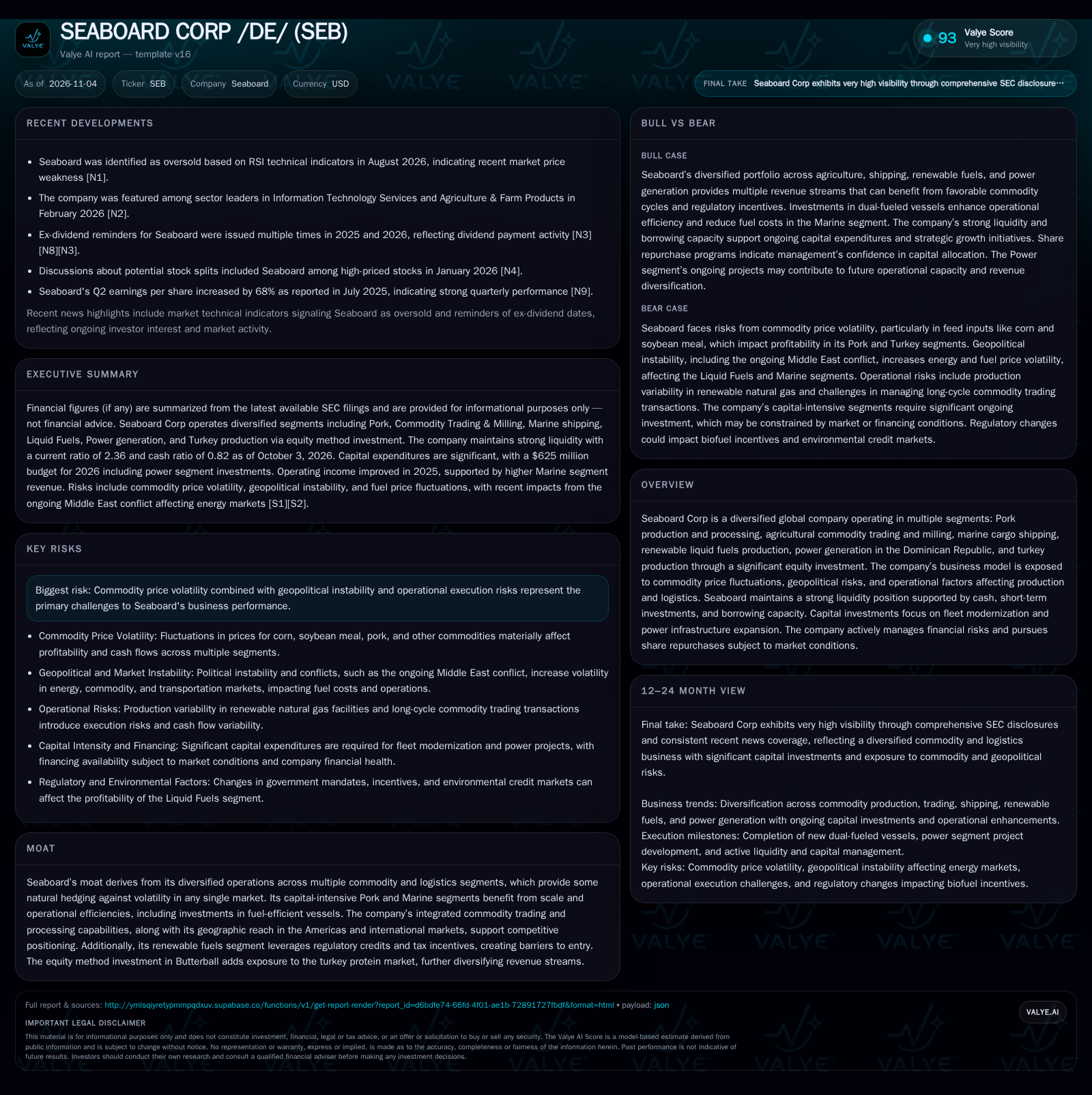
Seaboard Corp’s multi-segment business model spans the pork, commodity trading, marine shipping, renewable fuels, and power sectors, providing multiple revenue streams but significant exposure to commodity and geopolitical volatility. Recent investments in efficient marine vessels and a major power project highlight the company’s capital allocation priorities, while reported liquidity metrics include $159 million in cash and $1.313 billion in short-term investments as of October 2026. The ongoing Middle East conflict has increased volatility in energy and transportation markets, directly impacting fuel costs and segment results. Seaboard’s outlook hinges on managing commodity cycles, capital deployment, and execution of large-scale projects amid unpredictable external shocks. [S1] [S2]
Seaboard Corp’s business model exemplifies the strengths and vulnerabilities of deep diversification in global commodities, logistics, and energy. While its broad footprint across pork, trading, marine shipping, renewables, and power generation creates multiple profit centers and hedging opportunities, it also exposes the company to a web of commodity, geopolitical, and regulatory cycles that can swing results sharply. The recent delivery of fuel-efficient vessels and a major power project signal a long-term capital allocation strategy, yet persistent external shocks—from commodity price swings to geopolitical upheavals—will likely define the company’s risk/reward profile over the coming years.
Recent Capital Allocation and Market Shocks: The Current Landscape
As of October 3, 2026, Seaboard reported $159 million in cash alongside $1.313 billion in short-term investments, supporting a current ratio of 2.36 and a cash ratio of 0.82 [S2]. The company reported cash and liquidity metrics for the period; these figures do not by themselves establish operating runway, investment capacity, financial flexibility, or financing capacity. [S2]
In the Marine segment, Seaboard completed delivery of six new dual-fueled vessels in 2025 and committed to a ninth, aiming to improve fuel efficiency and capacity [S2].
However, the company’s operating environment has become more volatile due to the ongoing Middle East conflict since February 2026, which has elevated energy, commodity, and transportation market volatility—directly affecting fuel prices and the performance of the Liquid Fuels segment [S2].
These developments illustrate Seaboard’s ongoing balancing act: deploying capital to enhance efficiency and capacity amid an unpredictable and inflationary external environment.
How Seaboard’s Multi-Segment Model Drives—and Complicates—Earnings Power
Seaboard’s economic engine is anchored in multiple capital- and working-capital-intensive segments. The Pork segment, representing about 41% of fixed assets and 37% of inventories, is highly sensitive to feed costs (corn and soybean meal) and pork market prices, resulting in margin compression or expansion depending on commodity cycles [S1] [S2].
The Commodity Trading & Milling (CT&M) segment derives its economics from trading, processing, and logistics, with profitability tied to commodity price spreads and volatility. This creates opportunities for trading gains in volatile markets but also exposes the company to inventory risk and mark-to-market swings.
Marine shipping is a fixed-cost-heavy business where operating leverage can be substantial: higher freight rates or improved vessel efficiency drop quickly to the bottom line, but downturns can leave the company exposed to underutilized assets. Recent dual-fueled vessel investments aim to reduce fuel costs and comply with tightening emissions regulations, potentially enhancing segment margins if fuel price differentials and regulatory incentives remain favorable.
The Liquid Fuels segment’s profitability depends on the spread between feedstock costs and diesel prices, as well as the value of regulatory credits (e.g., RINs, tax credits). This segment is particularly exposed to government policy shifts and credit markets.
Diversification as Both Shield and Constraint: Competitive Dynamics in Seaboard’s Markets
Seaboard’s core advantage is its scale and integration across multiple commodity and logistics value chains. In pork, its vertically integrated model (from hog production to processing and export) enables some cost control and market access advantages, though it competes with both global protein giants and regional players.
The CT&M segment’s global sourcing and distribution network provides flexibility and reach, but commodity trading remains a crowded and low-margin field, where information, logistics execution, and counterparty risk management are critical.
In marine shipping, the new dual-fueled vessels may confer a temporary cost and compliance edge, particularly as environmental standards tighten. However, the shipping sector is cyclical and prone to overcapacity, with large global and regional competitors able to pressure rates.
The Liquid Fuels segment’s viability relies on regulatory frameworks and access to feedstock; while government credits create barriers to entry, they also introduce policy risk. The power segment, operating as an independent producer in the Dominican Republic, faces less direct competition but is exposed to regulatory and fuel supply risks.
When Diversification Delivers: How Favorable Cycles and Execution Could Compound Value
A constructive scenario for Seaboard would see synchronized tailwinds across its major segments. If global protein demand remains robust while feed input costs moderate, Pork and Turkey margins could expand significantly. Meanwhile, volatility in agricultural markets could enhance CT&M trading profits, especially if Seaboard’s logistics network captures incremental volume or arbitrage opportunities.
In Marine, higher freight rates and the operational efficiency of new vessels could widen segment margins. If regulatory incentives for renewable fuels persist or expand, the Liquid Fuels segment could see both higher volumes and stronger spreads, particularly if feedstock costs stabilize.
Timely completion and ramp-up of the EDM IV power project would add stable, contracted cash flow, further diversifying earnings.
Confirmation would come from rising segment margins, sustained or growing operating cash flow, and evidence of successful project execution (e.g., on-budget, on-schedule delivery of EDM IV and new vessels). Further, regulatory clarity on biofuel credits and stable or declining feedstock costs would reinforce the upside case.
Managing Through Cycles: What a Typical Year Might Look Like for Seaboard
A plausible base case is one of mixed segment performance: protein and trading margins fluctuate with commodity cycles, but diversification prevents severe swings in consolidated results. The company continues to self-fund most capital expenditures from operating cash flow, with only modest draws on short-term investments or borrowing.
Marine segment benefits from improved vessel efficiency, but freight rates remain under pressure due to global shipping dynamics. Liquid Fuels profits are volatile, reflecting swings in credit values and feedstock costs, while the Power segment delivers steady but unspectacular returns as EDM IV is constructed.
The main risks managed in this scenario are commodity price swings, execution delays in large projects, and incremental regulatory changes. Results would be confirmed by stable consolidated margins, continued operating cash flow generation near recent levels, and capex staying within budget. Delays in project execution, persistent cost inflation, or sharp regulatory changes would tilt outcomes below this baseline.
When Volatility Overwhelms: Adverse Chain Reactions Across Segments
A negative scenario could materialize if commodity prices move against Seaboard across several fronts. A spike in feed costs (corn and soybean meal) without a corresponding rise in pork or turkey prices would compress margins in those segments. Simultaneous declines in agricultural trading spreads or inventory write-downs could erode CT&M profits.
Marine shipping could suffer from lower freight rates or underutilization, while higher fuel prices—perhaps exacerbated by ongoing geopolitical instability—could compress margins even with new vessel efficiency.
In Liquid Fuels, a collapse in regulatory credit values or a sharp increase in feedstock costs (or both) could render operations unprofitable. Delays or cost overruns on the EDM IV project would further strain cash flow and capital allocation.
What Could Shift Seaboard’s Thesis: Metrics and Milestones to Track
Monitor segment-level operating margins, especially in Pork and CT&M, for signs of commodity price pass-through or margin compression.
Track the completion timeline and budget adherence for the EDM IV power project; delays or overruns could strain cash flow.
Watch realized fuel cost per ton-mile in the Marine segment to assess the impact of new vessel efficiency.
Observe trends in regulatory credit (e.g., RIN) values and U.S. biofuel policy, which directly affect Liquid Fuels segment profitability.
Monitor inventory and working capital levels, especially in commodity trading, for signs of risk build-up or stress.
Evaluate the pace and size of share repurchases relative to free cash flow; aggressive buybacks amid weak cash generation would be a cautionary signal.
A useful metric would be the proportion of cash flow generated from operations versus financing or asset sales, to gauge underlying earnings quality.
Track any new geopolitical developments or regulatory changes that could alter energy, commodity, or credit markets relevant to Seaboard.
Disclaimer: This is research-only, informational analysis and not investment advice. It may include AI-generated interpretation and general industry context. Always verify important details using primary sources.

Comments