
Lumentum’s Path to Marvell: AI Optics Ambitions, Merger Uncertainties, and the Future of Optical Components
Lumentum’s reported liquidity position, robust recent earnings, and strategic alignment with Marvell Technology in AI optical connectivity have positioned it as a pivotal player in next-generation data infrastructure. Yet, the pending merger introduces integration risks, regulatory hurdles, and operational constraints that could reshape its trajectory in the highly competitive optical components market.
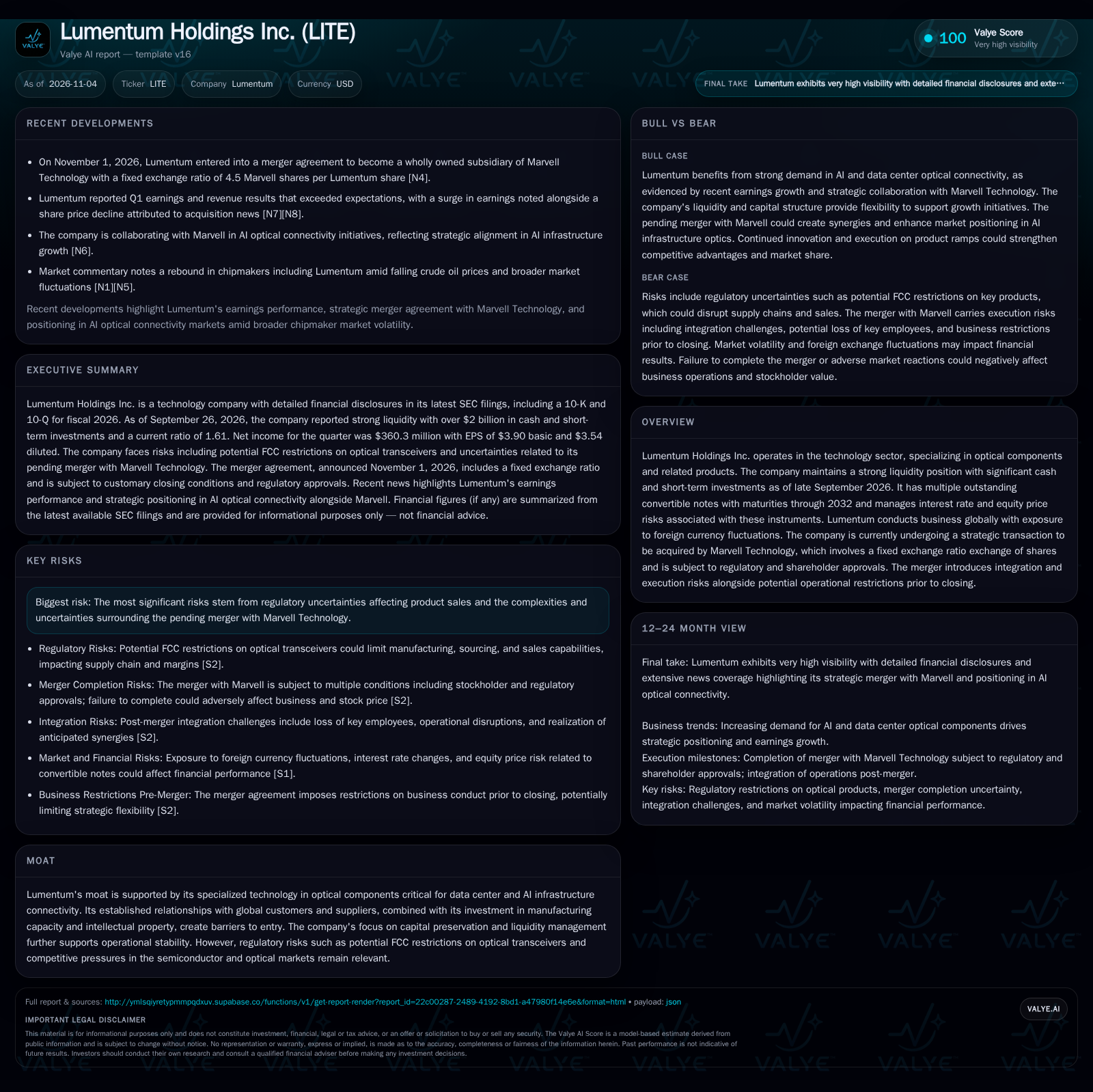
Lumentum has entered a definitive merger agreement to become part of Marvell Technology, driven by shared ambitions in AI/data center optics and backed by a reported cash position. While recent earnings surpassed expectations and the company’s reported balance sheet position, the outcome now hinges on merger execution, regulatory approvals, and the ability to maintain momentum amid competitive and policy headwinds. Near-term performance will be shaped as much by the merger process as by core operating fundamentals. [S2] [N4] [N7] [N8]
Lumentum Holdings Inc. stands at a pivotal juncture: its robust financial position and recent earnings momentum have made it an attractive acquisition target for Marvell Technology, with a definitive merger agreement now in place. The company’s specialization in optical components for AI and data center connectivity dovetails with Marvell’s long-term infrastructure ambitions. Yet, the merger process introduces integration risks, regulatory uncertainty, and operational constraints that could alter Lumentum’s trajectory—at a moment when the demand for high-performance optical solutions has never been greater. The central question is whether Lumentum can convert its current strengths and strategic alignment into durable value as it transitions into Marvell’s broader platform.
Merger Agreement and Recent Financial Outperformance Drive Strategic Pivot
Lumentum has entered into a merger agreement to become a wholly owned subsidiary of Marvell Technology, with a fixed exchange ratio of 4.5 Marvell shares per Lumentum share. This transaction, announced November 1, 2026, is subject to shareholder and regulatory approvals, as well as standard closing conditions. [S2] [N4]
As of September 26, 2026, Lumentum reported approximately $2 billion in cash and short-term investments, and a current ratio of 1.61. Net income for the quarter was $360.3 million, with EPS of $3.90 basic and $3.54 diluted. [S2]
Despite exceeding earnings and revenue expectations in Q1, Lumentum’s share price declined, reflecting investor focus on the acquisition’s implications rather than on standalone performance. [N7] [N8]
Lumentum’s collaboration with Marvell in AI optical connectivity initiatives signals strategic alignment in a segment seen as critical for future data infrastructure. [N6]
How Lumentum’s Optical Components Business Scales—and Where Economics Could Shift
Lumentum’s business model centers on manufacturing and supplying high-value optical components and systems for data centers, AI/ML workloads, telecom, and industrial applications. The company’s product segmentation—Components (semiconductor lasers, sub-assemblies, wavelength management systems) and Systems (optical modules, circuit switches, industrial lasers)—spans both foundational elements and turnkey solutions for network operators and cloud providers. [S2]
Pricing in this market is typically driven by technological complexity, performance, and customer integration requirements. Scale economies are significant: high fixed costs in R&D, fabrication, and testing are offset by large-volume orders from a concentrated customer base, particularly in cloud and hyperscale data centers. Variable costs are primarily tied to materials and labor, but gross margins are sensitive to product mix, manufacturing yields, and competitive pricing pressures.
Convertible notes with staggered maturities through 2032 provide flexibility but also introduce interest and equity dilution risks, particularly if market volatility or integration hurdles arise. The pending merger could alter capital structure priorities and investment cadence, depending on Marvell’s post-close integration playbook.
AI Infrastructure, Regulatory Uncertainty, and the Battle for Optical Market Share
Lumentum’s competitive position is rooted in its ability to deliver high-performance optical components that are essential for cloud, data center, and AI/ML infrastructure. The company’s moat is supported by a combination of technical know-how, intellectual property, and long-standing relationships with major systems integrators and cloud providers. [S2]
Competition is intense and includes other vertically integrated optical component manufacturers, diversified semiconductor giants, and emerging players specializing in next-generation photonics. The market is characterized by rapid technological upgrades, customer consolidation, and frequent price competition.
Potential regulatory changes—such as FCC restrictions on optical transceivers—pose a unique challenge, as these could directly limit Lumentum’s ability to manufacture, source, or sell critical products. [S2]
The merger with Marvell, if successful, would offer scale, channel reach, and R&D synergies, potentially strengthening Lumentum’s position against both established and upstart competitors. However, integration missteps or market-share losses during the transition could erode these advantages.
AI-Driven Demand and Seamless Integration Unlock Post-Merger Upside
If the merger with Marvell closes smoothly and integration is well-executed, Lumentum’s technology could become core to Marvell’s AI infrastructure platform. This would allow for cross-selling into a broader customer base, accelerated product development cycles, and more aggressive participation in high-growth AI and data center optical markets.
Upside would be confirmed by evidence such as: rapid post-close integration milestones, new joint product launches targeting AI optical connectivity, and Marvell disclosing increased revenue synergies or improved margin profiles attributed to Lumentum’s portfolio. Additional confirmation would include continued outperformance in quarterly earnings, growing share in hyperscale data center contracts, and successful navigation of any regulatory hurdles without major business disruption.
A scenario where global demand for AI/ML optical connectivity accelerates faster than expected would further amplify this upside, especially if Lumentum’s technology is differentiated in speed, power efficiency, or cost.
Merger Process Dominates Near-Term Trajectory as Lumentum Maintains Core Momentum
The most plausible scenario is that Lumentum continues to deliver stable results, with its core optical business benefiting from secular growth in AI and data center demand, while the merger process proceeds through regulatory and shareholder approval phases. [S2] [N4]
In this scenario, operational performance remains solid but is overshadowed by the uncertainty and restrictions that accompany the pre-merger period—such as limitations on new business initiatives or capital commitments. Integration planning absorbs management attention, and some customers may delay orders or reevaluate relationships until post-merger clarity emerges.
Base case confirmation would include continued, but not accelerating, earnings performance; steady (but not expanding) backlog if disclosed; and no major regulatory or integration surprises. Falsification would involve a significant drop in order activity, unexpected regulatory delays, or the emergence of disruptive new technology from competitors during the transition.
Regulatory Setbacks or Integration Failures Could Derail Value Creation
A negative outcome could arise if the merger is delayed or derailed by regulatory opposition, shareholder dissent, or unforeseen material adverse effects. In this case, Lumentum would face the dual challenge of resuming independent operations amid heightened uncertainty and potential reputational damage.
Downside would be confirmed by: missed regulatory deadlines, the imposition of new FCC restrictions that materially impact product lines, or the departure of key personnel critical to both ongoing projects and integration planning. [S2]
Further downside risk would materialize if pre-merger restrictions hobble Lumentum’s ability to respond to competitive threats, or if integration post-close proves disruptive—resulting in lost market share, customer attrition, or failure to realize the anticipated synergies. Prolonged macroeconomic volatility or a sharp slowdown in AI/data center investment would compound these risks.
Milestones That Will Reveal Whether Lumentum Delivers on Its AI Optics and Merger Potential
Progress on regulatory and shareholder approvals for the Marvell merger—delays or unexpected conditions would materially alter the risk/reward profile. [S2]
Disclosure of integration planning milestones or early post-close synergies, especially around joint AI optical connectivity solutions with Marvell. [N6]
Any new or expanded FCC restrictions on optical transceivers—direct impact on revenue, supply chain, and customer relationships. [S2]
Quarterly trends in revenue and net income during the merger process, as evidence of sustained operational performance or emerging disruption, if disclosed.
Shifts in order activity or customer concentration, especially from hyperscale data center and AI infrastructure customers—a useful metric would be backlog or major contract wins, if disclosed.
Retention of key technical and commercial personnel through the merger transition—unplanned departures could signal deeper integration risks.
Any changes in capital allocation, R&D intensity, or product roadmap investments in the pre-close period—would help test whether operational momentum is being sustained or deferred.
Disclaimer: This is research-only, informational analysis and not investment advice. It may include AI-generated interpretation and general industry context. Always verify important details using primary sources.

Comments